
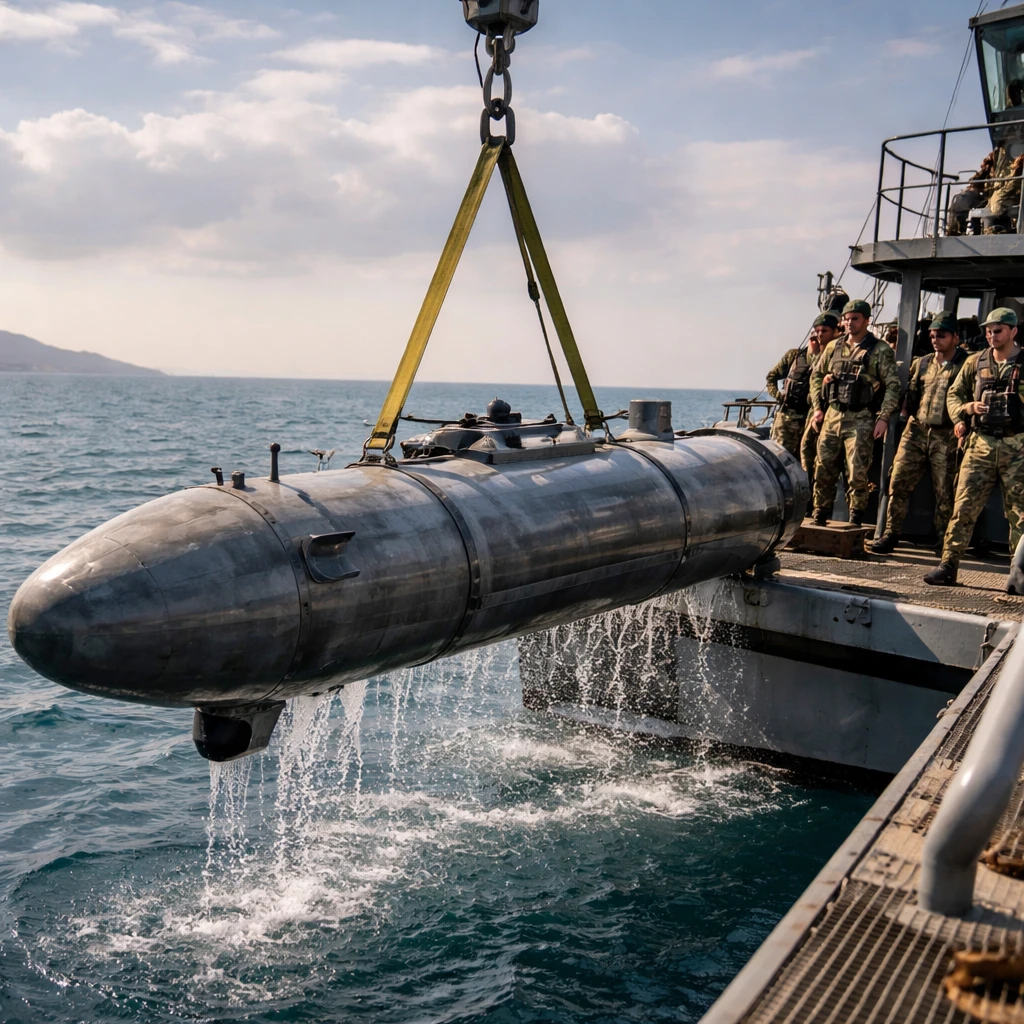
Iran's Islamic Revolutionary Guard Corps reported on Tuesday that it had taken control of a U.S. uncrewed submarine near the mouth of the Strait of Hormuz, providing a rare public example of how underwater autonomous systems are being deployed in military settings.
Iranian state media identified the recovered craft as a Dive-LD, an autonomous underwater vehicle manufactured by the California-based defense company Anduril. The vessel is 19 feet long, or about 5.8 metres, and, according to the company, is capable of a range of missions including mine countermeasures, seabed mapping, intelligence collection and the inspection of underwater infrastructure such as cables and pipelines.
The Revolutionary Guards Navy issued a statement carried by state media saying, "We trapped one of the most modern, intelligent and unmanned submarines of the terrorist American army at the entrance to the Strait of Hormuz. This submersible is equipped with the latest technologies."
In Washington, a Pentagon spokesperson characterized the device differently, saying an underwater drone had "malfunctioned more than a day ago." The spokesperson added, "It was surveying regional waters in support of ongoing operations. The defective drone was an older model that neither collected sensitive data nor carried any classified sonar or radar equipment."
Independent verification of Iran's account was not available, and the Pentagon did not address those specific claims in its statement. Anduril did not respond to a request for comment.
The episode highlights a growing role for unmanned naval systems in U.S. military operations. The U.S. armed forces have been investing in both underwater and surface unmanned vessels as a lower-cost method to monitor broad ocean areas, gather intelligence and track foreign ships and submarines while minimizing risk to personnel.
Company materials indicate Dive-LD can operate for up to 10 days between returns to base and is designed to dive to depths as great as 6,000 metres, or roughly 19,700 feet. Reports in 2024 from a U.S. military news outlet put the unit price for Dive-LD at about $2.5 million each.
Contextual note on capabilities and cost: The information released publicly describes a platform intended for tasks that range from ocean mapping to infrastructure inspection. The stated endurance, depth rating and reported per-unit cost provide a sense of the unit economics and mission profile of systems that militaries are increasingly fielding to extend maritime situational awareness.
What remains unclear from the public statements is which specific sensors, if any, were aboard the drone at the time of the incident beyond the Pentagon's assertion that no classified sonar or radar equipment was present and that the device did not collect sensitive data. The differing accounts from Iranian officials and the U.S. department underscore uncertainties about the device's condition and the nature of the mission it was performing when it was taken.