
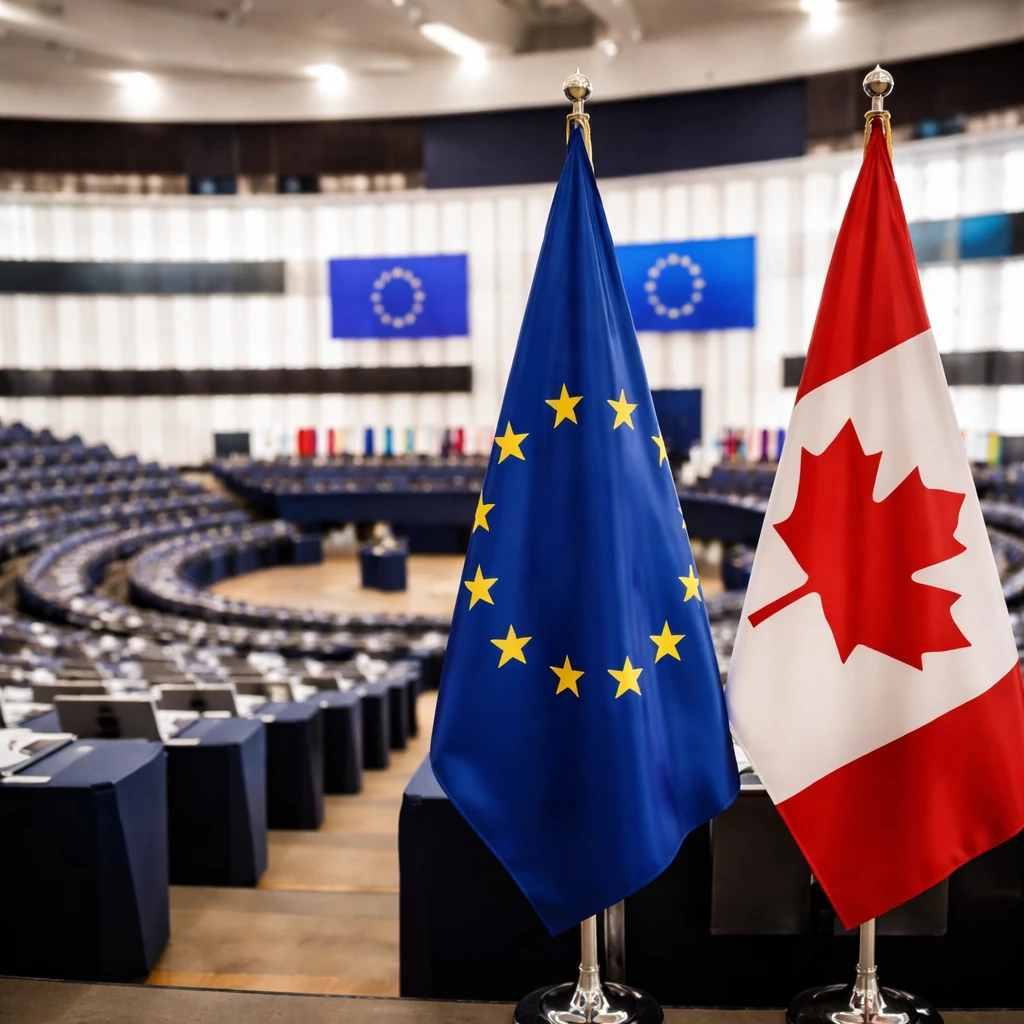
European Commission President Ursula von der Leyen said the European Union is preparing to create a new form of association with Canada, proposing that Canada could become the bloc's first "associate member" - a designation that does not appear in the EU's treaties.
The announcement, delivered in von der Leyen's annual State of the European Union address to the European Parliament in Strasbourg, marks a notable change in EU practice. The bloc has traditionally shied away from ad hoc membership categories, and EU governments previously reacted coolly to a May proposal from Germany that would have offered Ukraine an associate membership as a step toward full accession.
Von der Leyen positioned partnerships as both strategic and responsive to shifts in the global order. She said:
"Partnerships are a strategic choice for Europe. But they also respond to the fracture in the international rules-based system,"
She underscored perceived alignment between the EU and Canada on several fronts, stating:
"We see the world with the same eyes: from AI to climate change, from the Arctic to geopolitics. And we have stood together: on Ukraine, on defence, on raw materials and on supply chains. But above all...Europe and Canada believe in democracy."
Von der Leyen said she invited Canada’s Prime Minister Mark Carney to join her in Strasbourg; Carney had said earlier in the week that Canada sought a "unique alliance" with the EU but was not seeking membership. Carney is scheduled to make his own address on Thursday.
The proposed association was framed as part of a broader agenda of cooperation. Von der Leyen said the EU and Canada would work together across a range of sectors, including manufacturing, artificial intelligence, critical minerals and energy. She listed concrete areas of collaboration, saying:
and she added that the initiative was intended to avoid confrontation:"We will work on intelligent manufacturing. We will create a tech alliance. We will integrate defence industrial bases. We will make the Arctic a flagship joint project,"
"this is a partnership not against anyone else"
The timing of the proposal coincides with heightened tensions between Canada and the United States. Von der Leyen's remarks noted that Carney's European trip follows what the address described as a historic breakdown in Canada-U.S. relations after trade talks collapsed last month, leading to a sequence of tit-for-tat tariff measures.
While von der Leyen presented the plan as a forward-looking reimagining of alliances, the concept of associate membership remains outside the EU's current legal framework, and the reaction of member states to any specific plan will be an important determinant of how the proposal proceeds.
What this means
- The EU is exploring a new, treaty-external status to deepen ties with Canada.
- Planned cooperation covers industrial policy, advanced technology, defence industrial bases, resource security and Arctic work.
- Diplomatic sensitivities are noted explicitly, with assurances the partnership is not directed at any other country.