
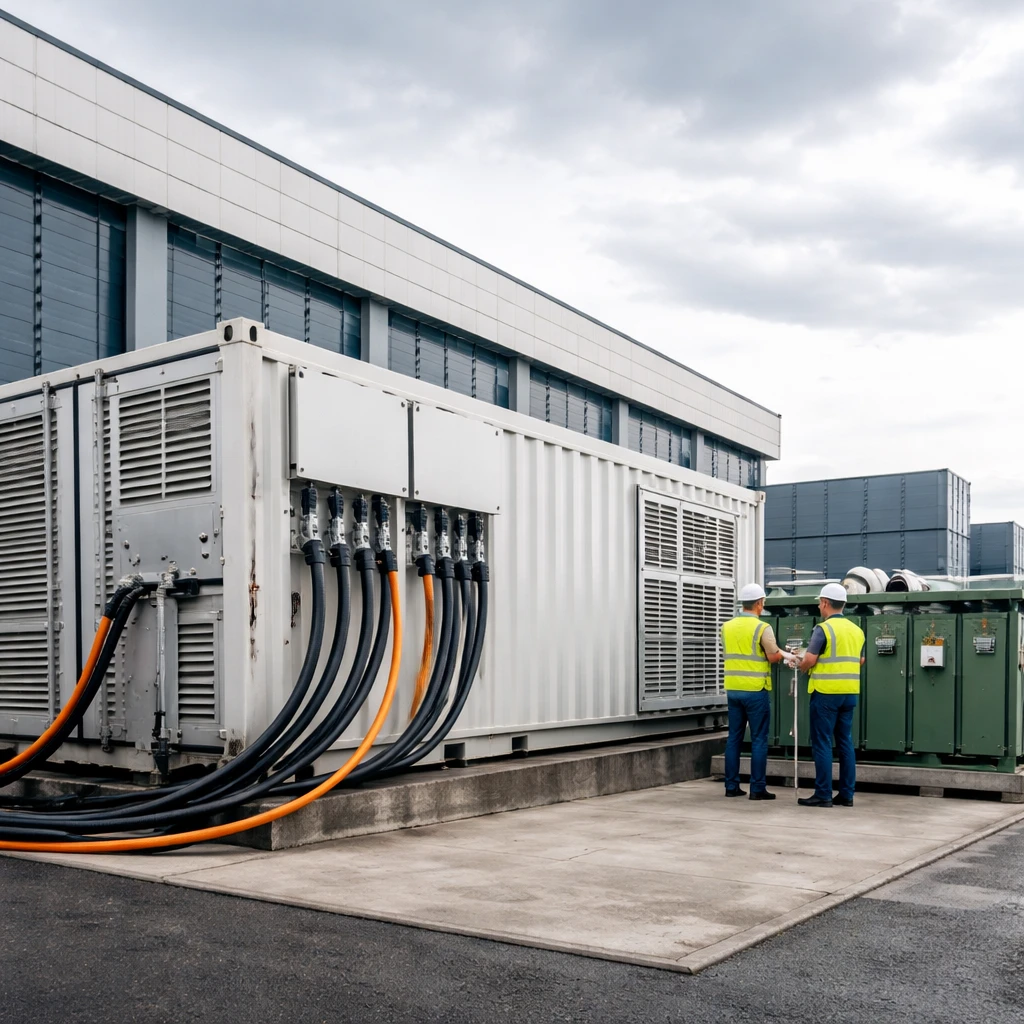
Xos Inc reported a sharp increase in its share price after markets closed Tuesday following the introduction of its Power Hub series, a behind-the-meter energy storage product designed for rapid site deployment at data centers and industrial locations.
The company positioned the Power Hub as a response to lengthy grid interconnection timelines in the United States, which Xos says currently stretch from three to seven years. By delivering megawatt-scale power in physically containerized units, facilities can obtain on-site power within days of delivery, Xos said.
The Power Hub family ships in standard intermodal containers and is offered in modular sizes that scale from 1.2 MWh up to 4 MWh. The flagship 2.5 MWh model provides 1.2 MW of continuous output, while the smaller 1.2 MWh configuration supplies 0.6 MW continuous output. The 4 MWh option is described as the model optimized for maximum energy density. Individual units are designed to be combined to form multi-megawatt power plants.
Xos noted the Power Hub leverages the same system architecture that underpins more than 250 MWh of energy storage currently operating across North America. The company also reported operating in excess of 1,400 assets in commercial service, including deployments for fleet charging linked to autonomous vehicle operators and for emergency-response use cases.
The company highlighted broader market context for its product launch, citing an International Energy Agency projection that global electricity consumption by data centers will roughly double by 2030, with artificial intelligence described as the primary driver of that growth. Xos also pointed to grid bottlenecks affecting consumers in the PJM region, stating those constraints drove costs to $14.7 billion in a single capacity auction in 2025, up from $2.2 billion two years earlier.
On the technical and integration side, Xos said the Power Hub integrates power conversion, controls, and packaging into a single system. The company contrasted that approach with conventional containerized battery energy storage systems, where such components are typically sold separately. Xos asserted that comparable utility-scale deployments commonly incur several hundred thousand dollars in additional integration costs and involve project timelines measured in quarters.
Target markets for the Power Hub series identified by the company include artificial intelligence data centers, industrial facilities facing grid-connection delays, and defense installations that require power independent of the local grid. The product's containerized design and stated rapid deployment cadence are presented as operational advantages for sites constrained by long utility interconnection processes.
Market reaction to the announcement was acute: Xos shares rose about 90% in after-hours trading on the day of the launch announcement.
Summary
Xos launched a containerized energy storage product family called Power Hub, ranging from 1.2 MWh to 4 MWh and intended to deliver megawatt-scale power rapidly to sites facing multi-year grid interconnection delays. The 2.5 MWh flagship offers 1.2 MW continuous output, and the product leverages architecture already deployed across more than 250 MWh of storage in North America. The announcement drove a roughly 90% increase in Xos shares in after-hours trading.