
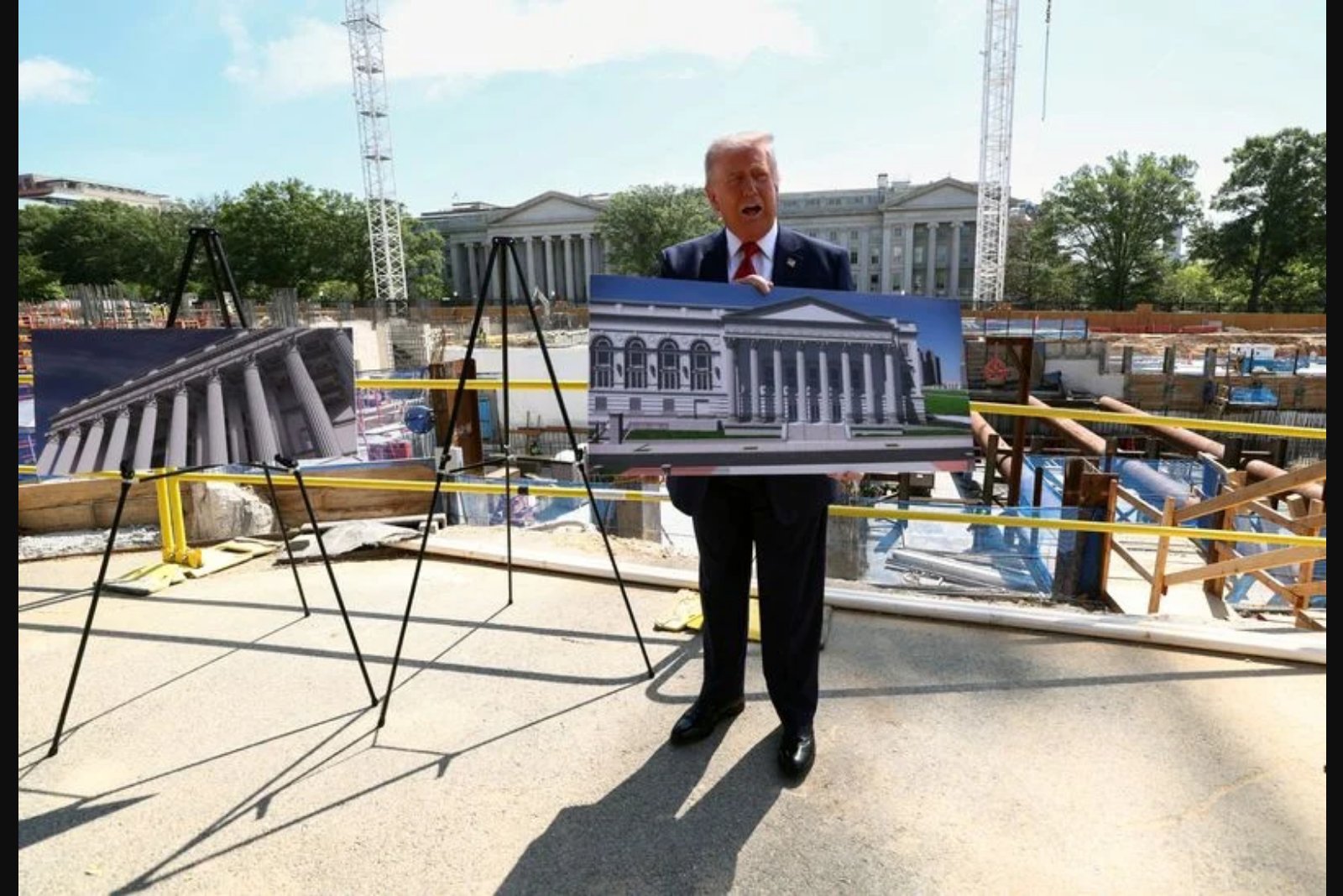
Federal appeals judges will hear arguments on Friday over the Trump administration's plan to build a $400 million ballroom on the footprint of the White House's former East Wing, testing the scope of presidential power in an unprecedented dispute between the president and preservation advocates.
The East Wing historically contained the offices of the first lady and her staff. In October 2025 the administration demolished that portion of the White House complex and began erecting a 90,000-square-foot (8,360-square-meter) ballroom without seeking authorization from Congress, prompting a lawsuit from the National Trust for Historic Preservation, a nonprofit dedicated to protecting important American sites.
The case is scheduled before a three-judge panel of the U.S. Court of Appeals for the District of Columbia Circuit at 9:30 a.m. EDT (1330 GMT). The panel hearing the appeal includes Judges Patricia Millett and Bradley Garcia, both appointed by Democratic presidents, and Judge Neomi Rao, a Trump appointee. Earlier, U.S. District Judge Richard Leon, who was appointed by former President George W. Bush, twice enjoined above-ground construction while allowing excavation and other underground work to continue. Leon wrote that no federal statute "comes close to giving the President" authority to build the ballroom without congressional approval.
Last month the D.C. Circuit issued an order permitting construction to proceed while the underlying legal claims are resolved, but the court did not decide the merits of the dispute. The appeals hearing will address whether that construction - and the wider project - should be allowed to continue or whether the lower court's injunction should be reinstated.
The administration has argued the ballroom is a national security necessity, pointing to recent assassination attempts against the president. In filings to the appeals court in May, the Justice Department said: "The East Wing Project answers that critical security need, and ensures that the President can fulfill his constitutional duties in a safe and heavily secured facility." Preservationists reject that characterization, arguing that the executive branch cannot override Congress's authority based solely on a claim of exigency.
In its court filing the National Trust for Historic Preservation said neither the D.C. Circuit nor the U.S. Supreme Court has ever permitted a president to "usurp powers vested in Congress by the Constitution based on nothing more than his claim of necessity." The organization warned that the public has a substantial interest in halting work on a project that it says will cause irreparable harm to what it described as "perhaps the most significant historic site in the country."
Beyond the East Wing ballroom, the administration has proposed other high-profile changes to central Washington's civic landscape. Those proposals include erecting a 250-foot (76-meter) arch near the National Mall and undertaking a renovation of the Kennedy Center performing arts complex. A federal judge last week ordered the removal of the president's name from the Kennedy Center building and barred plans to close the center for renovations.
The administration has set a target opening date for the planned ballroom of around September 2028. The appeals hearing will determine whether the project can proceed on the current timetable or whether court orders will require additional pauses or modifications while the legal challenge continues to wind through the federal courts.
Key points
- The administration seeks appellate approval to continue construction of a $400 million, 90,000-square-foot ballroom built on the demolished East Wing site.
- A federal district judge blocked above-ground work twice but allowed underground activity; the D.C. Circuit previously permitted construction to continue during litigation.
- The administration frames the project as a security necessity; preservation groups argue it circumvents Congress and will irreparably harm a major historic site.
Risks and uncertainties
- Legal uncertainty - The outcome of the appeals court hearing could halt above-ground construction or require additional judicial oversight; this affects contractors and the construction sector involved in the project.
- Historic preservation and regulatory risk - Preservationist claims that the project will cause irreversible damage could lead to injunctions or remedies that change the scope or timeline, affecting firms tied to architectural restoration and cultural institutions.
- Programmatic and scheduling risk - The administration's planned opening around September 2028 faces potential delays if courts impose restrictions or require legislative authorization.