
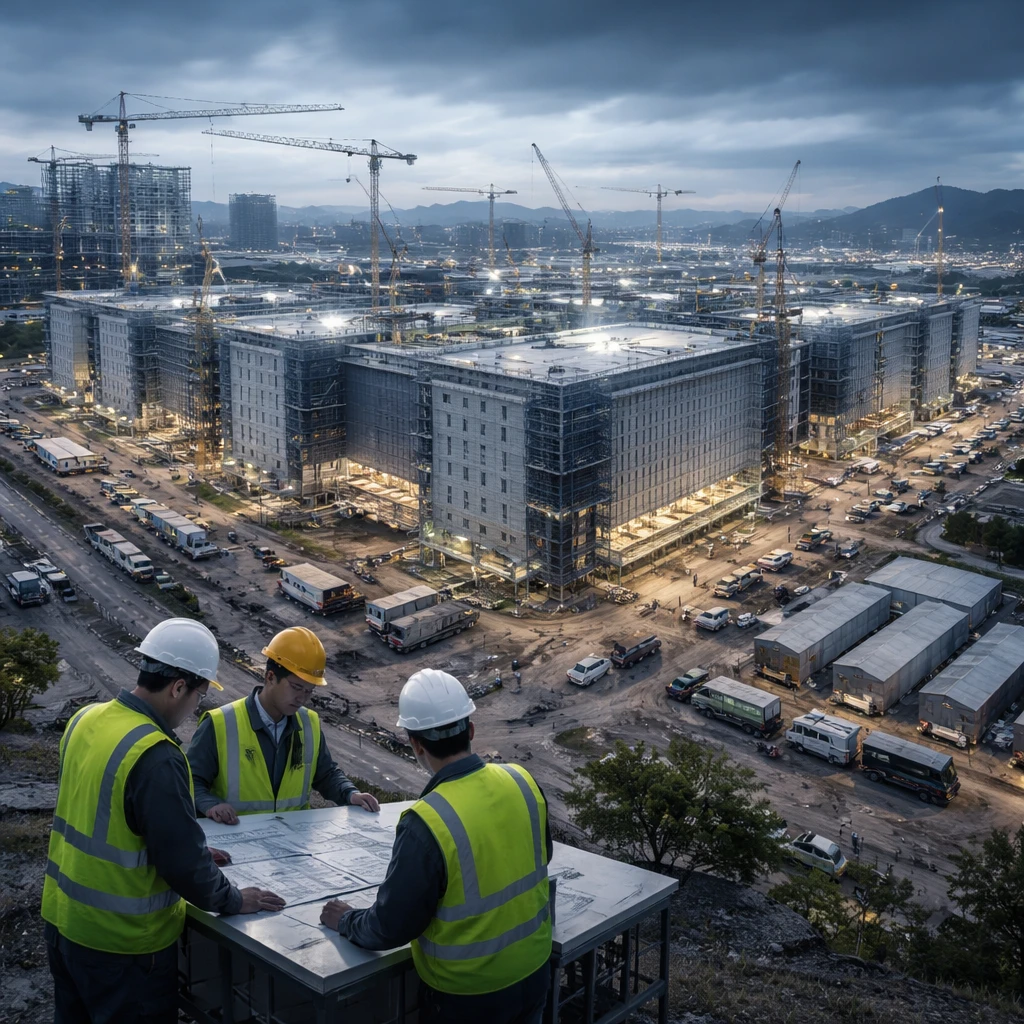
Samsung Electronics and SK Hynix announced an ambitious wave of investment designed to seize on surging global demand for memory chips driven by artificial intelligence, committing a combined 3,200 trillion won in projects that include an 800 trillion won chip cluster in the country’s southwest.
The commitments were made public at a government presentation where the companies won public praise from President Lee Jae Myung. The announcements mark a notable shift from the memory industry’s historically cautious stance on capacity expansion - an approach shaped by repeated boom-and-bust cycles that have punished overinvestment in the past.
Seoul’s plan accompanies the corporate pledges: the government hopes to double South Korea’s memory chip production capacity within five years. As part of that effort, Samsung and SK Hynix said they would accelerate construction in the existing Yongin semiconductor cluster, compressing typical seven-to-12-year timelines so that new capacity can come online sooner.
Together, the two firms — currently the world’s largest memory chipmakers and dominant providers of high-bandwidth memory (HBM) used in advanced AI processors — pledged 3,200 trillion won, a total the companies said would cover the new southwest cluster as well as projects already announced.
South Korea’s standing in the emerging AI-driven memory market has been reinforced by a worldwide shortage that has driven up demand from cloud AI providers, electronics manufacturers and other large consumers. The scarcity has also contributed to sharply higher memory prices in the near term, supporting strong profitability for the memory divisions at Samsung and SK Hynix.
Yet several industry analysts and academics warned that the very scale and speed of the proposed build-out carry meaningful risk. Memory fabs are complex facilities requiring long lead times to construct and even longer to ramp to commercial output, meaning much of the new production capacity will not be available until deeper into the next decade.
"We see memory pricing remaining a function of demand and supply, and accelerating capex over the next decade further increases the risk of an oversupply longer term," said Morningstar analyst Jing Jie Yu, noting that the boom depends heavily on continued expansion by AI hyperscalers.
Lee Jong-ho, a professor in the Department of Electrical and Computer Engineering at Seoul National University, reflected similar caution, saying the recent decisions may have been rushed. "It is the kind of investment that could determine a company’s future," he said. "No one knows what the situation will look like three years from now. We need to respond quickly while demand is strong, but after that, demand is uncertain and decisions should be made cautiously."
Past cycles in memory prices and demand have left deep marks on the industry. Severe downturns have inflicted heavy losses on leading firms and, in extreme cases, threatened solvency; in the past these dynamics prompted companies to pause or scale back projects until market conditions improved.
That history shaped a more conservative approach to expansion for many years. Indeed, as recently as two months before the announcement, SK Hynix Chairman Chey Tae-won voiced skepticism about new chip factories in the southwest when asked by a lawmaker, saying, "I’m not sure semiconductors are necessarily the field you have to go into." Neither Samsung nor SK Hynix offered detailed explanations for what prompted their change in stance.
Both companies, however, pointed to the government’s pledge to streamline approvals as a factor enabling faster construction at Yongin. With quicker regulatory sign-offs, the firms said they could shorten usual construction timetables and bring capacity online earlier to meet urgent demand.
CW Chung, an analyst at Nomura, suggested that diversifying production locations might be a hedge against uncertainty around the Yongin cluster. "Investing in other regions could be a way of hedging the uncertainty surrounding the Yongin semiconductor cluster," he said.
Analysts also emphasized that the memory producers retain tools to manage investment pacing. CLSA senior analyst Sanjeev Rana noted that a downturn in the memory industry is a clear risk to the expansion plans, but added that producers have the flexibility to slow projects if excess capacity begins to appear.
Samsung’s stated roadmap foresees up to 2,100 trillion won in spending on chip production through 2040, though the company has said that levels of expenditure could be adjusted depending on market conditions and business needs. The company has precedent for pausing construction during weak markets: work on its P5 plant in Pyeongtaek was halted nearly two years in response to a market downturn before being resumed late last year.
SK Hynix’s leadership said the company would monitor demand conditions when deciding the final scale of its investments but acknowledged that current supply shortages make it difficult to fully meet customer needs at present. The comments were delivered during the presentation attended by the president.
For the government, the project is a strategic priority. Presidential chief of staff Kang Hoon-sik said authorities would fast-track approvals and aim to complete the chip cluster before President Lee’s term concludes in 2030.
Koh Taebong, head of research at iM Securities, characterized the combined move by government and industry as a bet that aligns with South Korea’s aspirations to be a leading AI power. "Yesterday’s message was that South Korea is serious about becoming one of the world’s top three AI powers. This isn’t just rhetoric - the government is committing to spending real money to make it happen," he said.
The announcements have immediate implications for several sectors. Memory suppliers, equipment manufacturers, construction and permitting-related services, and regional economies where fabs are located stand to be affected by the accelerated timelines and capital deployment. At the same time, the broader semiconductor market and companies dependent on memory supply for AI and consumer electronics will be closely attuned to how quickly additional capacity comes online and how pricing evolves.
Summary
Samsung Electronics and SK Hynix unveiled plans for a combined 3,200 trillion won in investments to expand memory-chip production in South Korea, including a new 800 trillion won cluster. The government aims to double memory capacity within five years and will speed approvals to accelerate fab construction, particularly in the Yongin cluster. While the move strengthens South Korea’s position in high-bandwidth memory for AI, analysts warn that long construction and ramp-up times and aggressive capital spending raise the risk of oversupply if AI demand growth slows.
Key Points
- Combined corporate pledge of 3,200 trillion won, including an 800 trillion won new chip cluster in the southwest - impacts semiconductor and construction sectors.
- Government goal to double memory production capacity within five years and to accelerate approvals to bring capacity online faster - impacts permitting and regional economic development.
- Memory producers’ recent profitability is driven by AI-related demand and a current chip shortage, but long lead times for fabs mean new supply may only materialize well into the next decade - impacts supply chains and pricing across electronics and AI infrastructure markets.
Risks and Uncertainties
- Oversupply risk from accelerated capital expenditure - faster and larger builds could outpace sustainable demand if growth from AI hyperscalers slows, affecting memory pricing and margins.
- Timing and ramp-up uncertainty - fabs take years to construct and bring to full production, so promised capacity may not relieve near-term shortages and could create mismatches in later years.
- Execution and policy dependence - the plan relies on expedited government approvals and the companies’ ability to manage investment pacing; shifts in policy or market conditions could alter outcomes.
Tags: ["semiconductors","memory","investment","SouthKorea","AI"]