
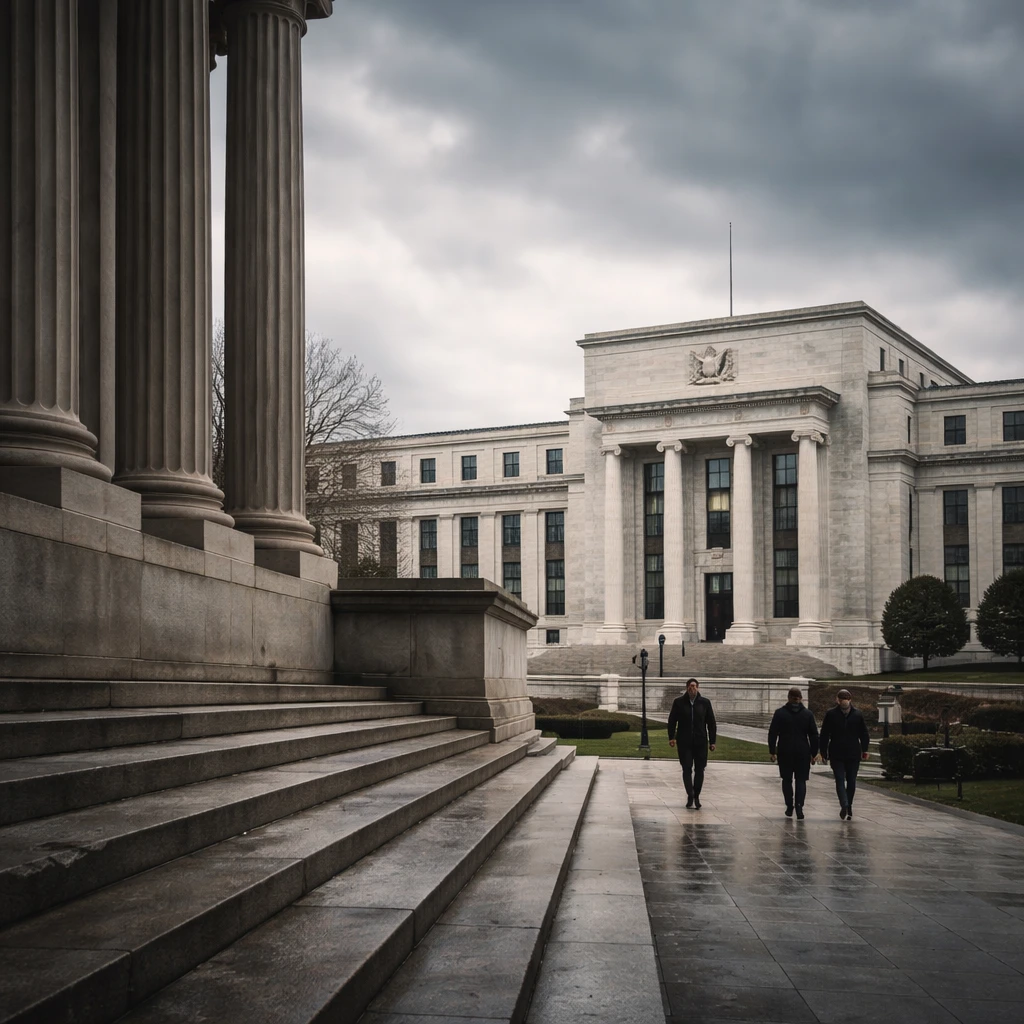
The Supreme Court's rulings on Monday preserved the Federal Reserve's current insulation from at-will presidential removal but simultaneously curtailed protections long enjoyed by other independent agencies, a legal outcome that leaves the central bank both vindicated and potentially more exposed to political debate.
In a closely divided 5-4 decision, the court declined to permit President Donald Trump to remove Federal Reserve Governor Lisa Cook based on allegations of mortgage fraud that Cook has denied. The opinion said any attempt to dismiss a Fed governor would face a "substantial" evidentiary threshold that requires showing both the seriousness of alleged misconduct and a clear "nexus" to the individual's duties at the Fed.
At the same time, the justices backed the president's firing of Federal Trade Commission member Rebecca Slaughter, overturning a 1935 Supreme Court precedent that had provided a statutory shield for officials at certain regulatory agencies. That precedent, originating in Humphrey's Executor v. United States, had previously underpinned protections against arbitrary dismissal for officials whose roles were understood as independent of direct presidential control.
Legal scholars and former regulators emphasized that the practical effect of the two rulings is to single out the Fed from other agencies. "Fed independence lives on but the foundation is much weaker than it has been over the past 90 years," said Columbia Law School professor Kathryn Judge, who has written on the Fed and regulatory institutions. Judge noted the narrow margin of the court's decision and added that "the Fed is now going to be forced to stand alone." She warned that as other agencies lose the protections once shared with the Fed, the central bank will face greater pressure to demonstrate publicly why its independence should be maintained.
The Cook decision also removed an immediate cloud hanging over the new Fed chairman, Kevin Warsh, a Trump appointee who assumed leadership of the central bank last month. Had the court allowed Cook's removal, Warsh and his colleagues could have been vulnerable to a sudden shift in presidential tolerance for policy choices. Instead, the ruling established that removing a Fed governor on allegations unrelated to job functions would be difficult to sustain.
Chief Justice John Roberts authored the opinion in the Cook case, warning that without meaningful limits on removal, "any perceived or alleged misstep (past or present) could provide a ready pretext for a governor's removal." He added, "Nothing could be more corrosive of the independence that Congress sought to preserve." Those constraints, the court said, are necessary to maintain both the reality and the appearance of a policymaking body able to act on expertise rather than immediate political pressures.
Yet Roberts reached a contrasting conclusion in the Slaughter matter, writing that "Subordinates who exercise the president's power are subject to removal by him." In doing so, the court expanded the president's removal authority for officials the majority concluded were effectively executing executive functions as part of the administration, and in the process rejected the Humphrey's Executor framework that previously protected multiple independent agencies.
The court's reasoning for protecting the Fed rested in part on the institution's distinct legal and organizational features. Congress created the Federal Reserve in 1913 with the Federal Reserve Act, which included a statutory provision that governors could be removed by the president only "for cause." Although the law did not define "for cause" or set out removal procedures, those statutory protections were cited by the court as part of the Fed's unique pedigree.
Beyond statutory language, the court underscored structural differences. The Fed's seven-member Board of Governors in Washington is appointed by the president with Senate confirmation, while the 12 regional reserve banks are organized as quasi-private institutions whose leaders are selected by local boards of directors. The Fed also operates without reliance on congressional appropriations for its policymaking functions; it funds its operations from earnings generated through its conduct of monetary policy, allowing it to establish staffing and spending levels independently.
That hybrid public-private design and financial autonomy led the court to treat the Fed differently than other agencies. The opinion cited warnings from Alexander Hamilton about the risks of allowing political actors to manipulate monetary policy, invoking the idea that insulating monetary authorities from transient political pressures has long been considered important to protecting long-term economic stability.
Not all observers accept that treating the Fed as an island of independence is a sustainable legal or political arrangement. Randal Quarles, a former Fed vice chair for regulation, warned in remarks anticipating the court's decision that carving out the Fed while stripping similar protections from other agencies raises a deeper question about why monetary policymakers should receive special treatment when it comes to oversight. "At some point that is an unstable solution," Quarles said, arguing that the divergent treatment could invite future challenges.
Cook's case itself remains unresolved on its merits. The court's action preserves her tenure pending a separate proceeding on whether the president may remove her based on the disputed allegations. President Trump said he intends to continue pursuing the matter.
In a statement following the court's decision, Cook denied wrongdoing and described the firing attempt as politically motivated. "This was never about mortgage documents signed years before I became a Federal Reserve governor. It was an attempt to remove me on a manufactured pretext because I refused to bow to political pressure and continued to set interest rates based only on what would best serve the American people," she said. "Today's ruling affirms a principle that has underpinned sound economic stewardship for generations."
Observers pointed to the broader implications for financial markets and public confidence in central banking. The conventional argument for insulating central banks from direct political control is that it helps avoid short-term policy choices that might stoke inflation for electoral gains and would undermine trust among domestic and global bond markets. The court's decisions preserve that insulation for the Fed, at least for now, but do not settle the normative debate about how democratic accountability and technocratic policymaking should be balanced.
Until Monday's rulings, officials at the Fed shared a legal protection against arbitrary dismissal with leaders at several other independent agencies, a protection derived from the Humphrey's Executor precedent. With that precedent overturned in the Slaughter ruling, a number of agencies now face a different legal environment in which their leaders may be more directly removable at the president's discretion if the court deems them to be executing the president's power.
The tension created by these twin rulings is likely to manifest in two ways. First, the Fed will be compelled to more visibly justify why it remains an exception to a legal regime that now applies differently across the federal government. Second, litigants and political actors may mount additional challenges aimed at clarifying or altering the contours of the Fed's statutory protections.
For now, the central bank retains a measure of autonomy that its supporters argue is essential to maintaining stable long-term interest rates and credible monetary policy. But by separating the Fed from other independent agencies, the court may have set the stage for intensified scrutiny of the institution's legal status and its role in the broader architecture of governance. Whether that scrutiny results in legislative changes, further litigation, or sustained political pressure is an open question that the rulings themselves did not resolve.
What this means for markets and policymakers
- Monetary policy retains its legal guardrails for the moment, reducing the immediate risk of politically driven changes to interest-rate decisions.
- Other regulatory agencies have lost a precedent that previously limited presidential removal powers, potentially altering the independence of regulatory decision-making outside the Fed.
- The Fed may face increased scrutiny and will likely need to more actively defend, in public and legal arenas, why its special treatment is warranted.