
Jefferies has upgraded Friedrich Vorwerk Group SE to a "hold" rating from "underperform," leaving its price objective unchanged at €65 and retaining its earlier forecasts. The move comes after the stock retraced roughly 40% from an October peak amid investor questions over the durability of the company’s earnings trajectory.
The brokerage said it now sees limited valuation downside from prevailing levels. Analyst Martin Comtesse noted that Friedrich Vorwerk "has significantly derated over the last eight months" and highlighted current trading multiples of 6.7 times EV/EBITDA and 14 times forward price-to-earnings for fiscal 2026. Jefferies described those multiples as "a fair reflection of the elevated risks."
Jefferies’ model projects fiscal 2026 EBITDA growth of 8% and earnings per share growth of 5%. The broker positions its EBITDA estimate toward the upper half of management’s guidance range, which runs from a 2% decline to 10% growth. For fiscal 2027, Jefferies is forecasting 10% revenue growth and a 21.7% EBITDA margin, which sits within the company’s stated target band of 20% to 22%, translating into roughly 4% EPS growth. Jefferies cautioned that year-on-year comparisons will become materially tougher as the company progresses into the third quarter and especially the fourth quarter.
A recent legislative change approved by the German Bundestag shifts transmission grid policy toward favoring new high-voltage direct-current, or HVDC, power corridors as overhead lines rather than underground cables. The government framed the change as a way to lower construction costs and speed up both permitting and network deployment. The law removes the earlier preference for underground cabling on new HVDC projects, including the DC42 and DC42plus corridors, but it does not make that approach mandatory. The Bundesrat retains the ability to review the legislation and could potentially object in its post-summer sitting.
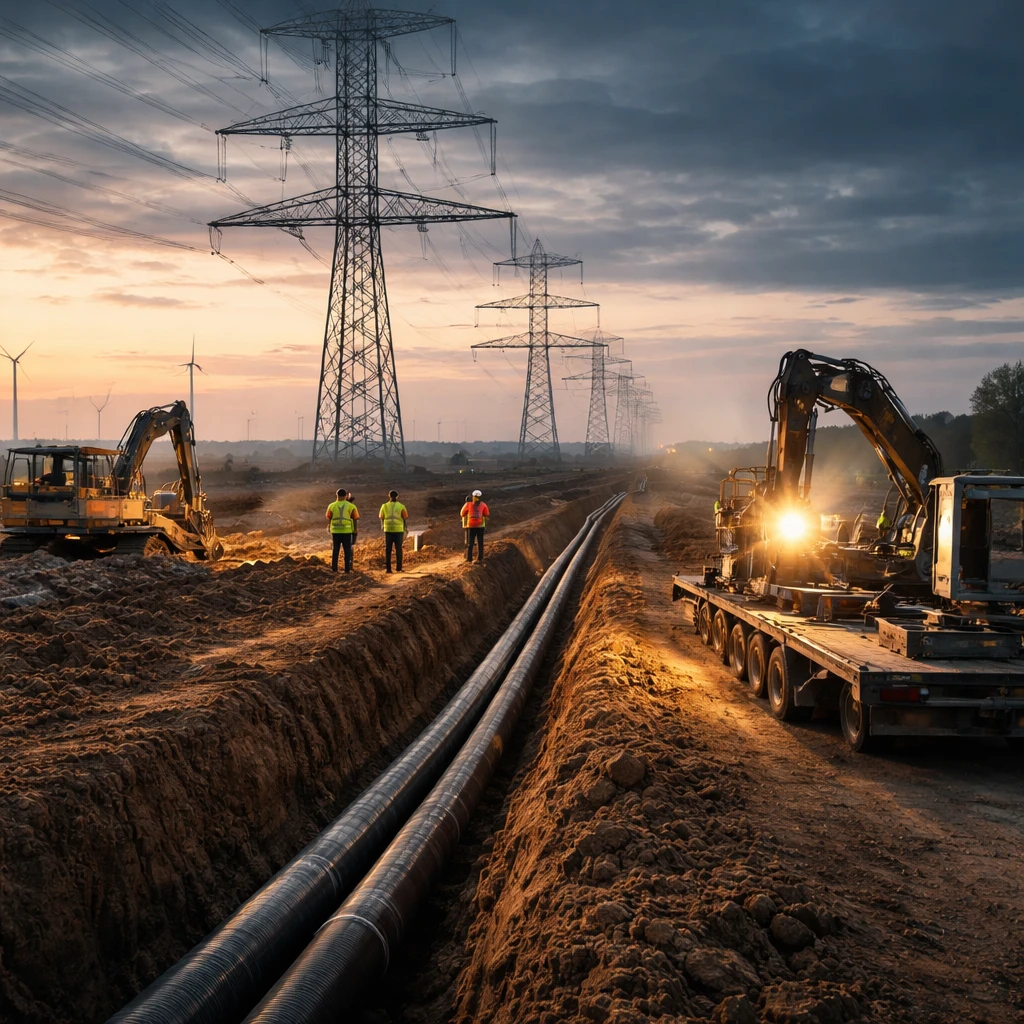
Jefferies’ analysis shows Friedrich Vorwerk has more than 60% of its order backlog tied to electricity projects, with roughly half of that exposure directly linked to underground cabling. While contracts already tendered and in the backlog would remain unaffected by the changed guidance, the brokerage notes that many future tenders are likely to specify overhead lines. Friedrich Vorwerk currently has no exposure to overhead HVDC line construction, a potential structural mismatch for future business opportunities.
For the second quarter, Jefferies modeled revenue of €190 million and assumed a margin similar to the company’s first-quarter margin of 22.9%, producing an EBITDA estimate of €43.6 million. The brokerage expects that project progress in the seasonally stronger quarter will help offset some of the weather-related shortfall seen in the first quarter.
In June, Friedrich Vorwerk announced deployment of automated welding robots in Central Asia to assist expansion of Kazakhstan’s gas pipeline network. Management has indicated that, should the company successfully scale this adjacent offering into the U.S. market, it could contribute as much as €50 million in long-term revenue.
Jefferies’ valuation work uses a base-case discounted cash flow that assumes an organic top-line compound annual growth rate of 10% from 2025 through 2028 and a sustainable EBITDA margin of 21%, which produces a fair value of €65 per share. The broker’s upside case values the stock at €98, assuming a prolonged period of mid-teens revenue growth and mid-20s EBITDA margins. Its downside case falls to €50, which assumes flat top-line development and no persistent margin improvement.
The brokerage’s upgrade to hold reflects a view that the stock’s recent derating has largely captured the company’s risks, while the legislative and market-structure changes create uncertainty about future tendering and exposure. Jefferies left its forecasts intact, flagging both seasonality in project execution and legislative developments as near-term factors to watch.