
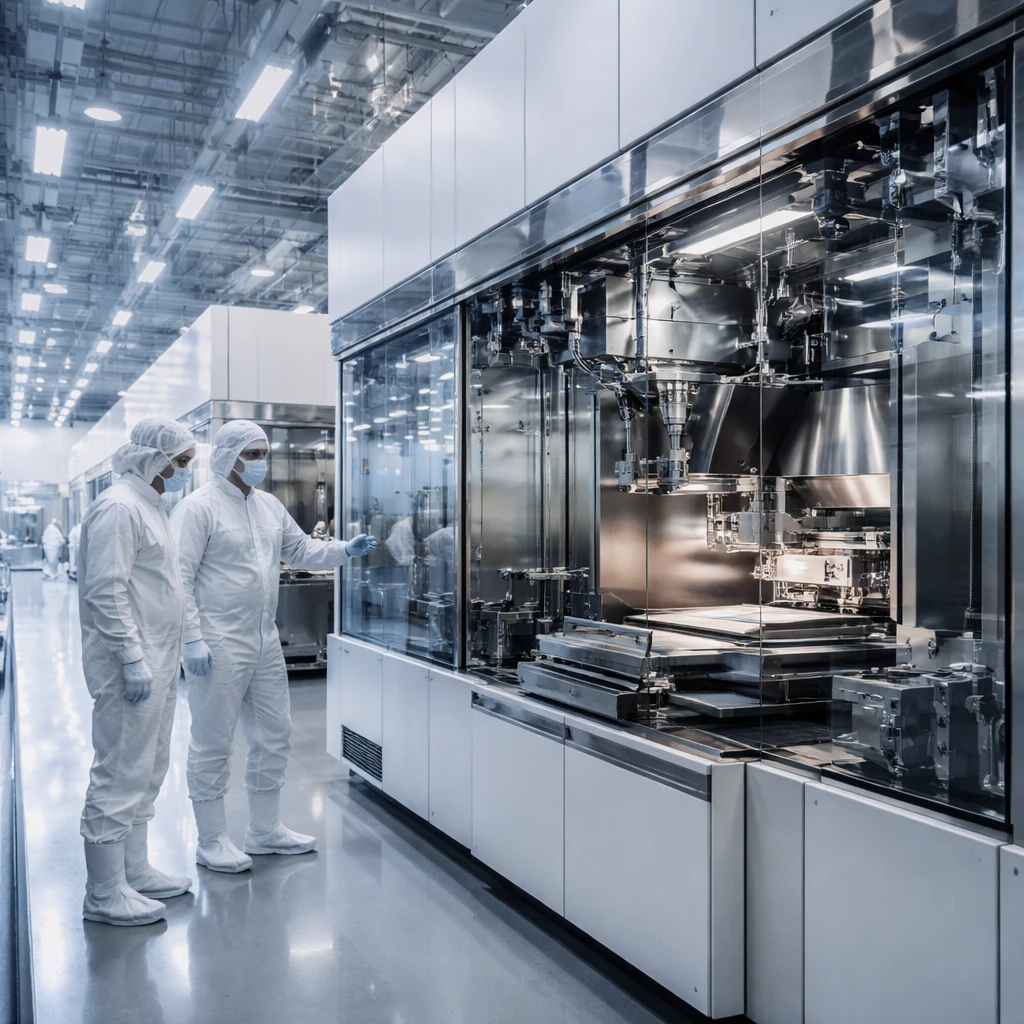
Goldman Sachs has revised upward its outlook for wafer fabrication equipment (WFE) spending through 2028, driven by stronger-than-expected semiconductor capital expenditure signals that emerged during the second-quarter earnings season. The investment bank now sees WFE spending of $150 billion in 2026, $218 billion in 2027 and $281 billion in 2028 - increases of 36%, 45%, and 29% year-over-year, respectively.
The updated forecasts reflect a combination of significant upward revisions to capital expenditure plans and more constructive near-term commentary from suppliers of semiconductor processing equipment. Goldman Sachs singled out two segments as the engines of the expected momentum: DRAM and leading-edge foundry, which it views as the near-term drivers. It expects NAND and Logic markets to contribute to growth on a medium-term horizon.
Against that backdrop, Goldman Sachs reiterated a bullish stance on stocks tied to semiconductor capital equipment and identified seven companies as preferred names in the sector, assigning Buy ratings across the list:
- Applied Materials - Goldman Sachs ranks Applied Materials as its top pick among global equipment suppliers positioned to benefit from the upgraded WFE outlook. Applied Materials reported fiscal third-quarter revenue that rose 15% sequentially and provided revenue guidance of $10.25 billion for its next quarter, a figure that topped consensus expectations. Following those results, other brokerages also maintained positive views on the company.
- Lam Research - The bank maintains a Buy rating on Lam Research, noting the company’s exposure to a strengthening equipment cycle across several semiconductor segments. Lam reported record revenue of $6.72 billion and earnings per share of $1.82 for its fiscal fourth quarter, with both metrics exceeding analyst forecasts.
- ASML - Goldman Sachs assigns a Buy to the Dutch lithography specialist, expecting continued demand for advanced lithography tools that support leading-edge foundry production. ASML’s chief financial officer indicated there is scope for price increases on the company’s equipment and that capacity for its most advanced EUV tools is nearly fully booked through the end of 2027.
- Tokyo Electron - The Japanese equipment supplier also receives a Buy rating. Tokyo Electron’s most recent first-quarter results included an earnings-per-share beat and record-high net sales and gross profit, even though revenue fell short of estimates.
- ASMI - Goldman Sachs includes ASMI among its Buy-rated preferred equipment stocks globally.
- BESI - The firm assigns a Buy rating to BESI as part of its constructive outlook for the semiconductor capital equipment market.
- Lasertec - Rounding out the list, Lasertec is rated Buy by Goldman Sachs. Analysts at Morgan Stanley have noted that Lasertec’s key performance indicator guidance was aligned with their forecasts.
Goldman Sachs provided more granular forecasts within the WFE outlook. The bank raised its foundry WFE estimates to $58 billion in 2026, $84 billion in 2027 and $109 billion in 2028. For DRAM-specific equipment spending, the investment bank increased projections to $48 billion, $72 billion and $97 billion for the same respective years.
Despite the higher spending forecasts, Goldman Sachs expects the DRAM industry to remain capacity constrained through 2028. That view reflects the bank’s assessment that elevated investment levels may not be sufficient to fully alleviate capacity limitations in the DRAM sector within the forecast window.
Overall, Goldman Sachs’ upgraded numbers and Buy-rated company list underscore the investment bank’s view that semiconductor capital expenditure is re-accelerating, supported by recent corporate results and supplier commentary. The firm’s guidance revisions place emphasis on near-term strength from DRAM and leading-edge foundry demand, with NAND and Logic expected to add momentum over a longer timeframe.
Analysis context
This outlook update is anchored in second-quarter earnings season disclosures and subsequent capital expenditure revisions by semiconductor equipment suppliers and customers. Goldman Sachs interprets these inputs as evidence of a more optimistic equipment spending cycle than previously expected.