
Overview
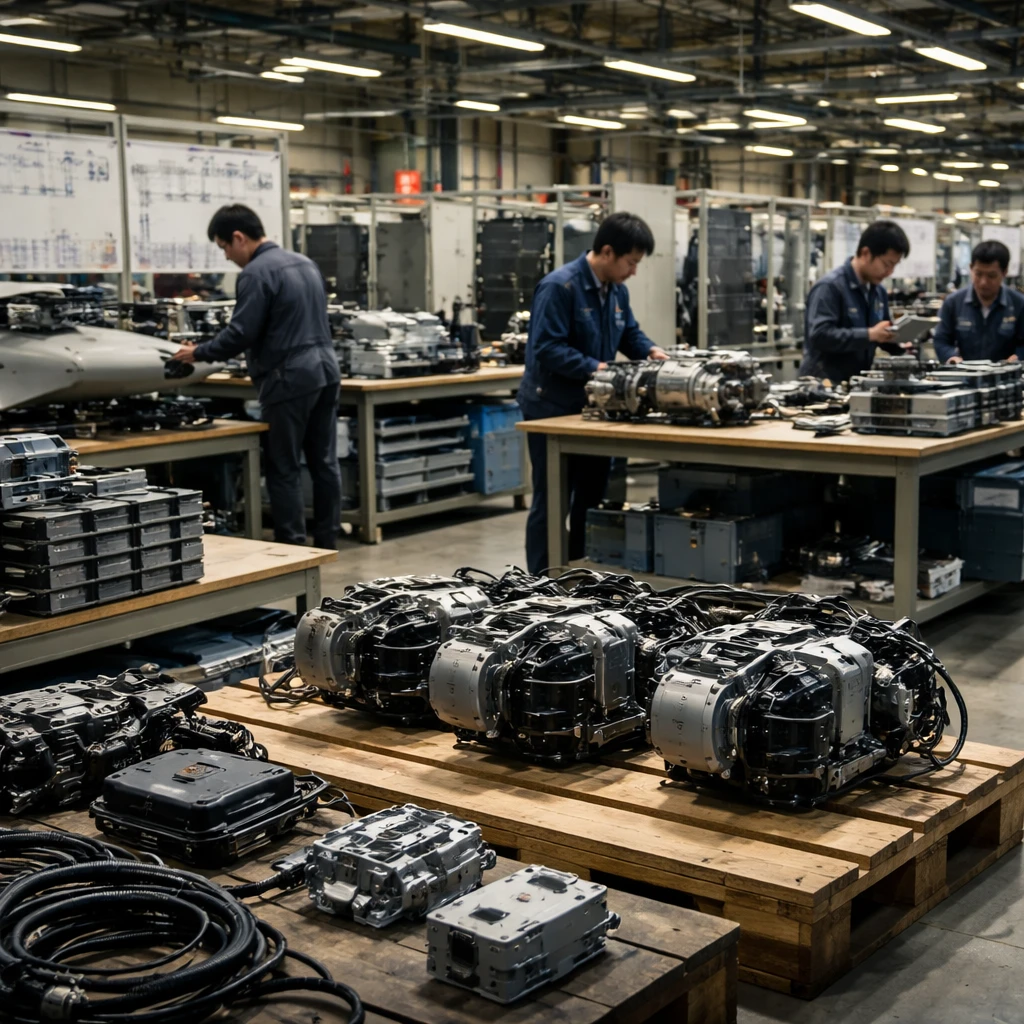
In recent months, a number of Japanese automotive component makers have begun shifting production and business plans toward military work, prompted by a government-led push to mobilize domestic manufacturing capacity for defense needs. Officials and industry figures describe a coordinated effort that pairs established auto suppliers with defense contractors and offers new funding to develop prototype systems - particularly unmanned aerial vehicles - as Tokyo seeks to accelerate a major rearmament drive.
Industrial pivot at the plant level
One visible example of this change is Aster, a supplier that historically earned most of its revenue selling electric motors to Toyota. After moving into defense last year, the company now records defense-related work at roughly one tenth of its revenue. Takenobu Hongo, Aster's chief executive, framed the shift bluntly: "Drones are a much better business," he said, adding that "At the moment, for us, automotive motors aren’t very profitable." The comments underline how some smaller parts makers see defense contracts as a path to healthier margins than low-margin automotive production.
Government coordination and support
Tokyo's Acquisition, Technology & Logistics Agency - ATLA - has taken a visible role in guiding suppliers that want to enter the defense market. An ATLA official and multiple company executives said the agency functions as a point of contact for firms seeking defense work. It has evaluated potential suppliers, facilitated pairings between automotive component makers and established defense companies, and launched programs to provide funding for development and testing of military technologies.
Officials said ATLA has been willing to provide substantial financial support for projects that progress to prototype development. The agency has also organized events in Tokyo to introduce Japanese suppliers to potential Western clients; roughly 48 Japanese companies across industries participated in a September forum, about twice as many as the previous year, according to the procurement agency.
An adviser to Prime Minister Sanae Takaichi’s cabinet, Koko Kato, has also been active in steering the industry transformation. Kato said that if synergies exist between auto and defense production, carmakers and their supply chains "should take the opportunity." She added that she oversaw February changes to a separate trade ministry program intended to help automotive suppliers diversify into defense and other sectors.
Strategic rationale and wider context
Officials driving the policy say the faster route to expand Japan's defense industrial base is to tap existing manufacturing networks developed for the automotive sector. Japan remains a major vehicle producer even after a decade of decline in volumes; the industry still manufactures more than 8 million vehicles annually, supports one in ten jobs, and involves roughly 70,000 companies supplying a wide array of components.
Proponents point to skills used in carmaking - precision engineering, electronic systems integration and rigorous quality control - as directly relevant to producing military hardware at scale. Pontus Haggstrom, an adviser to the auto industry based in Japan and a former chief executive of Stellantis Japan, noted that the sector "knows how to produce complex products reliably and at scale."
Another practical justification is capacity constraints among American defense manufacturers, who are reportedly struggling to replenish stocks. Between 2021 and 2025, Japan accounted for about a tenth of US weapon exports, according to trade data cited by an international research institute, reinforcing the logic of developing domestic supply lines.
Where demand has already shifted
Several smaller suppliers have seen defense orders increase substantially. Kyowa Industrial, which makes engine components for cars, said it has received a rising number of requests for prototype drone engines. Kyowa’s chief executive, Hiroko Suzuki, told industry contacts that Kyowa’s defense-related revenue has climbed to about 10% of annual sales, up from roughly 3% in spring 2025.
Terra Drone, a Japanese drone maker, reported that ATLA introduced its chief executive to Kaaz, a producer of racing-car parts that has developed a small gasoline aircraft engine. Kaaz has discussed engine development with ATLA and is pursuing military drone engine work. Ishikawa Energy Research, a startup known for agricultural UAVs such as crop-spraying aircraft, said it is also exploring military applications for its gasoline-powered drones. Founder Mitsuru Ishikawa pointed out that gasoline engines allow longer range and the carriage of heavier loads than many battery-powered models.
Ishikawa's company already sources a majority of its drone components from the local auto supply chain that feeds Subaru's manufacturing operations; more than half of its parts come from those suppliers. Subaru itself has a longstanding defense arm, having built military aircraft including attack helicopters for Japan’s Self-Defense Forces for decades. A Subaru spokesperson said the company expects defense-related demand to grow but declined to provide specific forecasts.
Focus on unmanned systems
Government planning foresees fleets of attack and interceptor drones becoming central to Japan’s evolving defense posture. ATLA launched a funding program in October to support development and testing of new military technologies and has explicitly encouraged some auto suppliers to produce components for unmanned aerial vehicles. The agency has signaled it could offer millions of dollars in support to projects that reach prototype stages.
Despite these initiatives, domestic drone production remains small in absolute terms. Japan exported slightly more than 1,100 drones last year, while Taiwan exported roughly 123,000 UAVs to overseas buyers over the same period, according to trade figures compiled by a Taiwan-based research institute. That disparity demonstrates both the scale of the challenge and the potential production headroom if automotive suppliers commit to the sector.
Budget realities could however pressure some planned procurements of missiles and manned aircraft. Officials familiar with budget planning said drone-related spending is likely to be ringfenced because of the urgent operational need for UAVs.
Limits of the shift - major automakers hold back
The reorientation toward defense contracting is currently concentrated among smaller component makers and new entrants rather than Japan's largest automakers. The country’s so-called big three - Toyota, Honda and Nissan - have shown limited interest in direct defense involvement. Reasons cited by company representatives include substantial existing business in China, sensitivities over reputational risk, and long-standing corporate aversions to defense contracting.
Senior Toyota executive Hiroyuki Ueda told investors at a recent results briefing that "The company’s basic position at this point is that we will not do anything related to defense." Nissan declined to comment when asked about potential defense work, and Honda said it has no specific plans to enter the sector.
That caution feeds down to the supplier tier. Mitsubishi Electric's chief financial officer, Kenichiro Fujimoto, said some auto-parts firms approached to join a military drone initiative declined because they feared upsetting their principal customers in the automotive industry. The identities of those suppliers were not disclosed.
When Aster’s Hongo told his roughly 100 staff at the Yokote plant in November 2025 that US military technology company Anduril wanted to use their motors for drones, he feared pushback. Instead, he said, the workforce reacted with enthusiasm, with many finding the development "impressive."
Hongo predicted that growing commercial opportunities in defense and rising public concern about regional security threats would draw more companies into the sector. "In Japan now, there are very few people who think this is somebody else’s problem," he said.
Procurement outreach and international clients
ATLA has been active in introducing Japanese suppliers to potential Western defense clients and in facilitating partnerships with established arms firms. The procurement agency's events have broadened their reach, with participation rising at recent forums. Some Japanese suppliers are explicitly seeking to sell components and prototype systems to US and European military contractors as well as to domestic defense prime contractors.
Implications for industrial policy and labor
The effort to refashion parts of the auto supply chain into a support base for defense production raises questions about production rates, capacity conversion and workforce acceptance. Officials and company executives interviewed for industry planning discussions stressed the relevance of automotive skills - precision manufacturing, electronics assembly and quality assurance - to defense manufacturing. Converting those capabilities toward military platforms may require new certification processes, supply-chain mapping, and capital investment to meet defense-specific standards.
Commercial messaging embedded in the coverage
Embedded in the broader reporting on industrial shifts was promotional copy related to financial trading. That material encouraged readers to consider a trade in the security labeled 7270, describing a swing trading approach and asserting that an automated analysis tool can produce an actionable trading plan in under a minute. The material also stated that the advertised service was being offered at a 55% discount for a limited time and referred to chart-reading, multi-timeframe analysis and alerting functions. The copy characterized the trading tool as providing entry, stop-loss and profit targets and presented the service as an aid to stick to a chosen plan.
Conclusion
Japan’s policy push to enlist automotive suppliers in defense production is a deliberate strategy to leverage an established industrial base for fast expansion of military capabilities, particularly in drones. Early adoption by smaller parts makers and start-ups, procurement agency outreach, and limited but growing defense orders point to a nascent industrial realignment. Major automakers remain cautious, and domestic production volumes for military drones are currently modest, underscoring the challenge ahead if Tokyo seeks to scale its ambitions. The coming national security strategy and the implementation of funding and procurement programs will determine how deep and rapid that transition becomes.