
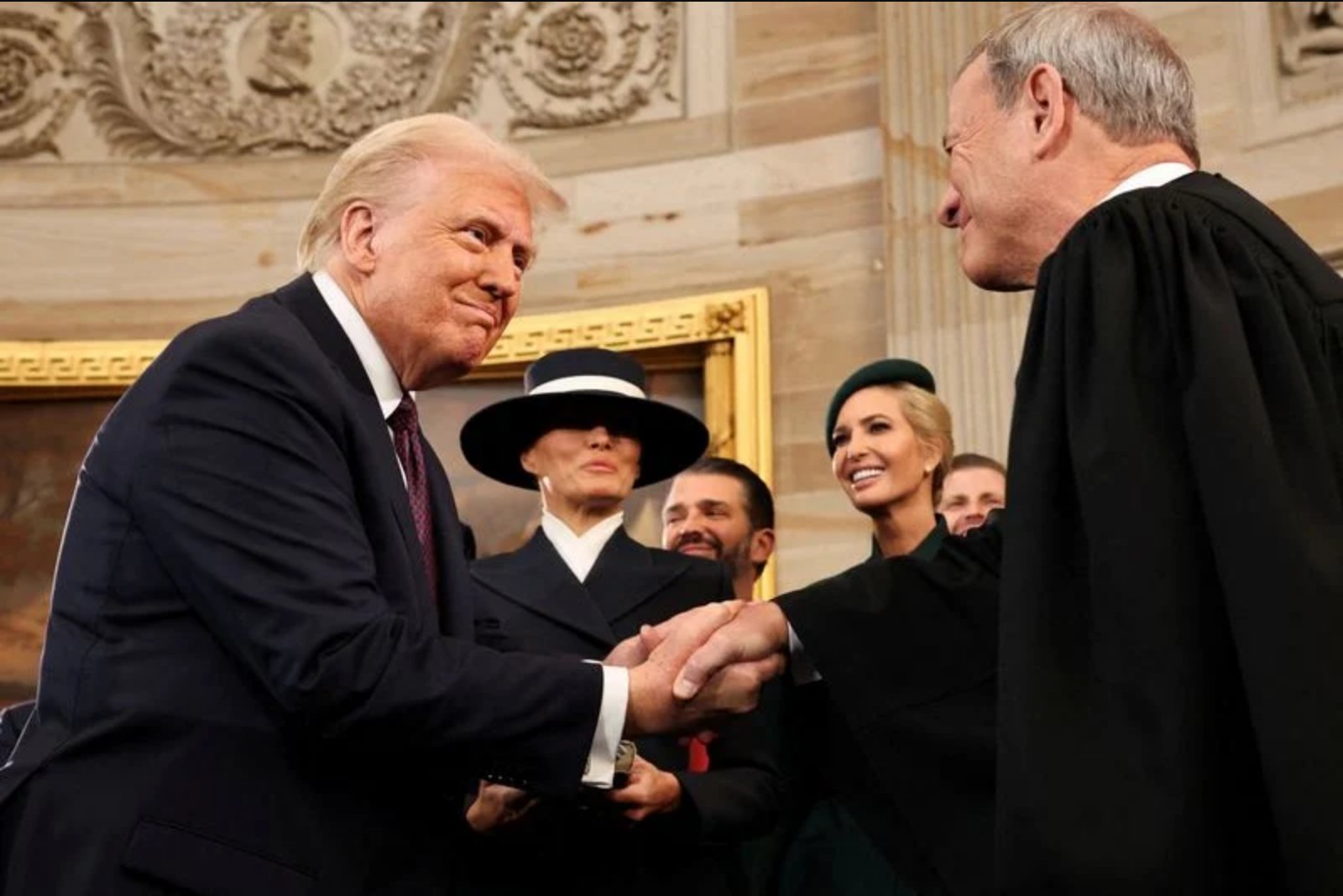
WASHINGTON, July 4 - U.S. Chief Justice John Roberts and President Donald Trump occupy contrasting public personae - Roberts a restrained Midwestern institutionalist, Trump an outspoken New York businessman - but the Supreme Court’s recently concluded term showed how the two can each prevail when their objectives coincide.
Over the court’s nine-month session, which ended on Tuesday, several consequential rulings favored the president, including a major decision authored by Roberts that broadened the president’s authority to remove heads of regulatory agencies. That opinion capped a long-running conservative effort to increase presidential control over the executive branch.
At the same time, the term underscored the limits of a simple narrative in which the court acts solely as an instrument of the president’s agenda. In three high-profile cases where Roberts’ jurisprudential instincts diverged from Trump’s goals - on tariffs, birthright citizenship and the president’s attempt to remove a Federal Reserve governor - Roberts wrote the opinions that rejected Trump’s positions. Each of those rulings constituted a significant setback for the president.
Where alignment brought benefits
When their interests overlapped, the results were unmistakable. The Roberts-authored decision in Trump v. Slaughter - a 6-3 ruling - overturned a 1935 precedent that had allowed Congress to shield leaders of independent regulatory agencies from at-will presidential removal. By doing so in a case arising from Trump’s ouster of Federal Trade Commission member Rebecca Slaughter, the court consolidated presidential authority over agency leadership.
The Slaughter ruling is widely seen as a victory for the unitary executive theory, a constitutional view that emphasizes broad presidential control over the executive branch. Some legal scholars quoted during the term characterized the decision as a culmination of John Roberts’ long-standing interest in reinforcing executive authority. Robert Luther III, a George Mason University law professor who worked in the White House Counsel’s Office during Trump’s first term, said Roberts’ most notable work has come when the boundaries of executive power have been tested by the president’s opponents.
Conservative trajectory and consequential rulings
The Roberts Court has shifted to the right in recent years, a change accelerated by Trump’s appointments of three justices during his first term: Neil Gorsuch in 2017, Brett Kavanaugh in 2018 and Amy Coney Barrett in 2020. That realignment has led to a string of decisions this decade that moved American law on issues from abortion and affirmative action to gun and religious rights, and the authority of federal regulatory agencies.
During the latest term, the court continued that pattern. In April, the court - in a 6-3 decision authored by Justice Samuel Alito - narrowed a central provision of the Voting Rights Act, making it more difficult for minority communities to challenge electoral maps as racially discriminatory under the 1965 statute. Syracuse University College of Law professor Jenny Breen described this decision as part of a decades-long project by Chief Justice Roberts to erode that portion of the law.
Additionally, in a Tuesday ruling the court struck down a federal campaign funding restriction on free speech grounds, invalidating limits on coordinated spending between political parties and their candidates. That decision was another advance for Republican priorities, and one that may benefit Republican efforts to maintain or expand political control as party committees head toward November midterm elections with a noted cash advantage over Democratic counterparts.
Where the court checked Trump
Even as the court handed Trump several wins, it also issued rulings that curtailed elements of his domestic economic agenda. In February, Roberts authored a 6-3 opinion that struck down the administration’s sweeping global tariffs, which had been justified under a law intended for use in national emergencies. The court concluded that approach exceeded the authority Congress had provided.
On another front, the court rebuffed a novel presidential effort to remove a member of the Federal Reserve Board of Governors. In a Monday opinion written by Roberts, the court declined to allow Trump to fire Fed Governor Lisa Cook, thereby protecting central bank independence.
Observers noted that those rulings reflected a judicial concern with protecting market stability and the broader economy from abrupt disruptions. Breen suggested the decisions were consistent with the court’s conservative economic orientation, which may favor predictability in economic governance.
Birthright citizenship ruling and longstanding precedent
In its final action of the term, the court, in another opinion authored by Roberts, ruled that an executive order seeking to deny birthright citizenship to the children of certain immigrants violated the language of the 14th Amendment that grants citizenship to persons born in the United States who are "subject to the jurisdiction thereof." That decision preserved the long-standing understanding of birthright citizenship, including precedent affirming that rule stretching back to the 19th century.
John Yoo, a professor at the University of California, Berkeley School of Law and a former Justice Department lawyer in the George W. Bush administration, said the trio of decisions in which Roberts opposed Trump should put to rest the idea that the court functions merely as "an arm of the Trump agenda." Yoo summarized the dynamic: "This term shows that Trump wins at the court only when his agenda coincides with Roberts' agenda."
Institutional themes and legal continuity
Several commentators and professors cited during the term framed Roberts’ jurisprudence as rooted in long-term institutional goals. Elizabeth Beske of American University Washington College of Law characterized the rise of the unitary executive doctrine in the court’s recent output as part of a decades-long Roberts project, adding that Roberts appeared to have pursued these ideas since his early career.
That mix of continuity and change helps explain why the court could both expand presidential power in certain dimensions while resisting other presidential initiatives. In matters where the court perceived risks to institutional stability - for instance, in preserving central bank independence or limiting sudden trade policy shifts - the conservative majority, led often by Roberts, sided against the administration’s preferred outcome.
Political implications heading into the midterms
The Voting Rights Act ruling and the campaign finance decision have direct political consequences heading into the November midterm elections. The Voting Rights Act ruling, by making it more difficult to challenge racially discriminatory maps, potentially paves the way for Republican-led state legislatures in the South to redraw districts that could dismantle Democratic-held majority-Black and majority-Latino districts. Given the tendency of Black and Latino voters to support Democratic candidates, that dynamic could affect the balance of power in Congress.
Similarly, the court’s rejection of limits on coordinated campaign spending removes one constraint on party spending strategies, reinforcing the existing cash advantage enjoyed by major Republican committees as they prepare for the midterms.
Conclusion
The Supreme Court’s most recent term revealed a complex alignment between the chief justice and the president. When Roberts’ institutional priorities and conservative legal principles converged with the president’s objectives, the court issued rulings that bolstered executive authority and Republican political interests. But where Roberts’ jurisprudence emphasized institutional stability or long-standing legal precedent, he authored opinions that checked the president, producing three significant losses for Trump on tariffs, the independence of the central bank, and birthright citizenship.
The term illustrated that outcomes at the court cannot be reduced to a simple partisan script. Instead, a blend of legal philosophy, institutional concern, and the particular contours of each case determined whether Roberts and Trump prevailed.