
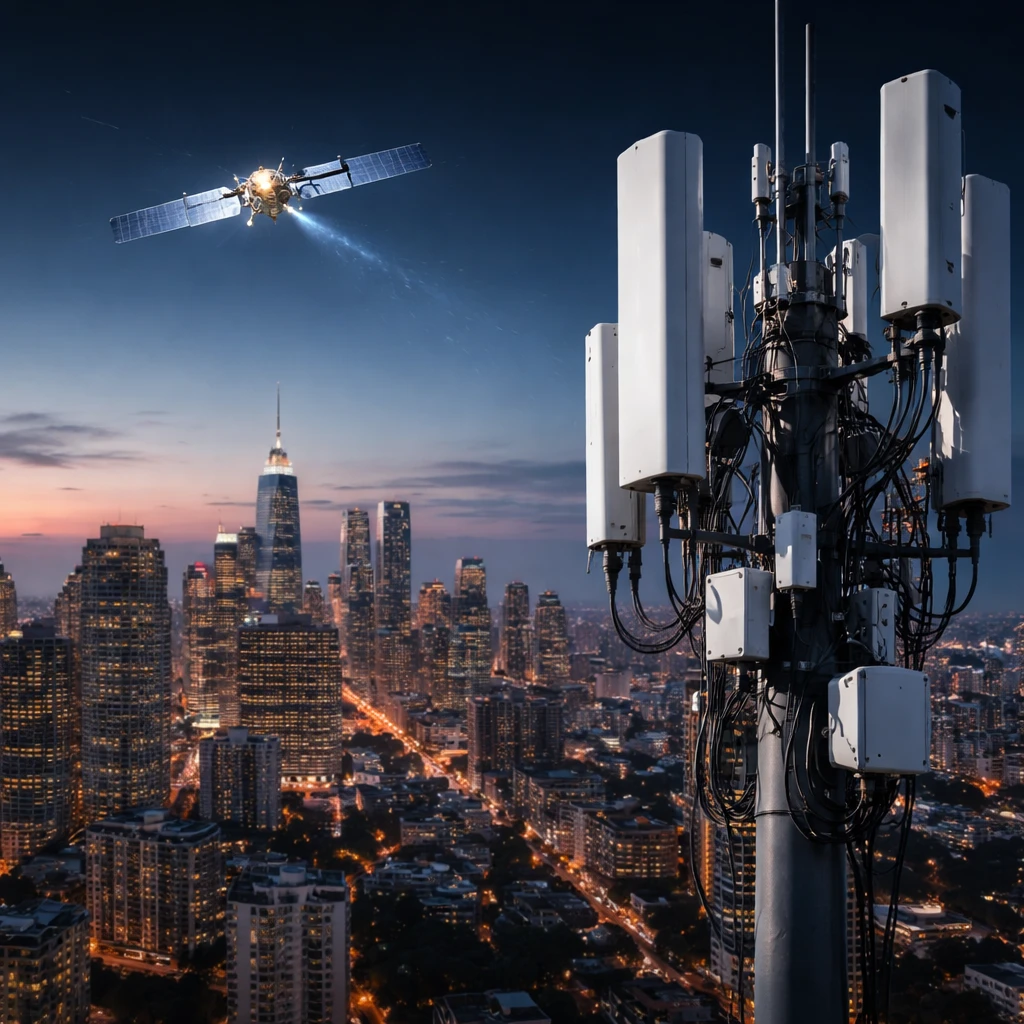
Bank of America on Monday upgraded T-Mobile U.S. to Buy from Neutral, saying the market has likely overreacted to fears that low-earth-orbit (LEO) satellite operators will materially disrupt wireless and broadband markets. The bank's analysis concludes T-Mobile has the smallest exposure to that threat among the large U.S. wireless providers.
Shares of the carrier climbed 1.8% in premarket trading by 07:46 ET. The stock has fallen roughly 15% year-to-date, mirroring weakness across the wider telecom sector.
BofA maintained a $220 price target on the shares. In a note accompanying the upgrade, analyst Michael Funk wrote that "bearishness has gripped the telecom market," and that T-Mobile is trading at near-trough valuations that, in BofA's view, already account for competitive pressures.
Funk identified two key drivers of the sector-wide selloff: concerns that LEO providers could meaningfully disrupt existing broadband and wireless offerings, and market speculation that cable giants Charter and Comcast could combine to create a stronger competitor.
The analyst also raised the possibility of a strategic response by incumbents, writing that a "prisoner's dilemma might drive AT&T, Verizon or T-Mobile to form a Mobile Virtual Network Operator (MVNO) with a LEO provider where self-interest wins over mutual benefit." He framed that scenario as a potential, rather than established fact.
BofA's note highlights T-Mobile's customer footprint as a structural factor in its assessment. The carrier holds roughly 50% of households in large urban markets such as Los Angeles and New York, compared with about 24% in rural areas. That pattern sits opposite the initial deployment profile for LEO direct-to-device services, which have concentrated in rural and underserved areas.
According to the analyst, LEO services "seem to work best in rural and underserved environments and face potential propagation and capacity limits in dense urban environments." Funk also underscored T-Mobile's strategic posture: a lack of a large-scale fiber strategy, a strong spectrum position and dense urban wireless coverage could make partnering with a LEO operator pragmatically attractive, even though company management has publicly denied interest in forming an MVNO.
BofA noted that T-Mobile carries the lowest-priced back book among U.S. wireless operators, which the bank says gives the carrier the most latitude to raise prices. That dynamic underpins BofA's forecast of 2.5%-3% postpaid average revenue per account (ARPA) growth.
This upgrade and the accompanying analysis provide a fresh lens on valuation and competitive risk within the telecom sector, with implications for investor positioning and relative earnings sensitivity across wireless and cable providers.