
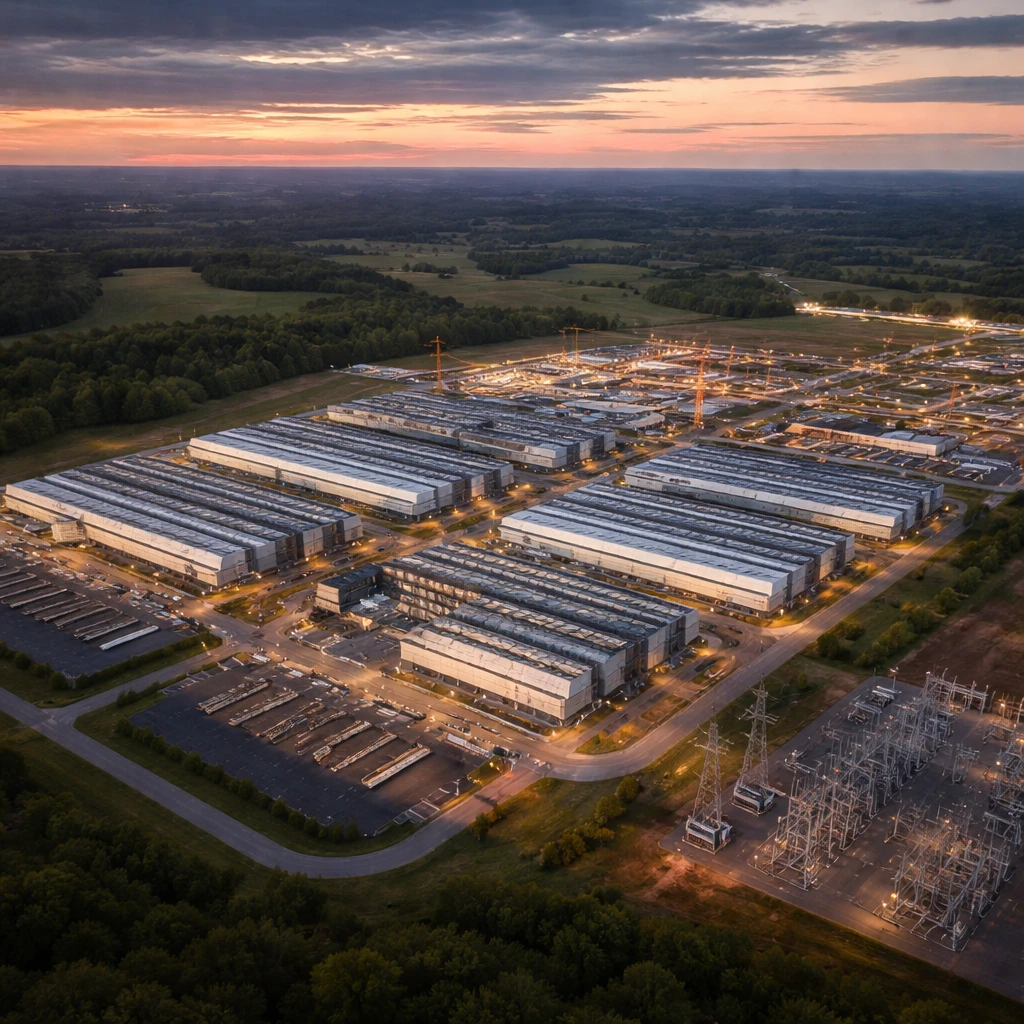
Terawulf shares spiked in early trading, rising 17.3% pre-open, following the company's announcement of two material corporate moves announced before the market opened. Management disclosed a long-term lease with Anthropic for its Justified Data AI campus in Kentucky and confirmed the concurrent sale of its majority position in the Abernathy Joint Venture to a buyer group led by Fluidstack.
The agreement with Anthropic is for a 20-year AI infrastructure lease covering the Kentucky campus. Terawulf said the arrangement is expected to generate approximately $19 billion in contracted revenue. The site in question is a 401 MW facility that Terawulf plans to bring online in phases, with commissioning scheduled to begin in the second half of 2027 and continue into early 2028.
At the same time, Terawulf will divest its 50.1% ownership in the 168 MW Abernathy Joint Venture to a Fluidstack-led consortium. The company indicated the sale will monetize roughly $450 million of capital invested in the joint venture, and that the transaction is being completed at a premium. Management framed the sale as a way to unlock capital for redeployment into fully owned AI infrastructure assets.
Investors and analysts homed in on two strategic elements of the announcements. First, landing Anthropic as a tenant adds a high-profile hyperscaler to Terawulf’s roster of contracted customers and significantly enlarges the company’s contracted revenue base. Second, monetizing the majority stake in the Abernathy JV crystallizes value at the asset level and supplies funds for projects that management expects will carry higher long-term margins because they will be wholly owned.
The company has been repositioning itself away from a pure bitcoin mining operator toward a business focused on nuclear-powered AI and high-performance computing (HPC) infrastructure. That strategic shift was plainly visible in the first quarter of 2026, when Terawulf reported $21 million in HPC revenue, surpassing $13 million in bitcoin mining revenue for the first time.
Market context amplified the company-specific reaction. Shares of Terawulf had declined sharply in the prior session and had fallen roughly 26% over a seven-session losing streak that began in late June. The pre-market rebound came even though broader index conditions were mixed: the Dow Jones was higher while the Nasdaq was modestly lower in pre-market trading, suggesting the move reflected corporate developments rather than a broad market upswing.
Analyst sentiment remains a supportive backdrop. Wall Street coverage carries an all-Buy consensus for the stock, and several firms have recently raised price targets, including Morgan Stanley, Bernstein, and Clear Street, according to the company’s statement. Those upgrades reflect growing conviction in Terawulf’s move toward contracted, recurring-revenue AI and HPC data center leasing.
Management highlighted that Terawulf holds over $17 billion in contracted revenue commitments, with additional capacity yet to be commercialized. The company’s challenge going forward will be converting those commitments into operating cash flow while managing an aggressive capital expenditure program needed to build and commission large-scale energy and data center projects.
By anchoring the Kentucky campus with Anthropic and recycling capital from the Abernathy sale into wholly owned projects, Terawulf has altered the near-term capital allocation picture. Investors appear to be re-evaluating the company’s risk-reward profile in real time, pricing in the revenue visibility provided by the new lease and the capital flexibility created by the asset sale.
That said, execution risks remain. Terawulf will need to deliver on construction timelines, ramp the Kentucky site on schedule from the second half of 2027 through early 2028, and successfully redeploy proceeds from the Abernathy transaction into higher-margin, fully owned infrastructure. The company must also continue to manage an intensive development program while converting contractual commitments into stable cash flow.
In sum, today’s pre-market surge was driven by company-specific news: a transformative tenant agreement with Anthropic, a capital-accretive sale of a joint-venture stake to a Fluidstack-led group, and the technical context of an oversold stock. Those elements combined to produce a marked recovery following a series of declines.