
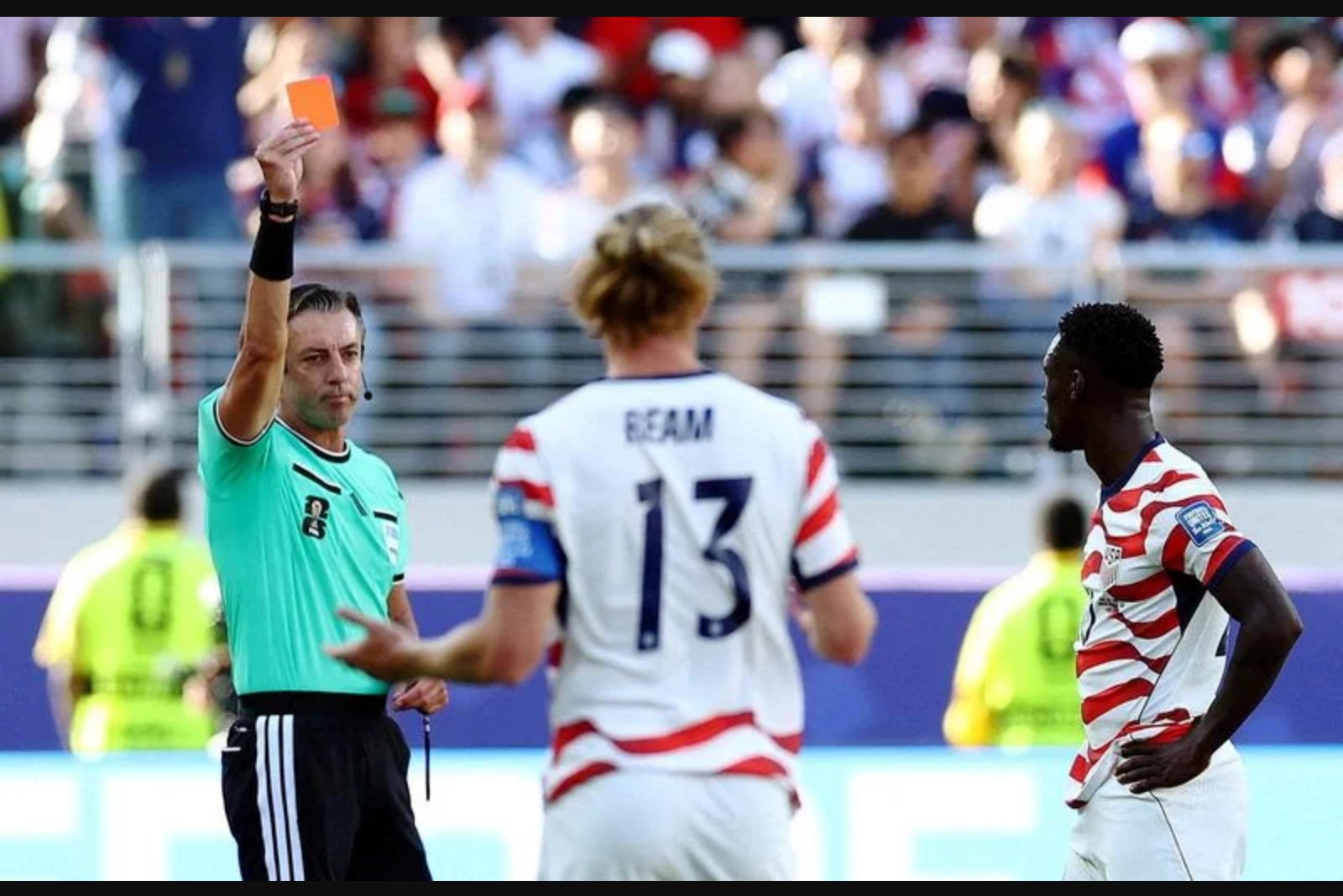
European football's governing body, UEFA, sharply criticised FIFA after the world governing body suspended the one-match ban for U.S. striker Folarin Balogun following an intervention by U.S. President Donald Trump. UEFA said the decision had "crossed a red line" and warned that the certainty of rules - and with it the integrity of the game - was now at risk.
FIFA's action, which allowed Balogun to be made available for selection despite the red card he received in the round of 32 match against Bosnia and Herzegovina, reverberated through the tournament. The move prompted an angry response from national associations and football figures, and shifted public debate away from on-field matters and towards the relationship between football authorities and political influence.
What FIFA did
Balogun was sent off after a VAR review for pulling his cleats down the back of defender Tarik Muharemovic's leg and onto his foot. Under the rules, the red card carried an automatic one-match ban, which would have ruled him out of the U.S. last-16 meeting with Belgium.
Following a personal request from President Trump to FIFA President Gianni Infantino, FIFA suspended the one-match ban. The governing body did not remove the red card itself; instead the ban was suspended for a one-year probationary period, leaving the card on Balogun's record while making him eligible to play.
UEFA response and wider criticism
UEFA issued a strong rebuke, saying it was in "disbelief at such an unprecedented, incomprehensible and unjustifiable decision," and that the action "crossed a red line." The statement warned that when the custodians of the rules no longer guarantee their certainty, the integrity of the sport and the credibility of competitions are undermined.
Prominent voices in the game echoed that concern. Former Liverpool manager Juergen Klopp described the situation as "madness" if the decision had effectively been arranged between Trump and Infantino, arguing the two men "who know nothing about football, should have absolutely nothing to do with this."
The head of the German football association raised similar alarms about the stakes for the competition's integrity and FIFA's credibility, while the European Commissioner for Sport cautioned against "the weaponisation of sport for political purposes," reflecting how the controversy migrated quickly into the political sphere.
Reactions from managers, associations and former officials
Within minutes of FIFA's decision on Sunday, the suspension of the ban dominated sports programmes and talk shows, provoking debate among pundits, commentators and ex-players over whether the governing body had corrected an injustice or undermined its own disciplinary framework.
England manager Thomas Tuchel said Balogun's challenge did not merit a red card but questioned the process by which the punishment was suspended. After seeing one of his own players sent off in England's last-16 win, Tuchel asked reporters: "Who overturns this decision then and when? And on what grounds? How far does this go now? This is strange for me. Where does this start and where does this end?"
The Royal Belgian Football Association said it was "astonished" by FIFA's declaration that Balogun was eligible for the match and said it was examining all potential options based on the rule book.
Even former FIFA president Sepp Blatter, who stepped down in 2015 amid corruption allegations, criticised the episode, asserting that "Red cards are not overturned by political phone calls. They are overturned by rules, evidence and independent bodies." He said that if a U.S. President intervened with the FIFA President and a player was cleared before a World Cup knockout match, the question of where FIFA is heading becomes unavoidable, adding that football must not become a playground for political power.
Public and political echoes
President Trump posted on his platform thanking FIFA for what he called "doing what was right, and reversing a great injustice." The White House also celebrated Balogun's reinstatement in the squad with a post on X reading: "USA-USA-USA."
The high-profile nature of the intervention ensured the incident became a major talking point for broadcasters and commentators during the tournament, with the focus shifting from on-field issues to concerns about governance and the influence of political actors on sporting decisions.
Related disciplinary decisions
In a separate, earlier decision that had also drawn scrutiny, FIFA suspended the final two matches of a three-game ban imposed on Portugal captain Cristiano Ronaldo after he had been sent off in a qualifying match against Ireland. That action meant Ronaldo was cleared to play Portugal's opening World Cup matches.
Standing questions
FIFA did not respond to requests for comment regarding the decision or President Trump's call with Infantino. As debate continued, the episode left national associations, managers and supporters wrestling with where disciplinary authority lies and how far external influence can extend into football's adjudication processes.
With the U.S. due to face Belgium for a place in the quarter-finals, the controversy guaranteed that the match build-up would be colored by broader concerns about governance, rule certainty and the role of political actors in the sport.