
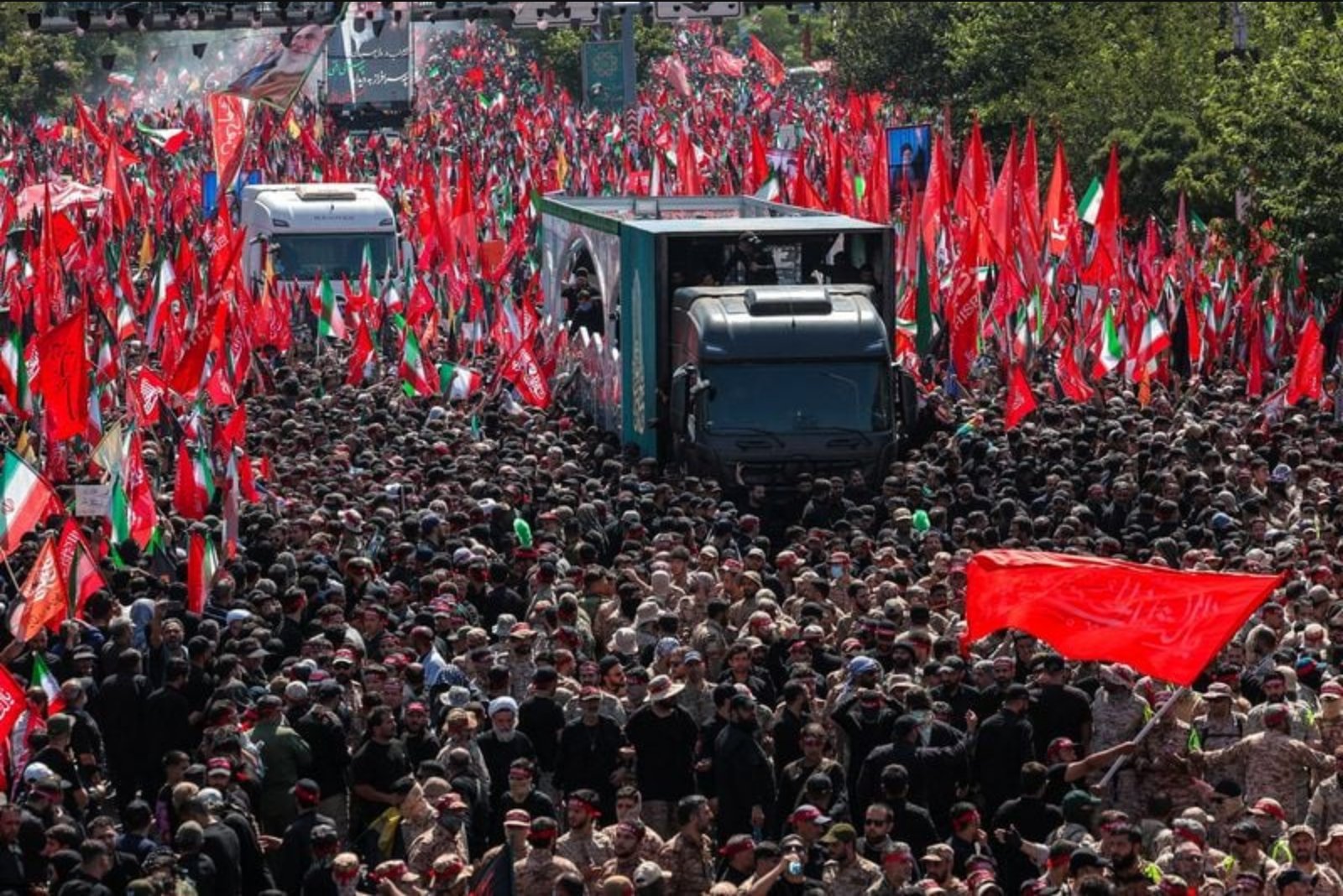
The funeral procession for the late Supreme Leader in Tehran was read by many inside and outside Iran as more than a ceremony of mourning. The dense crowds were interpreted as a demonstration that the Islamic Republic had not been fractured by the conflict that began with U.S. and Israeli strikes on February 28. Regional officials, diplomats and analysts say that display of unity and defiance is now a central element of Iran’s negotiating posture.
Rather than emerge weakened, Iran presented itself as cohesive and determined to consolidate gains from the recent hostilities. Sources tracking Tehran’s posture describe the funeral as a pivotal moment when endurance on the battlefield and in the streets was being converted into leverage at the negotiating table.
From nuclear focus to geographic leverage
Officials and analysts point to a clear pivot: the conflict has underscored Iran’s leverage over the Strait of Hormuz and allowed Tehran to insist that any diplomatic package on its nuclear programme must start with formal acceptance of its influence around the chokepoint. Washington envisaged a 60-day ceasefire as a window to revive diplomacy on preventing Iran from acquiring a nuclear arsenal. Instead, the pause has opened a different contest - one where Iran’s control of a strategic maritime route, rather than its uranium stockpiles, is its most potent bargaining chip.
That 60-day period that was supposed to begin a countdown toward a final deal has, according to analysts, yet to properly start. In the intervening vacuum, Iran is setting the tempo. Tehran’s calculation elevates control of Hormuz from a tactical wartime advantage to a strategic asset it seeks to institutionalise.
While fees levied on ships transiting the strait could generate substantial revenues, analysts say Tehran attaches greater value to the political recognition that comes with control. Alex Vatanka of the U.S.-based Middle East Institute framed the issue as largely symbolic: Tehran wants an explicit acknowledgement that the Strait is Iran’s, because that confers sovereign legitimacy over a vital artery for global energy shipments. Vatanka quoted a Persian saying to encapsulate Tehran’s stance: "Why give away a diamond for a lollipop?" - with Hormuz cast as the diamond and possible sanctions relief or released frozen assets as the lollipop.
Leadership rhetoric and negotiation tactics
Voices from Iran’s own leadership have reinforced that approach. Parliament Speaker Mohammad Bagher Qalibaf described the strait as "our greatest power tool" and called for its protection as a "divine blessing," saying Iran would "under no circumstances relinquish its rights" there.
Regional sources and diplomats say Tehran is intentionally slowing the pace of talks in order to secure the strategic advantages it believes the recent conflict has yielded before returning to the nuclear dossier. Tehran, which denies it is seeking a nuclear weapon, is prepared to defer nuclear negotiations while it focuses on cementing control of Hormuz, according to analysts.
Alan Eyre, a former U.S. diplomat with Iran expertise, said Iran is content to play for time and draw out diplomacy. "Iran is perfectly happy to play for time and just drag negotiations out," Eyre said. "It wants control of Hormuz and is holding talks to institutionalise that control." The mechanisms Iran aims to embed could include transit arrangements, coordination protocols or fees for services along the corridor that carries a fifth of global oil and liquefied natural gas supplies, analysts say.
Regional uncertainty and U.S. political constraints
Gulf states, the analysts add, are watching to see whether Washington can or will reverse what they perceive as a new reality around the strait. Tehran calculates that U.S. domestic politics have constrained President Donald Trump, and that the White House faces pressure to secure a deal rather than press a protracted confrontation - a dynamic Iran believes it can exploit.
Eyre argued Iran views U.S. politics as a tailwind for its approach: "The Iranians know that President Trump wants to get out; he wants to move on. They know they can squeeze him because time is on their side."
Aaron David Miller, a former U.S. negotiator on Middle East affairs, said Washington’s military campaign did not remove Iran’s leverage and left a ceasefire whose implementation has itself become contested terrain. Miller said Tehran has little incentive to seriously engage on the nuclear file until it is satisfied that the new status quo around Hormuz has been accepted and that meaningful progress has been made on releasing frozen assets abroad. "The 60-day clock was always a fantasy," Miller said. "The Iranians are not going to move to the nuclear file until they’re relatively confident they’ve achieved this new status quo. They want to make sure that Trump understands, and that the world understands, that there’s no going back to February 27."
Leverage entrenched, implications for energy and shipping
Analysts contend Iran is exploiting a central reality of the post-conflict environment: neither U.S. military action nor the prospect of a naval blockade fundamentally altered Tehran’s position on the Strait of Hormuz. "They’re not going to give it up," Miller said.
Ebtesam Al-Ketbi, president of the Emirates Policy Center, warned that by halting hostilities without resolving the underlying issues, Washington may have inadvertently elevated Hormuz from a pressure point to a lasting source of leverage for Tehran. Gulf officials share the concern that Tehran’s demonstrated ability to shape events around the strait has created a durable advantage it will be reluctant to trade away even in return for sanctions relief or progress on nuclear negotiations.
Al-Ketbi used pointed language about the effect on diplomacy: "They are twisting the arms of the Americans and everybody. Now that they have found this Hormuz treasure, they will not leave it."
Analysts assessing likely outcomes say Washington may ultimately have to accept the reopening of the strait under terms heavily influenced by Tehran. "No one’s going to win, but Iran will lose less than the United States will," Eyre said.
Outlook
The convergence of public displays of unity in Tehran, leadership rhetoric and a deliberate strategy to prioritise control of a strategic marine corridor has reshaped the bargaining landscape. For the energy, shipping and insurance sectors, the practical consequences hinge on whether Iran can successfully institutionalise its wartime gains through formal or informal arrangements governing transit in one of the world’s most important oil and gas arteries.
For now, the diplomatic countdown meant to shepherd the parties back to nuclear talks remains stalled. In the absence of movement on that timeline, Iran appears set on converting the momentum it says the conflict produced into a longer-term strategic foothold around the Strait of Hormuz.