
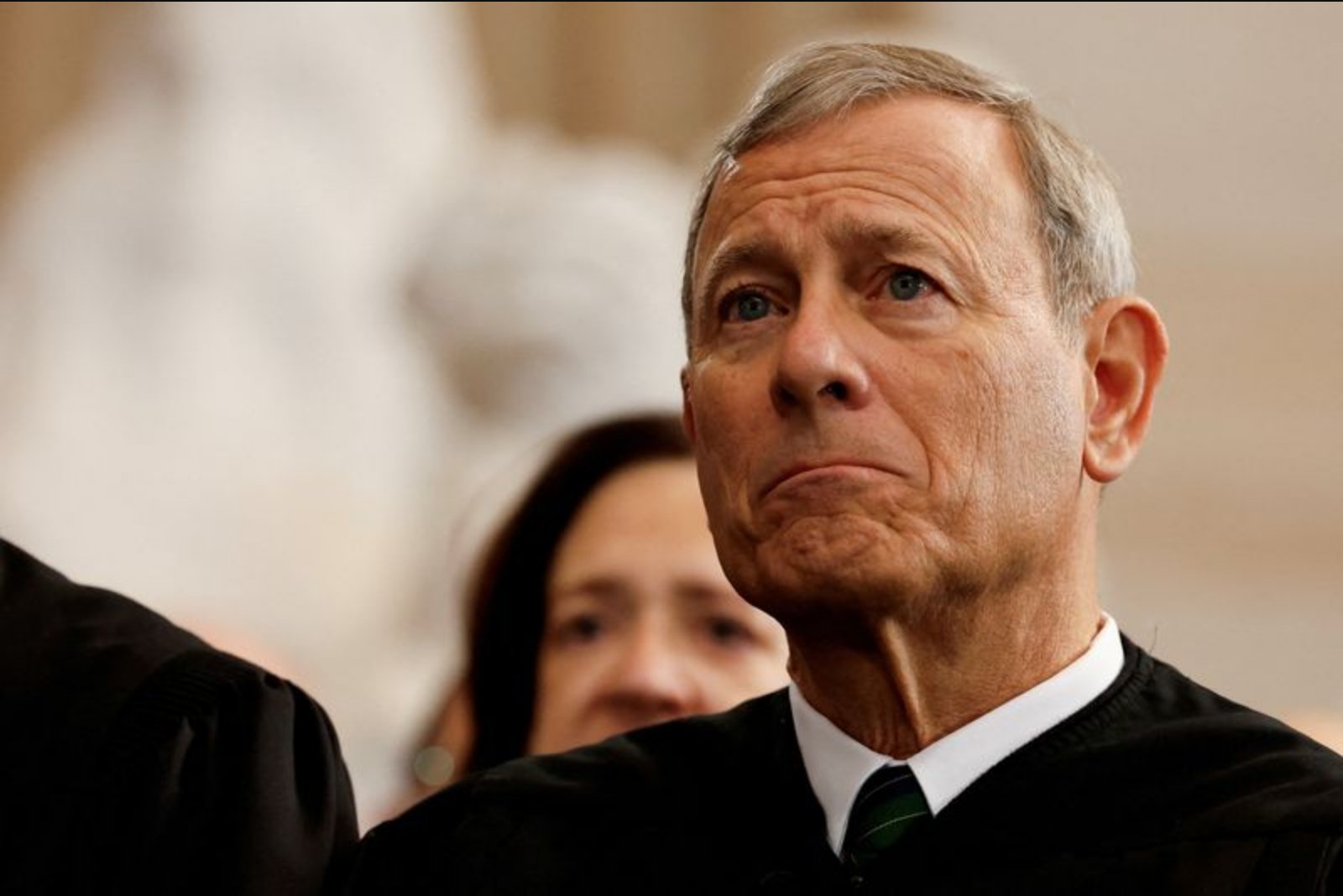
Summary: Chief Justice John Roberts said on Wednesday that many Americans view the Supreme Court as acting like a political institution rather than an impartial arbiter of law. Addressing an audience that included judges, lawyers and law students in Hershey, Pennsylvania, Roberts acknowledged declining public approval and cautioned that attacks targeted at individual justices can have damaging consequences for the court.
Chief Justice John Roberts, who has led the U.S. Supreme Court since 2005, directly addressed public skepticism about the court’s role and motivations. Roberts said critics often assume the justices are crafting policy, a perception he rejected. "At a very basic level people think we’re making policy decisions," he told the assembled audience. "I think they view us as purely political actors, which I don’t think is an accurate understanding of what we do."
Roberts, appointed by Republican former President George W. Bush, is regarded as a conservative jurist who is also attentive to the institution’s standing with the public. His comments came at a time when the court’s 6-3 conservative majority - a configuration set in 2020 after President Donald Trump made a third appointment to the bench - has issued a string of consequential rulings that have shifted American law on several fronts.
The court’s recent conservative rulings have moved on a range of issues: curbing abortion rights, restricting race-conscious affirmative action policies, expanding gun and religious rights, limiting some transgender protections, and narrowing the scope of federal regulatory authority. In yet another headline decision last week, the conservative majority weakened a central provision of the Voting Rights Act, making it more difficult under that statute for minorities to challenge racially discriminatory electoral maps. That ruling was a victory for Louisiana Republicans and the Trump administration.
Roberts’ own opinions have also drawn attention. In a 2024 opinion he authored, the court granted former President Trump broad immunity from criminal prosecution over efforts to overturn the 2020 election, a decision that effectively delayed a trial that ultimately did not occur and that has implications for Mr. Trump’s bid to return to the presidency. Since Mr. Trump’s return to the White House last year, the court has repeatedly issued emergency orders allowing aspects of his expansive executive actions to take effect while legal challenges proceed. In one decision authored by Roberts in February, the court struck down the former president’s global tariffs - a ruling that represented a setback for Trump.
On stage in Hershey, Roberts was asked directly how the Supreme Court is commonly misunderstood. He said that justices are "not simply part of the political process ... I’m not sure the people grasp that as much as is appropriate." His comments stressed the separation he sees between judicial decision-making and political maneuvering.
Liberal concern and broader commentary
Justice Elena Kagan, one of the court’s three liberal members, warned in 2022 that the court’s legitimacy could be jeopardized if the public comes to view the justices as imposing personal preferences rather than applying the law. Kagan said a court is legitimate "when it’s acting like a court," adhering to precedents and refraining from asserting authority to make political or policy decisions. "When courts become extensions of the political process, when people see them as extensions of the political process, once people see them as trying just to impose personal preferences on a society, irrespective of the law, that’s when there’s a problem," she said.
Kagan’s remarks were made in the wake of major rulings on abortion and gun rights, though she did not mention specific cases in that commentary. Some Democratic lawmakers and legal scholars have expressed related concerns. In 2024, Senator Edward Markey criticized what he called the "illegitimate, extremist U.S. Supreme Court majority," a remark directed at the court’s conservative wing.
Roberts on personal attacks and institutional risk
Roberts returned to the theme of personal attacks on judges during his Hershey appearance. He drew a line between legitimate criticism of judicial reasoning and attacks aimed at the individuals who serve on the bench. "As soon as that happens, that’s not appropriate and it can lead to very serious problems," Roberts said.
He did not name former President Trump, who has repeatedly launched public assaults on the judiciary following decisions that impeded parts of his agenda. But Roberts has previously spoken more forcefully about personal attacks. "The problem sometimes is that the criticism can move from a focus on legal analysis to personalities, and you see ... that it’s more directed in a personal way," Roberts said last month, adding: "And that, frankly, can be quite dangerous." He concluded bluntly: "It’s got to stop."
The Supreme Court has been repeatedly called on to resolve several contentious cases tied to President Trump’s actions and assertions of presidential power. The court is expected to issue rulings by the end of next month in additional major matters involving Mr. Trump, including disputes over his reported efforts to remove Federal Reserve Governor Lisa Cook and challenges concerning restrictions on birthright citizenship.
After the tariffs decision, Mr. Trump criticized Roberts and five other justices who ruled against him and alleged, without evidence, that the court had been influenced by foreign interests. He also publicly chided two conservative justices he had appointed during his first term, Neil Gorsuch and Amy Coney Barrett, calling that decision "an embarrassment to their families."
Institutional stakes
Roberts’ public appeal underscores his broader concern with maintaining the court’s institutional credibility. His remarks at the Hershey event reflect a recognition that perception matters: if a significant portion of the public sees the court primarily as a political actor, the institution’s ability to function as an independent arbiter of legal disputes could be undermined.
Those questions about public confidence in the judiciary arise amid a flurry of consequential decisions and ongoing, high-profile litigation that will continue to place the Supreme Court at the center of national debates.
Reporting note: The remarks referenced above were delivered in Hershey, Pennsylvania, on May 6.