
Overview
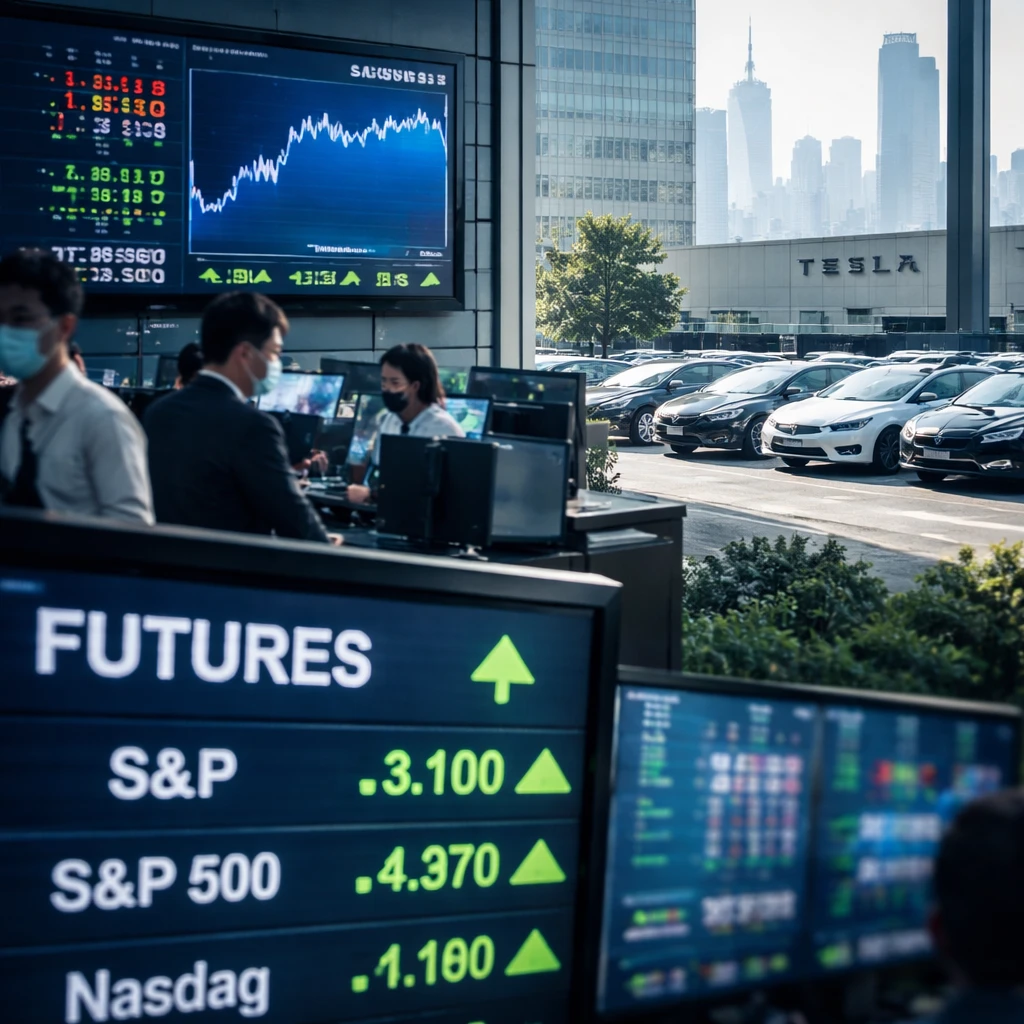
U.S. stock markets will be closed on Friday in observance of the Independence Day holiday, yet equity futures tied to the main Wall Street benchmarks were trading higher as investors digested a softer U.S. employment report and comments from policymakers that have eased the near-term outlook for interest rates. Asian equities staged a rebound after a difficult patch earlier in the week, while China’s services sector surprised to the upside in June and suppliers to Tesla in China saw sharp share gains following the automaker’s robust delivery tally for the quarter.
1. U.S. futures move higher as rate-timing worries abate
Futures on the major U.S. stock indices rose after a Labor Department report showed weaker-than-expected job gains for June, a development that reduced investor concern that the Federal Reserve would need to raise rates imminently. By 03:11 ET (07:11 GMT), the Dow futures contract had added 148 points, or 0.3%; S&P 500 futures were up 30 points, or 0.4%; and Nasdaq 100 futures had advanced 278 points, or 0.9%.
In regular trading earlier in the holiday-shortened week, the main Wall Street averages finished mixed. Benchmark 10-year U.S. Treasury yields were essentially unchanged while two-year yields edged lower.
The employment report showed that U.S. payroll additions in June were softer than anticipated, even as the unemployment rate dipped to 4.2%, a one-year low. That mix - fewer jobs added but a lower unemployment rate - combined with remarks from Federal Reserve Chair Kevin Warsh earlier in the week that inflation risks have abated to reduce the immediacy of a policy response.
Market-implied odds of a July rate hike fell notably over the week. Analysts at Deutsche Bank pointed out that pricing for a July increase had declined from 34% on Tuesday to just 18% by the close of U.S. trading on Thursday. They added: "Moreover, just 30 [basis points] of hikes are now priced in by the December meeting, the fewest since the Fed meeting a couple of weeks ago when the dot plot surprised in a hawkish direction." Those shifts in expectations factored into the rally in risk assets as investors recalibrated near-term rate risk.
2. Asian equities rebound on dovish tilt, tech bargain hunting
Markets across Asia registered gains as the softer U.S. data and a perceived dovish pivot in Fed expectations encouraged risk-on positioning. Technology stocks, and semiconductors in particular, attracted buying after earlier profit-taking tied to concerns over the sustainability of heavy artificial intelligence infrastructure spending.
Samsung Electronics was among the more notable movers, with its shares jumping on reports that Anthropic - parent of Claude Code - is considering plans to develop its own AI chip in partnership with the semiconductor firm. The improved tone lifted South Korea’s KOSPI, which had been nursing losses over the prior two sessions. Japan’s Nikkei 225 and Singapore’s STI also advanced during the session.
3. Tesla’s China-linked suppliers rally on strong deliveries
Shares of several Chinese suppliers to Tesla rose significantly after the electric vehicle maker posted strong second-quarter delivery numbers, reinforcing hopes of a recovery following two years of declining sales. In Mainland China trade, parts manufacturers Ningbo Xusheng, Ningbo Tuopu, and Zhejiang Sanhua advanced between 5% and 9%.
Tesla delivered a record 480,126 vehicles in the June quarter, supported by robust sales in Europe and marginal growth in China. The company’s introduction of a range of lower-cost variants of its Model 3 and Model Y helped support demand against the backdrop of rising global fuel prices. A refreshed Model Y also contributed to higher volumes of China-made vehicles, underscoring China’s continued importance as a production and sales hub for the automaker.
4. China’s services sector expands faster than expected in June
A private survey showed China’s services sector grew at a stronger pace in June than economists had projected. The RatingDog services purchasing managers index slipped to 54.1 from 54.4 in May but outperformed expectations of 53.0. Readings above 50 signal expansion, and the services index has remained in growth territory since January 2023.
The survey indicated that new business rose, with both domestic and international orders increasing. Services exports grew at their fastest rate since October 2024. Meanwhile, higher input costs associated with supply disruptions linked to the Middle East prompted companies to raise their selling prices for the first time in four months.
5. Uncertainty over Strait of Hormuz transit fees persists
Some European leaders have accepted the prospect that ships may be required to pay fees to Iran and Oman to transit the Strait of Hormuz, according to reporting that cited people familiar with the matter. The same reporting noted that some Gulf Arab officials share the view that some type of service fee will be imposed to use the waterway, though such a position has not been formalized by their governments.
It remains unclear what form or level of fees would be acceptable to affected countries, and commentators have raised concerns over the implications for international maritime law. The strait, which lies partially off Iran’s southern coast, became a geopolitical flashpoint after Tehran effectively closed the conduit following a joint U.S.-Israeli assault in late February. That closure sent oil prices sharply higher, though they have since eased back to roughly pre-crisis levels following an interim peace agreement between the U.S. and Iran.
Market implications
The combination of softer employment data and dovish signals from policymakers shifted market pricing for rate moves, lifting equities and supporting risk assets in Asia. Technology and semiconductor stocks led the rebound, while autos and parts suppliers with direct exposure to Tesla’s recovery saw notable gains. In China, services-sector strength and the re-acceleration of services exports were positive for domestic demand-sensitive sectors, though higher input costs are feeding through to prices. Geopolitical uncertainty in the Strait of Hormuz remains a watch item for energy and shipping-related markets.