
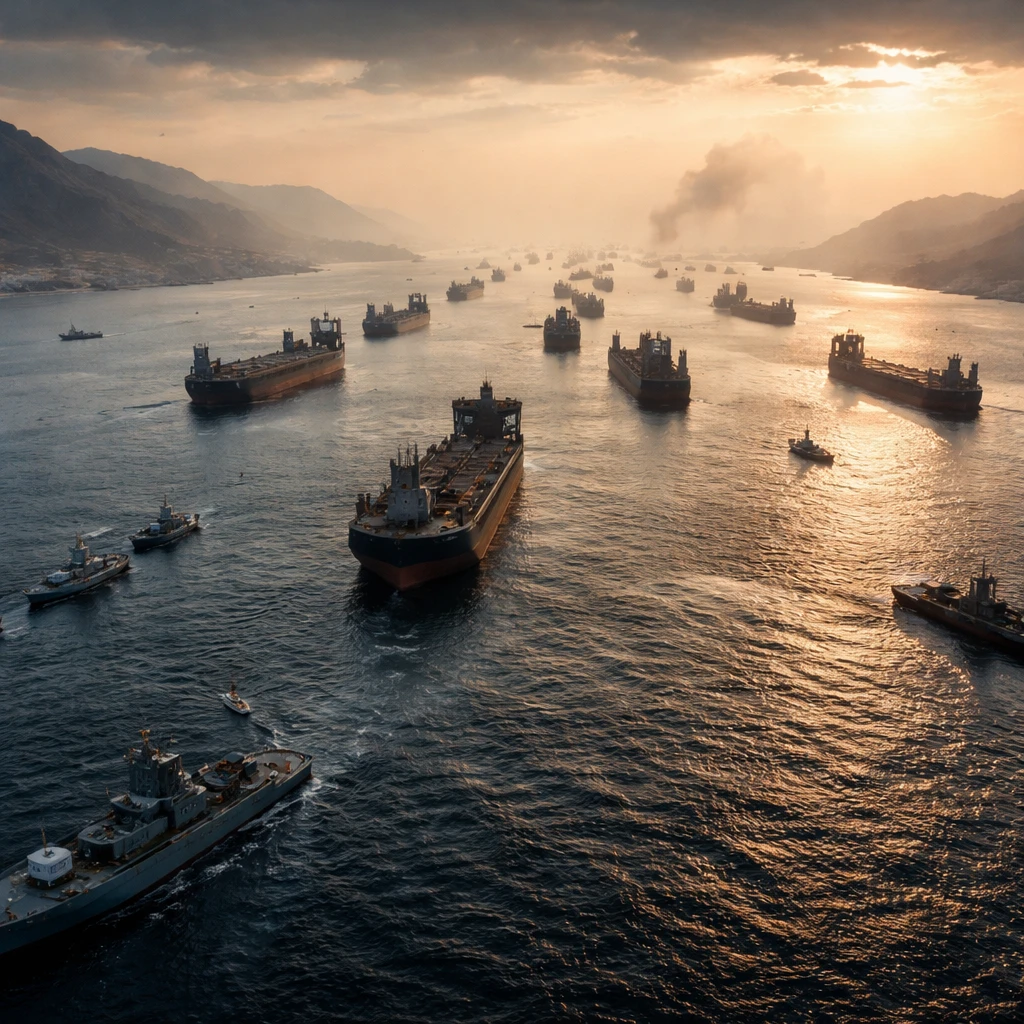
Iran's Strait of Hormuz will stay shut until Washington carries out the demands specified in an interim framework ceasefire, Mohammad Bagher Ghalibaf, Iran's parliament speaker and lead negotiator, said in a public statement. Ghalibaf outlined a set of requirements that the United States must meet before the strategically vital waterway is allowed to reopen.
Ghalibaf said the U.S. must end what he described as a naval blockade of Iranian ports, unfreeze Iranian assets, lift oil-related sanctions and stop "military operations on all fronts." He said these and other conditions must be implemented for the strait to be reopened, adding that "the strait will not be opened" until they are met.
The comments arrive after an interim agreement, the Memorandum of Understanding (MoU) signed in June, expired on Monday. The expiry has left the future course of the conflict and the status of the Strait of Hormuz uncertain, with recent weeks marked by alternating escalation and de-escalation attempts that have yet to produce a stable accord.
Iran has reportedly signaled a move to a "fully offensive" stance in the ongoing war, a conflict that the source material describes as having begun with an initial joint assault by U.S. and Israeli forces in late February. In addition, a senior Iranian official warned that entities within Iran must be ready to escalate tensions in the Strait of Hormuz and the wider region, saying: "Iranian entities must be prepared to escalate tensions in the Strait of Hormuz and wider region, as Iran will be ready to make decisions and take action on difficult decisions[.]"
Earlier statements from U.S. President Donald Trump indicated that Washington would not seek to extend the Memorandum of Understanding. The president also suggested the existence of a back channel to officials from Iran's Islamic Revolutionary Guard Corps, a claim that Iran later denied. The president additionally threatened to bomb Oman, which has been trying to broker its own arrangement with Iran aimed at reopening the Strait of Hormuz. Both Iran and Oman share coastlines on the waterway.
Markets reacted quickly to the heightened uncertainty. Brent crude futures, the global benchmark for oil, climbed above $90 a barrel, reviving concerns about the potential for energy-driven inflation and the prospect of tighter central bank policy. At the same time, yields on U.S. government bonds edged upward.
Analysts noted that the sizable gap between the parties' positions reduced the likelihood that the strait would reopen in the near term. In their assessment, the persistence of opposing demands had made investors pessimistic about a prompt resolution.
Shipping activity in the Strait of Hormuz has sharply slowed as tankers and commercial vessels adopt caution in the face of possible attacks. The United Kingdom Maritime Trade Operations agency reported that a vessel on an outbound transit of the strait was struck by an unknown projectile, damaging the ship's engine room and causing at least one crew casualty.
The combination of diplomatic stalemate, threats of military action, and concrete incidents at sea has contributed to elevated risk perceptions across energy, shipping and financial markets. For now, the strait remains closed pending implementation of the conditions Iran has set forth, and the outlook is clouded by both stated intentions to escalate and unresolved diplomatic claims surrounding back-channel communications.
Summary
Mohammad Bagher Ghalibaf stated that Iran will keep the Strait of Hormuz closed until the United States fulfills a set of conditions tied to an interim Memorandum of Understanding that expired on Monday. Key demands include lifting a naval blockade, unfreezing assets, removing oil sanctions and halting military actions on all fronts. The expiry of the MoU, coupled with Iran's reported shift toward a "fully offensive" posture and recent maritime incidents, has driven Brent crude above $90 a barrel and pushed U.S. government yields higher.
Key points
- Ghalibaf says the Strait of Hormuz will remain closed until the U.S. implements conditions from the expired Memorandum of Understanding, including lifting a naval blockade and removing oil sanctions - sectors affected: energy, shipping, international trade.
- Iran has signaled a move to a "fully offensive" posture in the conflict that began with joint U.S.-Israeli action in late February; a senior Iranian official warned of preparedness to escalate tensions in the strait and region - sectors affected: defense, regional security, insurance for maritime transit.
- Markets reacted to the standoff: Brent crude rose above $90 a barrel and U.S. government bond yields ticked higher as shipping traffic stalled and at least one vessel suffered damage and a crew casualty - sectors affected: commodities, fixed income, maritime transport.
Risks and uncertainties
- Diplomatic impasse - With both parties portrayed as far apart on terms, there is uncertainty over when, or if, the Strait of Hormuz will be reopened, posing continued disruption risk to oil flows and shipping routes (energy and shipping sectors).
- Military escalation - Iran's reported intent to adopt a "fully offensive" posture and statements about readiness to escalate raise the risk of further attacks on vessels or platforms in the region (security, insurance, logistics sectors).
- Market volatility - Elevated oil prices and rising bond yields reflect market sensitivity to geopolitical developments, introducing uncertainty for inflation expectations and central bank responses (financial markets, monetary policy).