
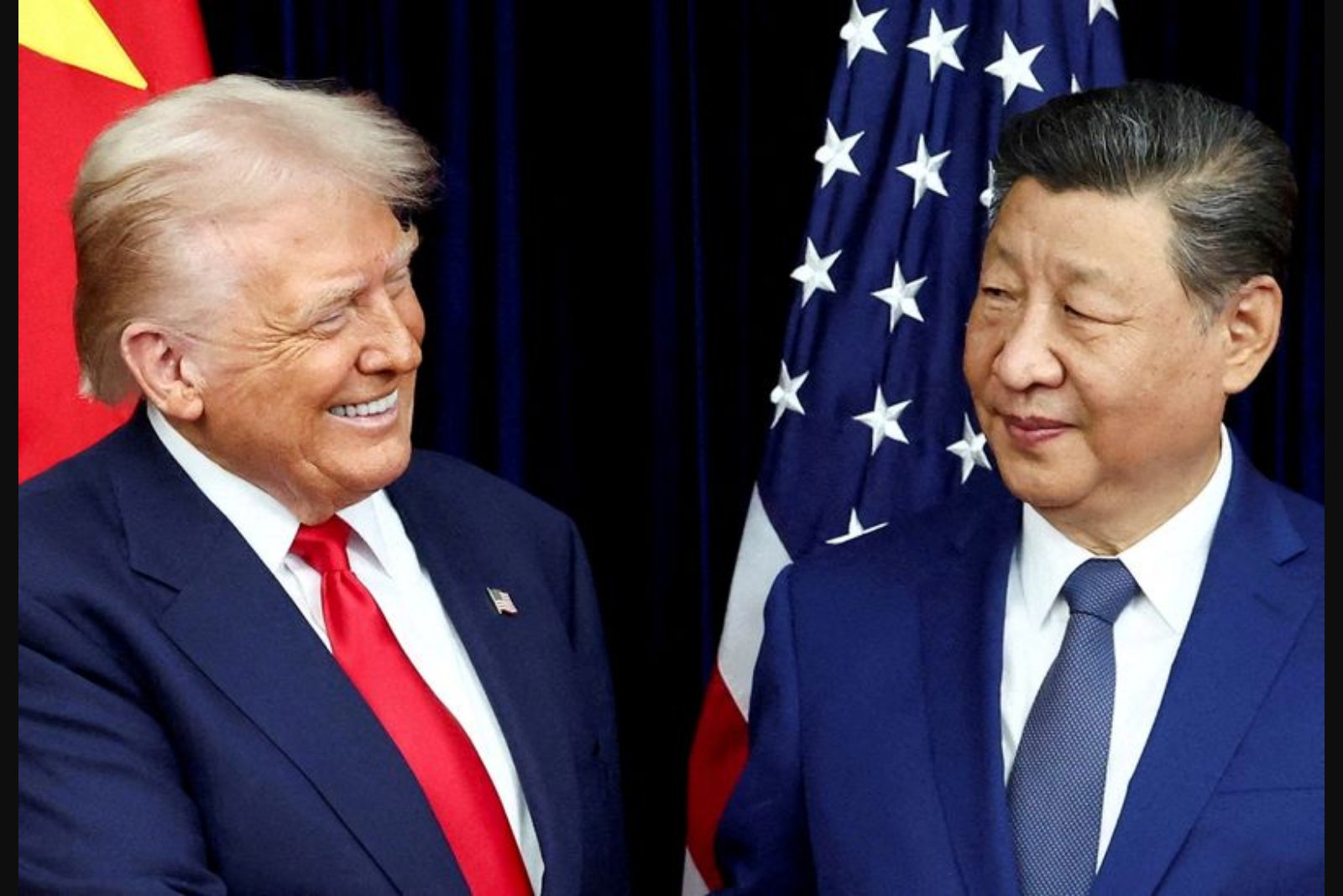
President Donald Trump’s planned trip to Beijing this month has left many Chinese exporters largely unmoved, according to company executives and supply-chain specialists speaking in Shanghai and Beijing. For several manufacturers that still ship substantial volumes to the United States, the diplomatic visit does not alter daily business decisions.
A salesperson at a Chinese firm that produces electric lockers and vending machines said the visit was "none of her business," even though a large share of the company’s output is bound for U.S. buyers. She explained her company copes with higher costs by passing some of them to U.S. consumers and by relying on the strength of domestic supply chains and product quality. "As long as the United States continues to trade, it will have to do business with us," she said.
The firm’s experience illustrates how many exporters calibrated through a volatile 2025 in which U.S. levies briefly rose into the triple digits. Despite that spike, the company’s U.S. client list remained largely intact, and it has been able to grow sales in other parts of the world. Executives and observers describe this pattern as evidence of Chinese manufacturing’s competitiveness and resilience, bolstered by a long-standing national push toward self-sufficiency and near-complete domestic supply chains across multiple industries.
One executive commented on the upcoming visit, saying it "does not pose a major threat to us," whether Trump intends to negotiate or to escalate tensions. The company’s strategy to ride out U.S. tariffs and rising raw material prices - which executives link partly to the Iran war - includes expanding into additional markets beyond the United States.
Market diversification as a strategic response
Executives are actively broadening their customer base across Europe, South America, Southeast Asia and Africa. This approach mirrors Beijing’s own commercial playbook. China closed out 2025 with a record trade surplus of $1.2 trillion, and firms say they were able to push into new markets by offering prices below those of incumbent suppliers.
While exports to the United States fell by 20% last year, shipments rose 25.8% to Africa, 7.4% to Latin America, 13.4% to Southeast Asia and 8.4% to the European Union. These shifts underline how exporters sought alternative demand sources as U.S. trade relations tightened.
Beijing’s leverage and export controls
To encourage a rollback of U.S. tariffs, Chinese authorities have leaned on global reliance on their supply chains and imposed export restrictions on rare earths. These elements, essential for certain semiconductor and defence-related applications, are produced almost exclusively in China and have become a focal point in trade leverage. Supply-chain consultants point to rare earth controls as a particularly powerful instrument in Beijing’s toolkit.
Cameron Johnson, a senior partner at supply-chain consultancy Tidalwave Solutions, described the rare earths move as "the ultimate trump card." He also noted that Beijing could restrict shipments of other critical goods such as pharmaceuticals, industrial machinery or transformers used to expand power grids in countries including the United States. In the shorter term, Johnson said the Iran war gives Washington some leverage because the United States currently has excess energy that China and other buyers need, but he added that China's broad industrial capabilities may give Beijing an advantage if the conflict escalates. "That’s why they’re playing nice," he observed, referring to U.S. actions.
Relocation pressure eases
As tariffs have withdrawn from the forefront of bilateral tensions, Chinese-based manufacturers report reduced urgency to move production abroad. Jonathan Chitayat, Asia head at contract manufacturer Genimex Group, said his company discovered alternative suppliers in Vietnam and Thailand during Trump’s first term, and more recently in India and Indonesia. Nevertheless, he noted that 75% of his network of 500 suppliers remains in China. Many suppliers dropped plans to relocate after the United States scaled back levies on China while duties increased elsewhere. "We’ve all learned not to take drastic action," he said. "Everyone who waited feels pretty good about waiting now."
For U.S.-focused manufacturers, the pattern looks similar. Mike Sagan, vice-president of sourcing at Pride Mobility Products, said his firm’s supply chain of about 100 companies remains 70% to 80% reliant on China. "De-risking and diversification aren’t going to go away, but it doesn’t have to be as rushed," Sagan said. "The panic has worn off and people have grown a little tougher skin when it comes to Trump making statements."
Business sentiment and the limits of a truce
Several business leaders described a new stoicism toward U.S. policy swings. Ren Yanlin, an executive at a Chinese company handling overseas factory projects, said firms had become "numb" to dramatic rhetoric and now assume that presidential pronouncements will not materially alter their business plans. "The mindset is that it doesn’t matter anymore," he said.
The American Chamber of Commerce in Shanghai, which represents nearly 3,000 members in the commercial hub, also signalled modest expectations for tangible outcomes from the visit. Eric Zheng, the association’s president, said members would welcome an extended truce on tariffs and export curbs, possibly accompanied by Chinese purchase commitments in areas such as Boeing aircraft, soybeans or U.S. energy. However, he warned that an agreement of this type would likely be temporary without more durable assurances. "A truce is great, better than a trade war, but a truce is temporary," Zheng said. "We need some certainty. Companies need to plan for the long term, not the next 90 days, not even six months. It has to be several years."
Overall, exporters and supply-chain experts interviewed in Shanghai and Beijing suggest that despite episodic tariff shocks, Chinese manufacturing has adapted through market diversification, deeper domestic sourcing and strategic leverage over critical inputs. These adjustments have blunted immediate disruption from U.S. policy swings, even as firms continue to monitor diplomatic developments closely.