
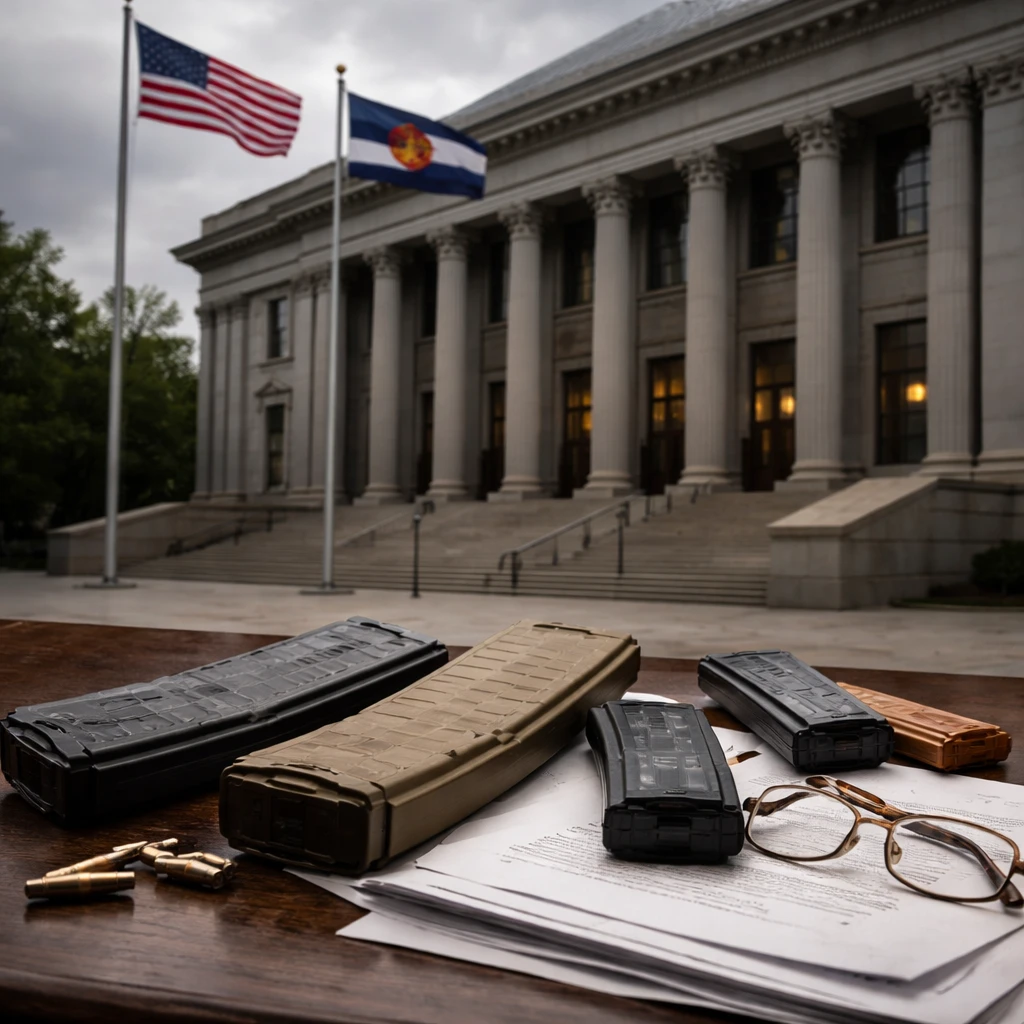
The U.S. Department of Justice sued the state of Colorado on Wednesday aiming to overturn a law enacted in 2013 that bans ammunition magazines capable of holding more than 15 rounds.
The complaint asserts that Colorado’s restriction on large-capacity magazines - adopted after a mass shooting at an Aurora movie theater that killed 12 people and wounded 58 others - infringes on rights protected by the Second Amendment to the U.S. Constitution.
The lawsuit, filed by the DOJ’s civil rights division, cites the U.S. Supreme Court’s 2008 ruling in District of Columbia v. Heller, saying that the Second Amendment safeguards the rights of law-abiding citizens to possess firearms commonly used for lawful purposes. The DOJ’s court filing is 11 pages long and centers on the prevalence of magazines holding more than 15 rounds with many of the nation’s most popular firearms.
Among the assertions in the complaint is the contention that such magazines "come standard with many of the most popular firearms in the U.S., including AR-15-style rifles and some semi-automatic pistols." The filing adds: "The number of lawfully owned semi-automatic firearms in the United States that utilize a magazine like the ones banned by the state is in the tens of millions."
The DOJ argues that by outlawing these large-capacity magazines, Colorado is effectively restricting individuals’ access to weapons that are "in common use." The complaint also states these weapons are "used for multiple lawful purposes," including recreational target shooting, collecting and self-defense.
The remedy sought by the lawsuit is a court order preventing enforcement of Colorado’s statute banning the magazines.
Colorado’s attorney general, Phil Weiser, responded to the filing by saying the state will defend its gun-safety measures. In a statement he accused the lawsuit of subverting the mission of the DOJ division that initiated it, saying it "turns the mission of the DOJ’s civil rights division on its head."
"Large-capacity magazine laws are responsible policies that satisfy Second Amendment protections, decrease impacts of mass shootings and save lives," Weiser said. "The state has a duty to protect Colorado residents from gun violence."
The DOJ action in Colorado follows closely on another challenge the department filed a day earlier, in which it contested a long-standing Denver ordinance that bans semi-automatic rifles the city defines as assault weapons.
The complaint comes after a prior legal challenge to Colorado’s 2013 measures. In 2016, a three-judge panel of the 10th U.S. Circuit Court of Appeals dismissed a case brought by county sheriffs, gun shops, outfitters and shooting ranges that had challenged both the large-capacity magazine ban and a separate measure requiring universal background checks for gun buyers. The appeals court found those plaintiffs lacked legal standing, concluding they had not shown they would be personally harmed by the laws.
With the new lawsuit, the Justice Department is directly contesting the constitutionality of the magazine restriction under the framework set by Heller. The outcome will hinge on how the courts reconcile the DOJ’s interpretation of what constitutes arms "in common use" and the state’s interest in measures intended to limit harm from mass shootings.
As the litigation proceeds, Colorado officials have signaled they will continue to defend the statute as part of the state’s effort to prevent and reduce gun violence. The DOJ and Colorado are now on a collision course in federal court over the legal boundaries of firearm regulation under the Second Amendment.