
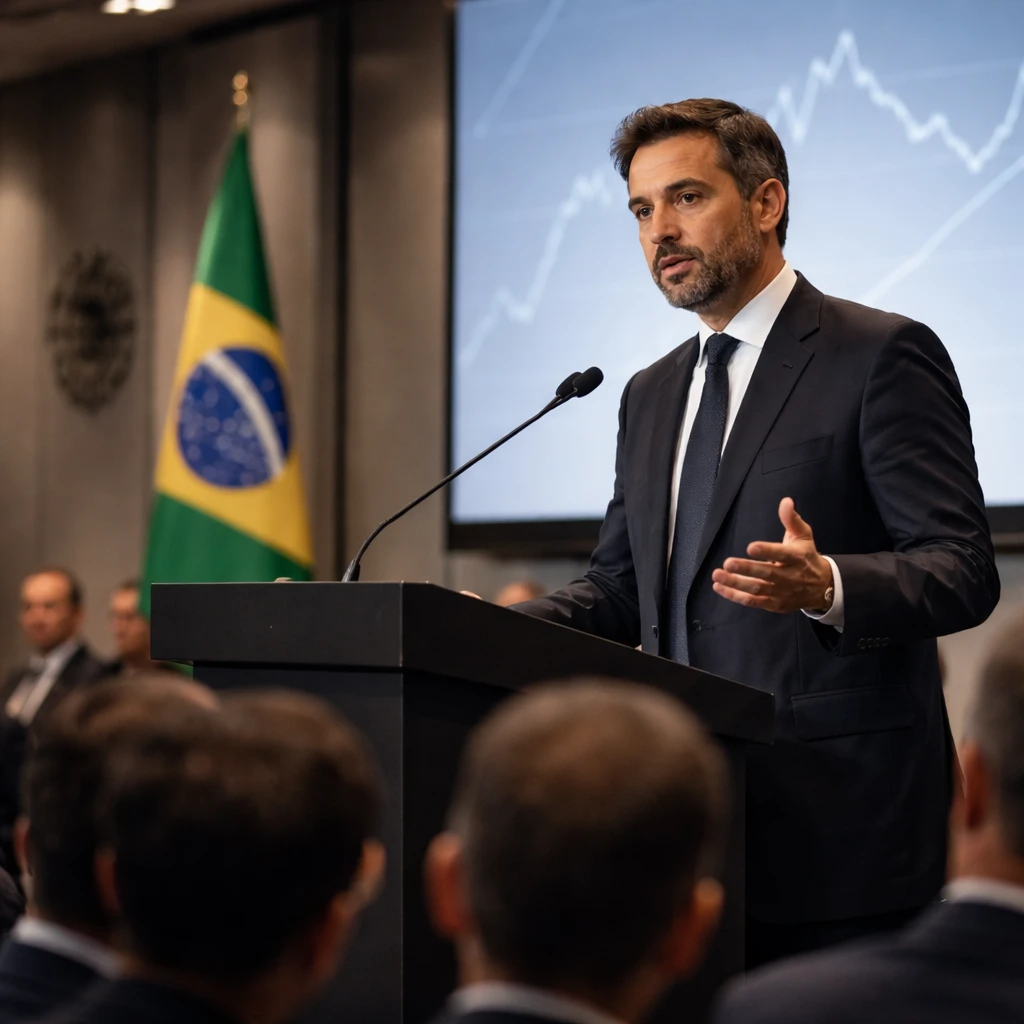
Brazil's central bank will continue to apply tight monetary policy to keep inflation in check, even when that approach creates tensions in other economic sectors, Governor Gabriel Galipolo said on Tuesday.
Galipolo's remarks, delivered at an event in Sao Paulo, came after market participants read the minutes from the central bank's most recent policy meeting as relatively dovish and concluded that the threshold for additional rate increases remains high despite a worsening inflation outlook.
Last week the central bank paused the easing cycle it began in March and held the benchmark Selic rate at 13.75%.
Policy minutes released recently noted that the deterioration in the inflation outlook was driven by supply-side shocks and included discussion that a sharper economic slowdown could help limit wider spillovers into consumer prices. Analysts widely interpreted those minutes as signaling caution about deploying further hikes quickly, even as inflation pressures intensified.
Speaking in Sao Paulo, Galipolo said that high long-term interest rates reflect influences the central bank cannot directly control. He pointed to investor behavior in the market for government securities indexed to the Selic - instruments that make up more than half of Brazil's public debt - saying demand for those securities ultimately depends on confidence that the central bank will raise rates when necessary to combat inflation.
"That is what the central bank has done historically and will continue to do," he added.
The governor also noted that investors' reluctance to hold inflation-linked bonds signals concerns that extend beyond the level of the policy rate and are visible across the broader yield curve.
Galipolo used a medical analogy to acknowledge that elevated interest rates can produce harmful side effects in the economy, but emphasized the bank's priority on price stability.
"The central bank will continue to prescribe the same treatment. The medicine will be administered, even in heavy doses," he said.
On the topic of public borrowing, Galipolo said that issuing debt predominantly in the country's own currency provides the government with more flexibility, while shifting risks onto investors who hold those local-currency bonds.
His comments arrive against a backdrop of recent political developments: President Luiz Inacio Lula da Silva's spending pledges and his reelection last month have coincided with a pronounced weakening of the Brazilian real and an increase in long-term interest rates. Those moves in the currency and bond markets have been cited in the minutes as part of the changing inflation picture.
While the minutes and Galipolo's statements together underscore the central bank's willingness to tolerate near-term economic strain to restore price stability, market participants continue to weigh how much further policy will move given the interplay between supply shocks, investor confidence and broader yield-curve dynamics.