
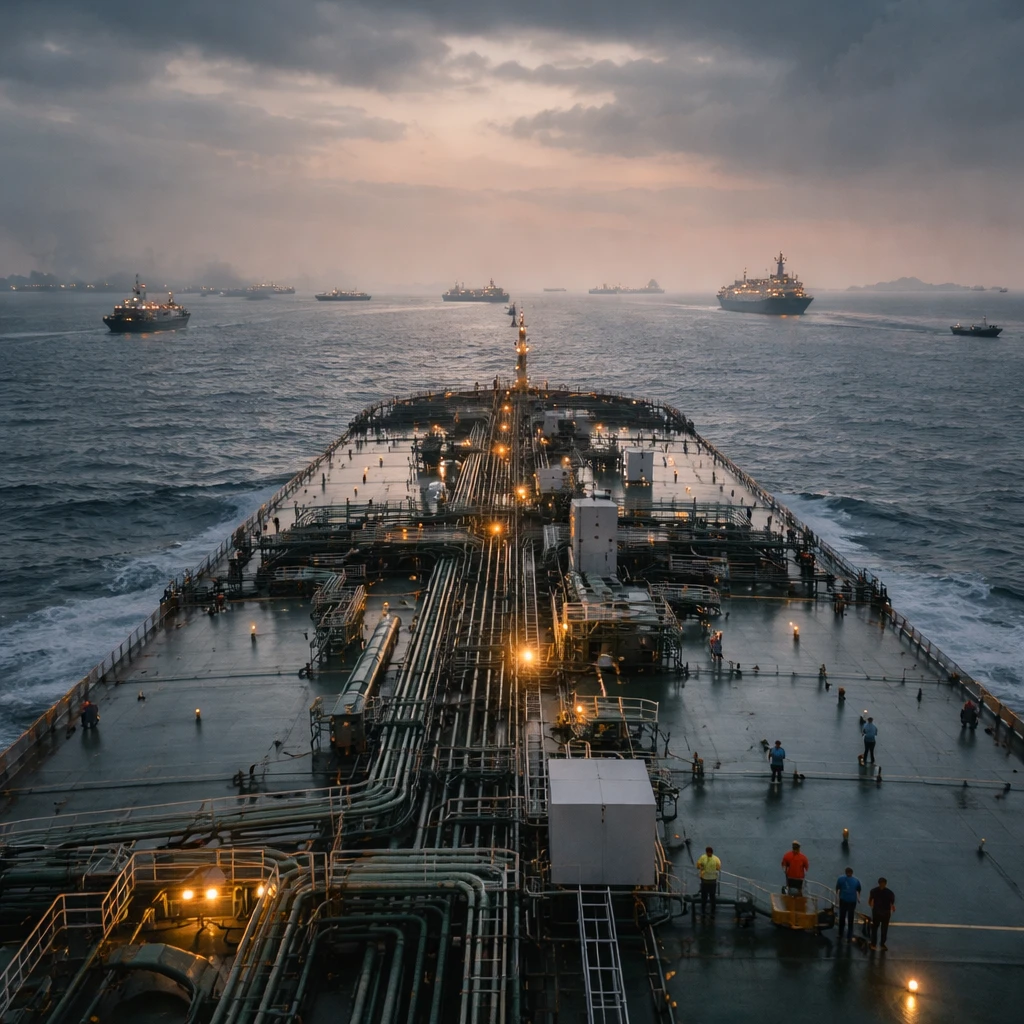
Oil extended gains into a third session on Wednesday amid heightened tensions between the United States and Iran that traders said could prolong interruptions to crude shipments from the Middle East.
As of 20:56 ET (00:56 GMT), November Brent futures were up 1.6% at $96.18 per barrel, while U.S. West Texas Intermediate futures rose 1.6% to $91.65 per barrel. Both benchmarks had surged almost 5% in the prior session, reaching their highest levels in about five weeks.
The recent price advance followed fresh U.S. strikes on Iranian targets and retaliatory Iranian attacks on U.S. forces and commercial vessels in and around the Strait of Hormuz - a key global oil transit route. Market participants cited the renewed hostilities as a source of increased concern over further limitations to tanker movements through the waterway and a potential deepening of an already significant supply shock.
Preliminary data from Kpler showed tanker traffic through the Strait of Hormuz remained extremely limited on Monday, with only five commodity vessels recorded crossing the channel. The constrained passage was compounded by two incidents on Monday in which unidentified projectiles struck two supertankers carrying Saudi crude as they transited the strait. Each of those vessels had loaded about 2 million barrels at Saudi Arabia's Juaymah terminal.
The tensions also come against a backdrop of sharply curtailed Iranian crude exports. Reuters reported that Iranian loadings fell to between 220,000 and 255,000 barrels per day in August from about 2 million barrels per day in March.
On the U.S. supply side, the American Petroleum Institute reported late Tuesday that U.S. crude oil inventories declined by 2.6 million barrels in the week ended Aug. 28, reversing a 4.2 million-barrel rise in the prior week. Gasoline stocks rose by roughly 300,000 barrels, while distillate inventories fell by about 300,000 barrels, according to the API figures. That report preceded the more closely watched weekly release from the U.S. Energy Information Administration, which was due later on Wednesday.
Taken together, limited vessel movements through the Strait of Hormuz, attacks on tankers in that corridor, sharply reduced Iranian loadings and a pullback in U.S. crude inventories are the factors that underpinned the recent rally in crude prices. Traders and market watchers will be monitoring subsequent EIA data and any further developments in the regional confrontation for indications of how sustained the supply disruption risks may be.
Market implications
- Physical constraints on tanker transit and direct hits on commercial vessels are tightening supply-side dynamics in a critical shipping lane.
- Falling U.S. crude inventories, as reported by the API, add to near-term price support ahead of the EIA's official weekly figures.
- Sharp reductions in Iranian loadings are contributing to an already significant supply shock in global oil markets.