
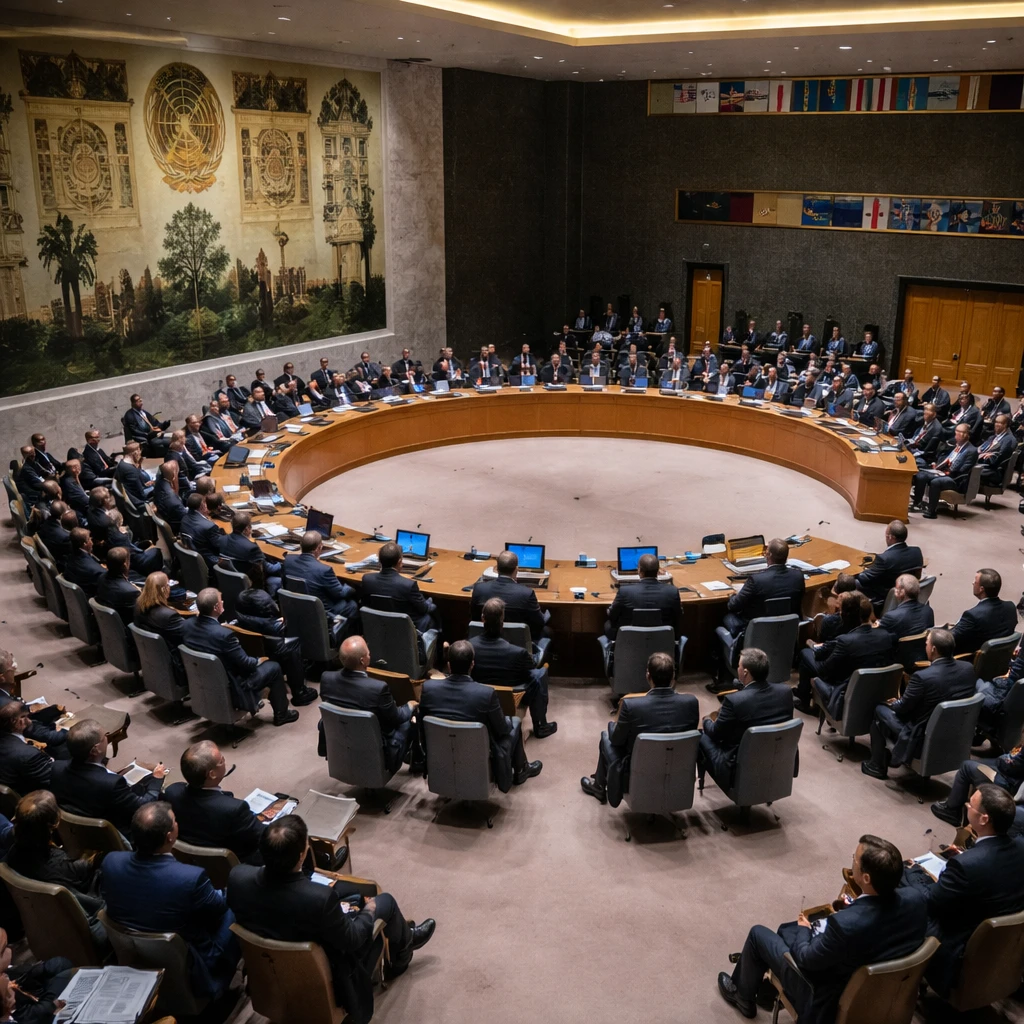
France has announced that the U.N. Security Council will vote this month on whether to renew the mandate of a panel of experts that monitors sanctions on Iran, a decision that sets up a likely clash with Russia and China, both of which oppose the sanctions regime and related oversight mechanisms.
The panel under consideration supports the work of the U.N. sanctions committee on Iran and is slated to see its mandate lapse on September 26, coinciding with the annual meeting of world leaders at the U.N. General Assembly. The U.S.-Israeli war with Iran is expected to top the agenda during that gathering.
Outlining France's program for its September presidency of the 15-member Security Council, French U.N. ambassador Jerome Bonnafont told reporters that the nuclear file and Iran’s failure to meet its U.N. obligations would be central to the month's discussions. "The Council will finally have to vote on renewing the mandate of the ... panel of experts on Iran," he said. "That was a matter reintroduced in September 2025, when we restored sanctions on the country following Iran’s non-compliance with its obligation under its nuclear program."
U.N. diplomats said the vote is expected to take place on September 17. Diplomats cautioned that the procedural move could prompt vetoes from both Russia and China, which argue the Security Council no longer holds authority to address the Iranian nuclear question. In a joint statement issued in March, Russia and China said in reference to the sanctions committee that the Security Council "cannot proceed to re-establish the 1737 Committee or its Panel of Experts."
Unlike the panel of experts, the sanctions committee itself does not have a fixed term. The committee was set up in 2006 to oversee the imposition and enforcement of sanctions on Iran related to its nuclear activities. It is commonly identified by the U.N. resolution number 1737, which created the mechanism.
Russia and China’s U.N. missions did not immediately reply to requests for comment on the plans for the upcoming vote.
The vote follows a series of developments that restored the sanctions architecture. The dispute traces back to a decision by Britain, France and Germany to trigger a U.N. "snapback" mechanism last year, which reinstated measures that had been lifted under the 2015 Iran nuclear deal. The three European powers concluded Tehran was not living up to the accord's terms put in place to prevent development of a nuclear weapon.
Iran rejects the allegation that it is seeking nuclear weapons, but its uranium-enrichment activities have long been a source of concern for the United States and its allies. Those nations worry Tehran may be preserving the technical option to produce a nuclear weapon in the future, because enriched uranium can be used either to fuel civilian power reactors or as the fissile core of a bomb.
There is a recent precedent for a vetoed renewal: in 2024 Russia cast a veto against the annual renewal of a panel of experts that monitored enforcement of U.N. sanctions on North Korea related to its nuclear weapons and ballistic missile programs. That action is part of the context for diplomatic expectations about how Russia and China might respond to the Iran panel vote.
With the Security Council presidency in hand for September, France has placed the Iranian nuclear file at the center of the agenda, setting the stage for intense diplomatic maneuvering in the run-up to and during the General Assembly session. The timing, immediately before the high-level meeting of global leaders, raises the stakes for a council vote that could reshape how the United Nations oversees Iran's compliance with its international obligations.
Context and timing
The panel's mandate expires on September 26 and a vote has been slated for September 17. The issue was reintroduced in September 2025 when sanctions were restored following findings of non-compliance. The sanctions committee, created by resolution 1737 in 2006, remains a standing body without a fixed term.
Diplomatic positions
France is driving the agenda during its Security Council presidency. Russia and China have publicly contested the council's authority over the matter and issued a joint statement in March opposing the re-establishment of the 1737 Committee or its Panel of Experts. Responses from their U.N. missions to the latest voting plans were not immediately forthcoming.