
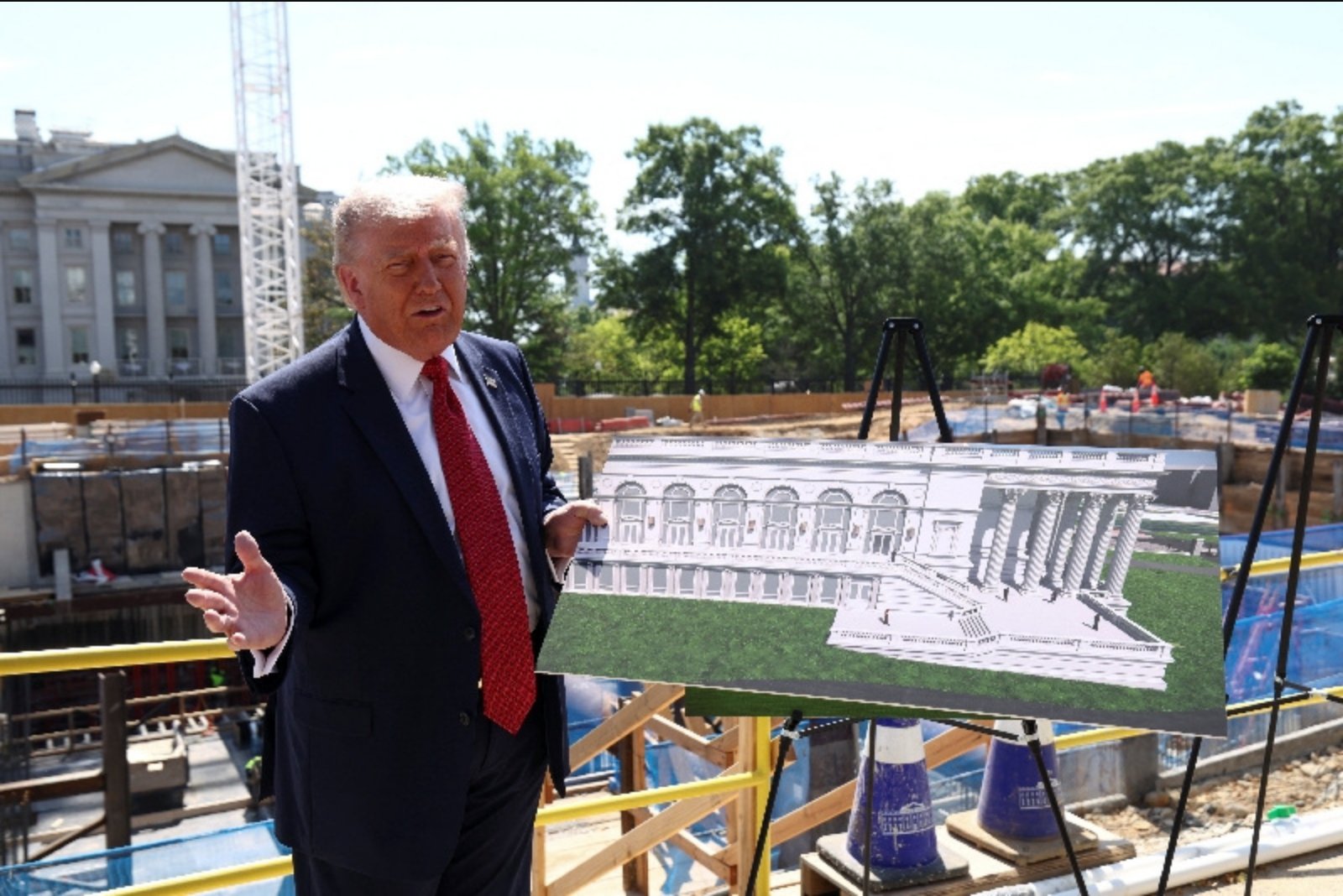
President Donald Trump on Tuesday outlined additional details about a planned White House ballroom project, describing it as a heavily fortified facility with a rooftop drone base and a multi-level subterranean complex. Speaking amid ongoing construction noise, the president escorted reporters through the site to press his case for congressional funding of the project.
Trump said the ballroom would measure 90,000 square feet, a footprint he noted would dwarf the neighboring White House, constructed in the late 18th century. He argued the space is needed to host gatherings of up to 1,000 people, a capacity he said surpasses existing White House entertainment venues. The president framed the ballroom's necessity in part by pointing to an apparent assassination attempt at a Washington hotel where he had been attending a media gala, saying the new venue would provide a more secure setting for large events.
At the construction site, Trump described the structure's security features in detail. He characterized the design as bunker-like with a hardened roof intended to withstand a direct attack. He said titanium fencing recently added around the ballroom was so robust that "a bulldozer cannot knock it over." He also described the roof as being made of "impenetrable steel."
According to the president, the facility will extend six stories below ground. He indicated that two of those subterranean levels are already under construction. The promised underground program would include a military hospital and research facilities, though the president did not provide specifics on what the research would focus on. The White House declined to offer further details.
Trump was particularly emphatic about plans for a rooftop drone installation, saying it would be "set up for unlimited numbers of drones." He also said the roof was designed with military use in mind: "The entire roof is built for military," he said. "They have a massive drone capacity. Not only is it drone-proof, if a drone hits it, it bounces off, it won’t have any impact. But it’s also meant as a drone port that would protect all of Washington."
The president additionally described the ballroom's glazing, saying the windows would be four inches thick and made from a specialized glass that, in his words, allows visibility "as though it doesn’t exist."
Trump used the site tour to urge Congress to approve roughly $1 billion to finance security enhancements to the project. His pitch comes as Democrats and some Republicans have expressed opposition to the funding request, calling it excessive at a time when many Americans are coping with rising gasoline prices and other consequences the article links to the president's military actions in the Middle East. Those fiscal and political tensions are occurring ahead of November's midterm elections.
The president, identified in public records as a real estate developer and billionaire, spoke at length about the technical and defensive aspects of the ballroom project. Beyond his descriptions, however, several elements remain unspecified: the precise nature of the research facilities, operational details for the military hospital, and broader programmatic uses for the subterranean levels. The White House has not provided additional information beyond the president's remarks.
Context and next steps
As lawmakers consider the funding request, debate appears likely to focus on cost, necessity and timing given broader economic pressures cited by opponents. The administration's presentation of detailed security features is intended to bolster the case for federal support, but key questions about the underground complex's functions and long-term plans remain unanswered in public statements.