
Economy April 16, 2026 10:13 AM

Williams Says Uncertainty Hampers Fed Guidance on Interest Rates

New York Fed president points to war-related shocks, inflation persistence and cyber risk as constraints on policy signaling

By Avery Klein
Williams Says Uncertainty Hampers Fed Guidance on Interest Rates

New York Federal Reserve President John Williams said uncertainty about the economic outlook - amplified by the Middle East conflict - limits the central bank's ability to provide firm forward guidance on interest rates. He reiterated that the Fed is positioned appropriately today, signaled that rates could be cut if inflation returned to 2%, and warned that inflation will remain above 3% for the coming months. Williams also highlighted market forces balancing a strong U.S. outlook against war-related uncertainty and named cyber risk as a top concern.

Key Points

  • Uncertainty around the economic outlook and the Middle East war restricts the Fed’s ability to provide strong forward guidance on interest rates - impacting financial market expectations.
  • Williams said the Fed is currently appropriately positioned and that a return of inflation to 2% would make lowering rates appropriate, but cautioned that inflation will be well above 3% in the coming months - relevant for fixed income and inflation-sensitive sectors.
  • Market pricing appears to balance a robust U.S. economic outlook against war-related uncertainty; Williams noted reduced U.S. exposure to oil shocks has contributed to some market strength, with implications for energy and commodity markets.

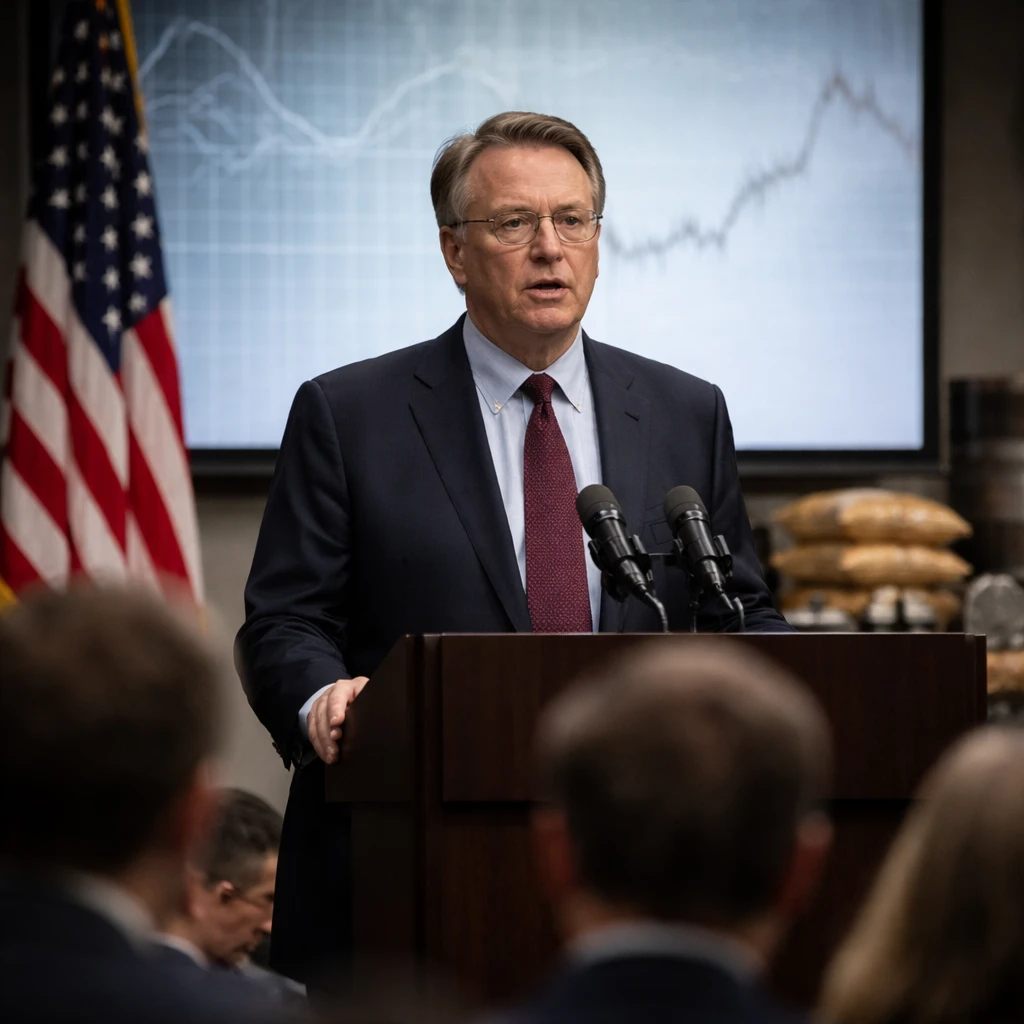
Federal Reserve Bank of New York President John Williams told reporters in New York that the level of uncertainty around the economic outlook constrains what central bankers can responsibly say about the future path of interest rates.

"It’s not a time to try to give strong forward guidance" he said after a speech, citing both the general economic uncertainty and the impact of the Middle East war as reasons for caution. Williams reiterated a conditional view on easing: "If inflation comes back to 2%, 'I do think it will be appropriate to bring interest rates down, but that’s not where we are today,'" he said.

Williams described the current stance of monetary policy as appropriately placed for the moment. He added a near-term outlook on price pressures, saying that inflation will be well above 3% over the next few months.

The New York Fed president warned that the duration of the armed conflict matters for the size of its economic consequences: the longer the conflict lasts, the bigger the economic impact will be.

On the interaction between market pricing and economic forces, Williams noted that pricing appears to reflect two competing narratives - a resilient U.S. economic outlook on one hand and uncertainty stemming from the war on the other. He said part of market strength can be traced to what he described as reduced U.S. exposure to oil shocks.

Williams also characterized the current war-related shock as not only a price shock but an availability shock, saying it affects prices and also "unavailable commodities." He emphasized the continued importance of well-anchored inflation expectations in the conduct of policy.

When asked directly about risks to the outlook, Williams pointed to cybersecurity as the specific concern that keeps him awake at night.


Context and takeaways

  • Williams stressed limited forward guidance given elevated uncertainty tied to the economy and the Middle East conflict.
  • He maintained that the Fed's policy setting is appropriate today and that rate cuts would be appropriate only if inflation returns to 2%.
  • Near-term inflation is expected to be above 3%, and prolonged conflict would increase economic strain.

Risks

  • Extended conflict in the Middle East - the longer the conflict lasts, the larger the economic impact is likely to be; this affects commodity availability and prices, and has consequences for energy and supply-sensitive industries.
  • Persistent inflation above 3% in the near term - keeps policy rates elevated and influences borrowing costs for households and businesses, affecting credit-sensitive sectors.
  • Cyber risk - Williams identified cybersecurity as a key concern, posing potential threats to financial systems, market infrastructure and technology-dependent sectors.

More from Economy

Miran Signals Possible Further Scaling Back of Rate-Cut Path as Inflation Persists Apr 16, 2026 ECB urged to favor steady judgment over rushed moves as inflation shock hits Apr 16, 2026 Finland’s Rehn Says ECB Can Potentially Ignore Temporary Inflation Spike Apr 16, 2026 CFTC Chair Says Rulemaking Will Continue Despite Four Vacancies Apr 16, 2026 Spain Proposes EU-Wide Bond Issuance to Create a Safer, Cheaper Market for Sovereign Debt Apr 16, 2026