
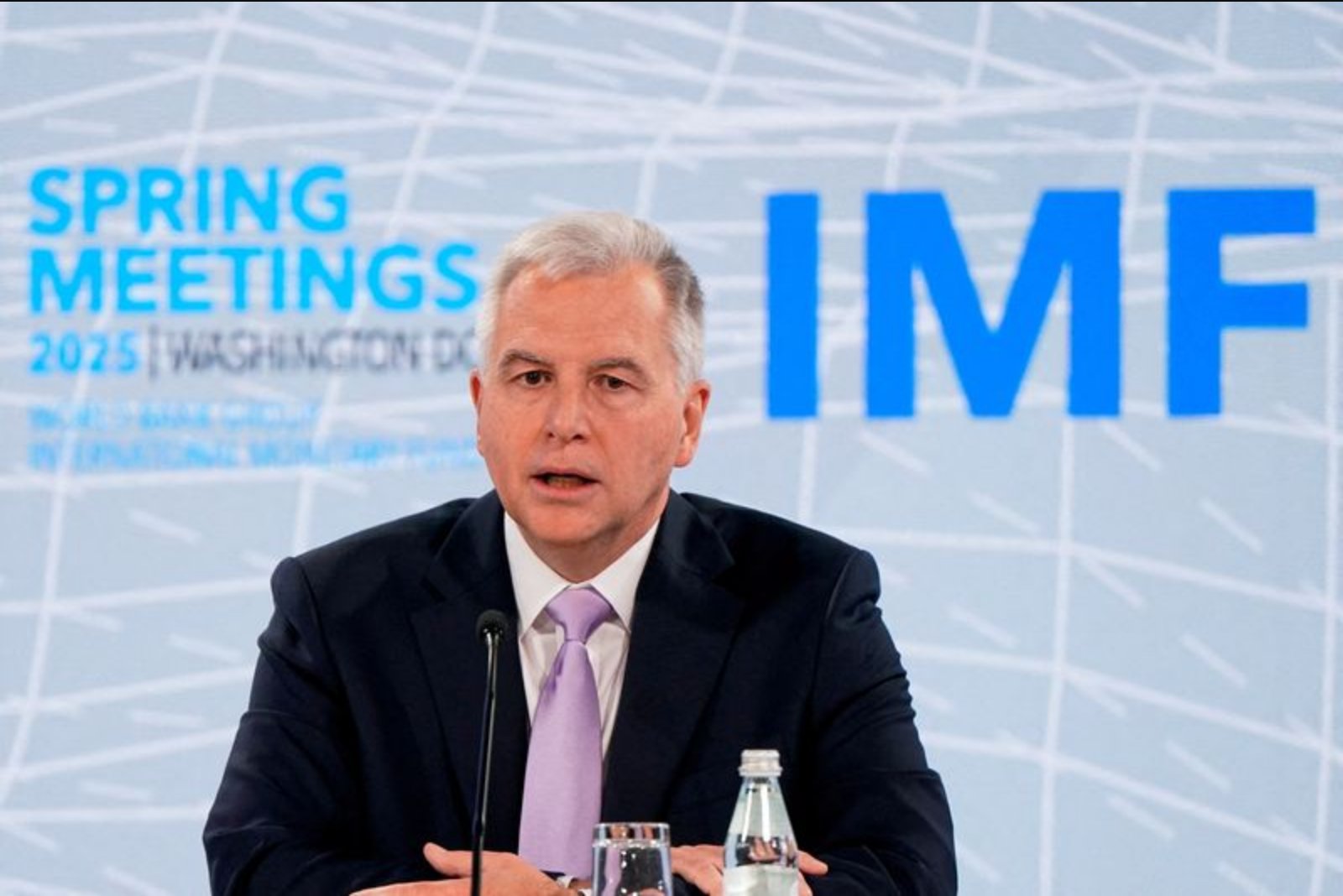
Officials at the International Monetary Fund are flagging a policy path for the European Central Bank that would see a measured tightening next year followed by a loosening the year after, based on the IMF's modelled projections.
Alfred Kammer, who leads the IMF's European Department, told reporters on the sidelines of the IMF and World Bank spring meetings in Washington that under the fund's reference scenario the ECB should increase its main policy rate by about 50 basis points in 2026. He added that those rate increases would be aimed at keeping the central bank's stance roughly neutral.
"Under our reference scenario, we would expect the ECB to raise rates by about 50 basis points in 2026 in order to maintain a neutral monetary stance," Kammer said. He cautioned that the projected path is model-driven rather than a definitive policy prescription. "This is not set in stone. This is just a model-based recommendation, based on where we are today," he said.
At present, the ECB's main interest rate stands at 2%. Kammer explained that if policymakers want to preserve constant real policy interest rates, they would need to raise the nominal policy rate somewhat - a technical adjustment reflected in the IMF's modelling. "If you want to keep the real policy interest rates constant, you would need to increase the nominal policy rate a bit," he said.
The policy challenge for the ECB is made more complex because the current inflation impulse is being driven by a supply shock rather than a surge in demand. Kammer pointed to the closure of the Strait of Hormuz - a development linked to the U.S.-Israeli war with Iran cited in his remarks - which has, in his assessment, reduced global oil and gas supply by one fifth. That abrupt contraction in energy supply has pushed energy prices sharply higher and led to downward revisions of growth forecasts alongside upward adjustments to inflation projections.
Kammer noted that the energy price shock could itself dampen demand. "The price shock is going to depress demand and you could be in a scenario where the price shock depresses demand sufficiently that you actually don't need central bank action," he said, highlighting an outcome in which market-driven demand contraction partially offsets the inflationary impulse.
On the outlook for inflation expectations, Kammer said the ECB is relatively well positioned because longer-term expectations remain anchored. He observed that inflation expectations have risen on a one-year basis but not on a five-year basis. That shorter-term uptick is precisely what the IMF models seek to address through adjustments in the nominal policy rate.
"We don't expect inflation expectations are going to de-anchor, but ... you need to be vigilant, because you want to avoid second-round effects," Kammer said, emphasizing the importance of monitoring how short-term inflation moves could feed into broader wage and price-setting behavior.
Context and takeaways
- The IMF's recommendation is conditional and model-based, not an explicit directive to the ECB.
- The central policy dilemma stems from a supply-side energy shock rather than demand pressures, complicating the standard monetary response.
- Short-term inflation expectations have risen, but five-year expectations remain anchored, reducing the immediacy of a forced tightening beyond what models suggest.