
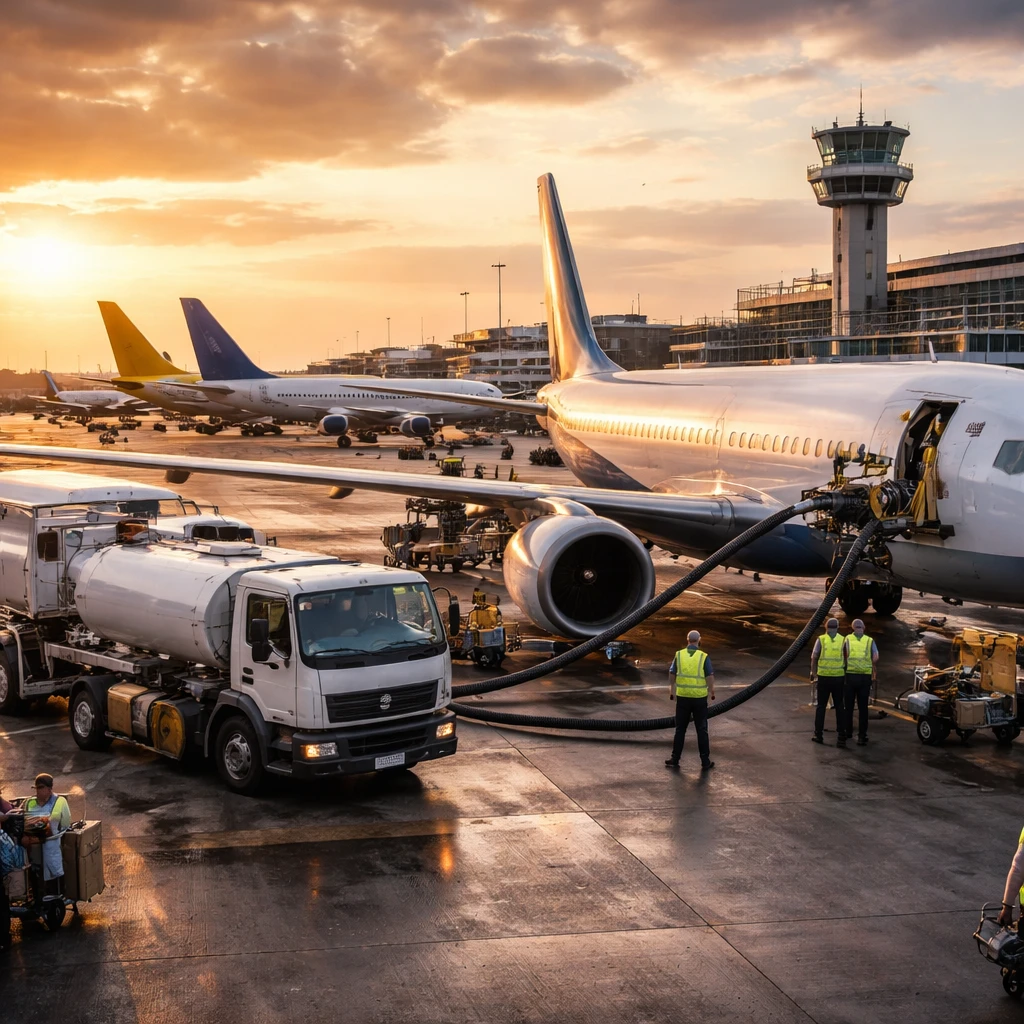
The International Energy Agency (IEA) has issued a warning that certain European countries may encounter actual jet fuel shortages over the coming six weeks should restrictions on the Strait of Hormuz continue. The advisory comes at a sensitive moment: the peak summer travel season approaches and the IEA estimates about 75% of Europe’s jet fuel consumption is sourced from the Middle East.
Energy and fuel markets have moved sharply since the outbreak of the U.S.-Iran war in late February. Brent crude has risen by more than 50% compared with the January average, while jet fuel prices have climbed even more steeply. U.S. Gulf Coast jet fuel, a key global benchmark, is up roughly 90% versus the January average.
Those price dynamics are prompting a range of responses from European carriers. Lufthansa has announced it will end CityLine operations, removing 27 regional jets from its network, and will retire four A340s and two 747s. The carrier is also reallocating nine A350s to Discover Airlines. Jefferies analysts led by Sheila Kahyaoglu noted that Lufthansa’s passenger airlines hedge fuel at around 80%, and that management plans to cut the unhedged portion by about 10%.
Low-cost carrier EasyJet has explicitly flagged the conflict and higher fuel prices as a drag on bookings further out in the year, with later-in-the-year reservations running approximately 2% below levels seen a year earlier. KLM has also reduced near-term capacity, removing 80 European return flights for the next month - a reduction that represents under 1% of total European capacity.
Industry group Airlines for Europe, whose membership includes carriers such as Lufthansa, Air France-KLM and EasyJet, has urged the European Union to take a series of measures aimed at stabilizing supply and easing costs. Their requests include EU-level monitoring of jet fuel inventories, a temporary suspension of the EU carbon market for aviation, and cuts to aviation taxes.
On the refining side, a subset of large European markets retains more domestic coverage of demand. Jefferies estimates that the U.K., Germany, France, Spain, Türkiye and Italy together supply about 63% of their own jet fuel demand through domestic refining, which offers relative insulation against disruptions originating in the Middle East.
European buyers are already seeking alternative sources: trade data show an increase in jet fuel imports from outside the Middle East, notably from the United States. Still, the cost challenge remains acute. Jefferies calculates that at $4.50 per gallon for jet fuel, returning airline margins to levels consistent with when fuel cost $2.50 per gallon would require fare increases of more than 30%, ceteris paribus.
The IEA’s warning and the subsequent industry responses underscore how concentrated supply routes and rapid price moves can quickly translate into operational and commercial adjustments for carriers, especially during peak travel demand.