
Summary
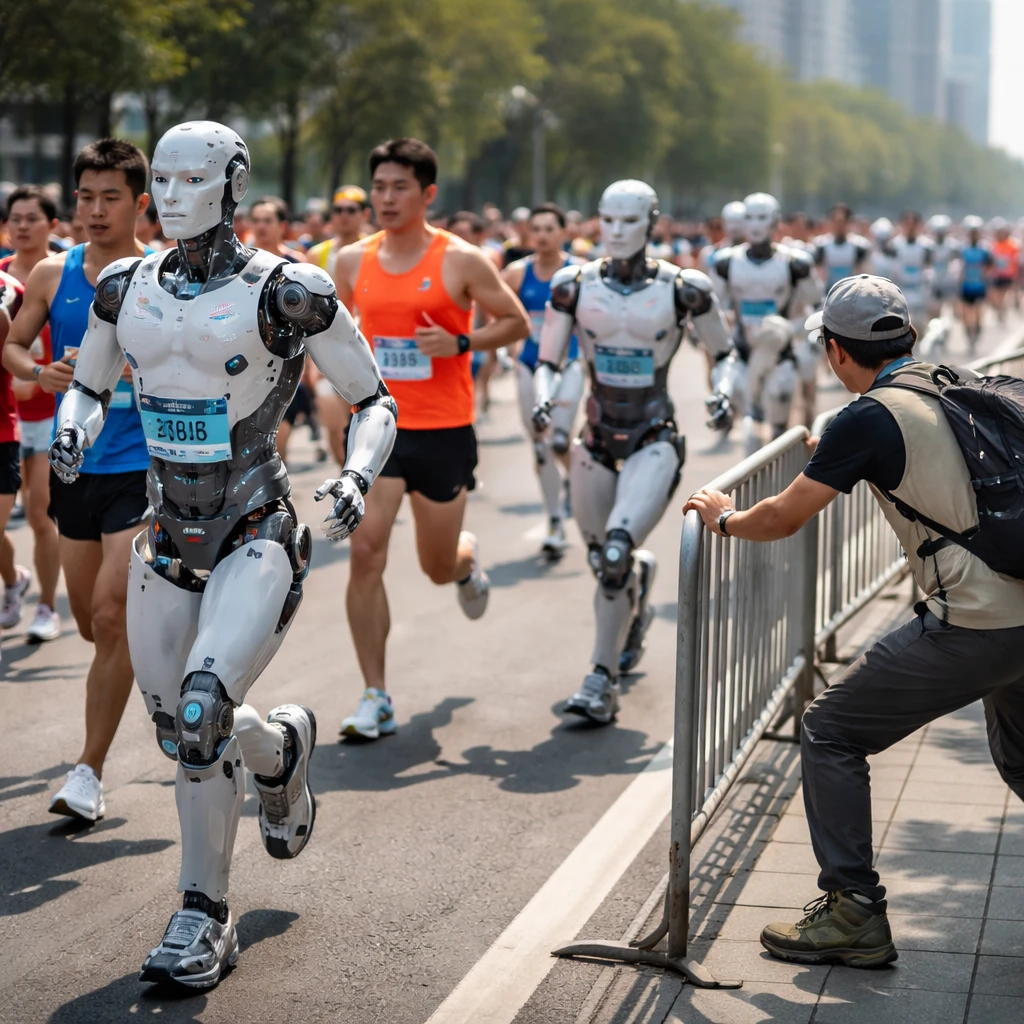
Domestically produced humanoid robots demonstrated marked improvements in athletic capability at a Beijing half-marathon, finishing faster than professional human participants. More than 100 robots competed, and the top finisher, built by Chinese smartphone company Honor, crossed the line in 50 minutes and 26 seconds. The showing represents a notable turnaround from last year’s race, when technical failures prevented many machines from even starting.
Performance turnaround
Organizers and observers noted a sharp change in outcome compared with the previous edition of the event. In the inaugural race a year earlier, technical problems dominated, with a sizable number of machines unable to clear the starting line. This year, however, the field expanded to exceed 100 robots and several units demonstrated speed and stability that matched or surpassed professional human athletes.
The winning robot, developed by Honor, completed the half-marathon in 50 minutes and 26 seconds. Although the unit required assistance to recover after colliding with a guardrail in the final meters, its overall pace was recorded as significantly faster than the current world record for the half-marathon.
Policy and industrial backdrop
Beyond the competition itself, the event highlighted Beijing’s broader strategy to cultivate a leading domestic humanoid robotics sector. The state has rolled out policy measures intended to support the industry, including substantial industrial subsidies and large-scale infrastructure projects aimed at nurturing a locally competitive ecosystem of firms.
Public displays of the technology have been staged on prominent national platforms. Notably, demonstrations of robotic dexterity were featured during the CCTV Spring Festival gala in February, showcasing technical progress in controlled environments such as choreographed performances and martial arts presentations.
Economic and labor implications
Participants and commentators at the event framed the improvements in physical capability as a transition point: the technology is moving from highly controlled demonstrations to more complex, uncontrolled physical environments. While commercial deployment of humanoid robots remains at early trial stages, the acceleration in mobility and robustness of these machines was portrayed as having potential implications for labor and the broader economy.
The article’s source material notes that robots could assume a range of roles, including automating high-risk tasks and possible uses in industrial and defense settings. These potential applications were described in broad terms, with the caveat that commercial rollout is still nascent.
Key points
- Performance leap - Over 100 domestically produced humanoid robots competed in Beijing, and several matched or exceeded professional human runners.
- Notable result - The Honor-built unit won in 50 minutes and 26 seconds, despite needing assistance after a late collision with a guardrail; its pace was noted as significantly faster than the current half-marathon world record.
- Policy push - Beijing has implemented industrial subsidies and infrastructure projects to support a domestic humanoid robotics ecosystem.
Risks and uncertainties
- Technical reliability - Last year’s race was marred by technical failures, and this year’s incidents, such as the finishing collision, illustrate ongoing reliability challenges for real-world deployment; these issues could affect sectors planning early adoption, including manufacturing and logistics.
- Commercial readiness - The article states that commercial deployment remains in early trial phases, leaving uncertainty about the timeline and scalability of applications in industrial and defense sectors.
- Operational limitations - Demonstrations to date have often occurred in controlled settings; as robots move into complex environments, unknown operational constraints could limit near-term adoption by employers in high-risk or precision-dependent industries.
Conclusion
The Beijing half-marathon offered a visible marker of rapid progress in China’s humanoid robotics capabilities. With expanded participation and notable race times this year, the event both reflects and reinforces a national strategy to accelerate the industry through subsidies and infrastructure. While commercial use cases remain under trial and certain reliability concerns persist, the advancements reported at the event point to an evolving set of possibilities for automation across several sectors.