
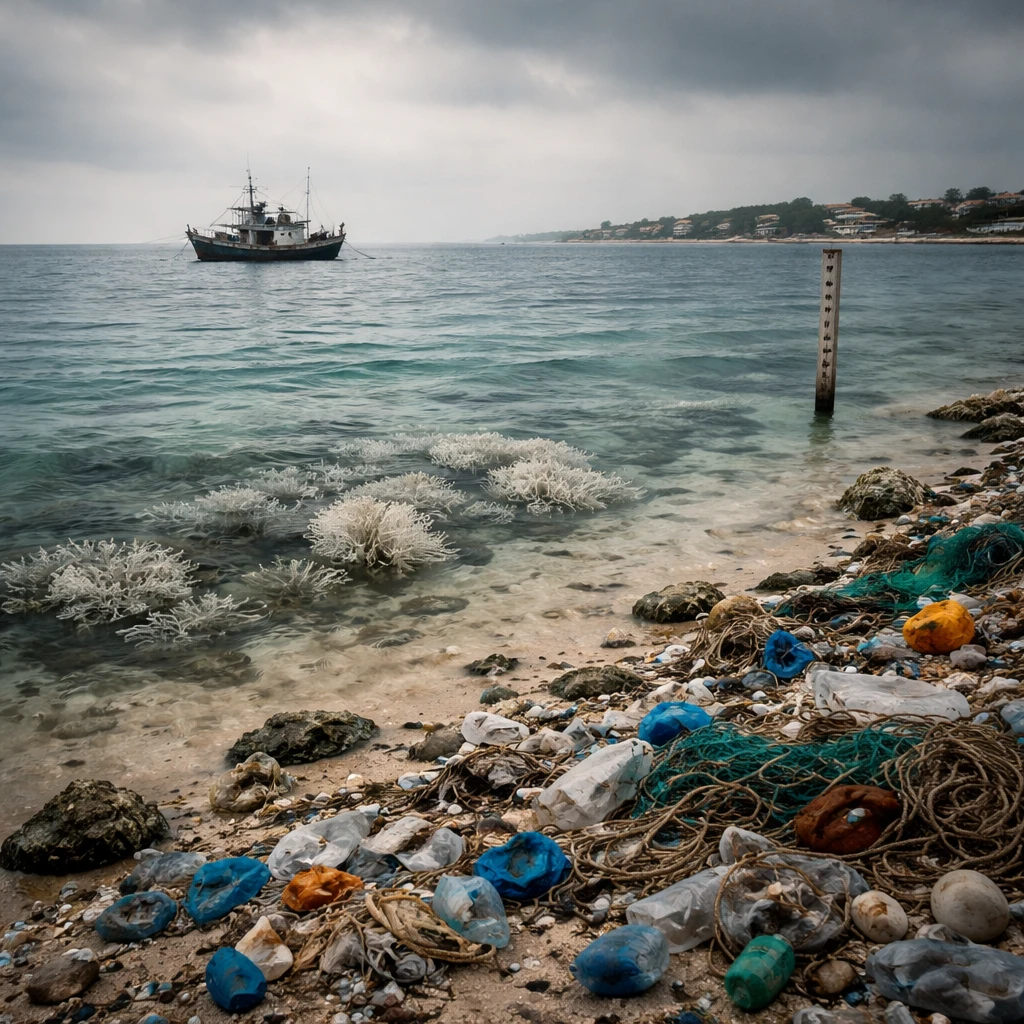
A United Nations assessment released today warns that the planet's oceans are facing an intensifying crisis stemming from climate change, pollution, unsustainable fishing and losses in marine biodiversity.
Titled the World Ocean Assessment, the report is the third comprehensive evaluation since 2015 and follows the previous update in 2021. Compiled by some 600 scientists representing 86 nations, the assessment runs to 1,352 pages and outlines a range of interconnected problems affecting ocean health.
The report highlights several measurable trends. It finds that fisheries supplying about 20% of the animal protein eaten by people are in decline. In 2021, around 38% of global fish stocks were being harvested at a rate faster than populations could replace themselves, an increase from 35% reported two years earlier.
Contamination and pollution are identified as major drivers of deteriorating marine conditions. The assessment lists plastic waste, agricultural run-off, sewage and chemical pollutants as significant contributors. These substances accumulate in marine organisms and can magnify up the food chain to animals consumed by people.
Economic and demographic concentrations along shorelines are also underscored. The assessment estimates that up to 45% of global economic activity occurs on the world's coasts, and roughly 3 billion people live within 100 kilometres of the ocean. Those concentrations increase the stakes for communities and economies exposed to ocean change.
Rapid ocean warming is flagged as a key factor in rising sea levels, accounting for an estimated 30% to 50% of observed sea-level increases. The report points to an acceleration in the pace of rise: between 2013 and 2023 global sea level rose by about 4.3 millimetres per year, compared with roughly 2.1 millimetres per year from 1993 to 2002. As water warms, its volume increases, contributing to higher sea levels that threaten coastal infrastructure and populations.
The assessment connects these physical and ecological changes to broader concerns about food security and economic exposure. Declining fish stocks, pollution that concentrates in food chains, and accelerating sea-level rise together present multiple pressures for coastal communities and sectors that depend on healthy marine ecosystems.
Report context and scope
- The World Ocean Assessment is the third such global evaluation since 2015, with the previous update released in 2021.
- It was prepared by 600 scientists from 86 countries and totals 1,352 pages.
Key empirical findings
- Fish stocks providing 20% of human animal protein are declining; 38% of global fish stocks in 2021 were harvested faster than they could replenish, up from 35% two years earlier.
- Pollution - including plastics, agricultural run-off, sewage and chemicals - accumulates in marine life and magnifies through food chains.
- Between 2013 and 2023, global sea level rose at about 4.3 mm per year versus about 2.1 mm per year from 1993 to 2002; ocean warming contributes 30% to 50% of sea-level rise.