
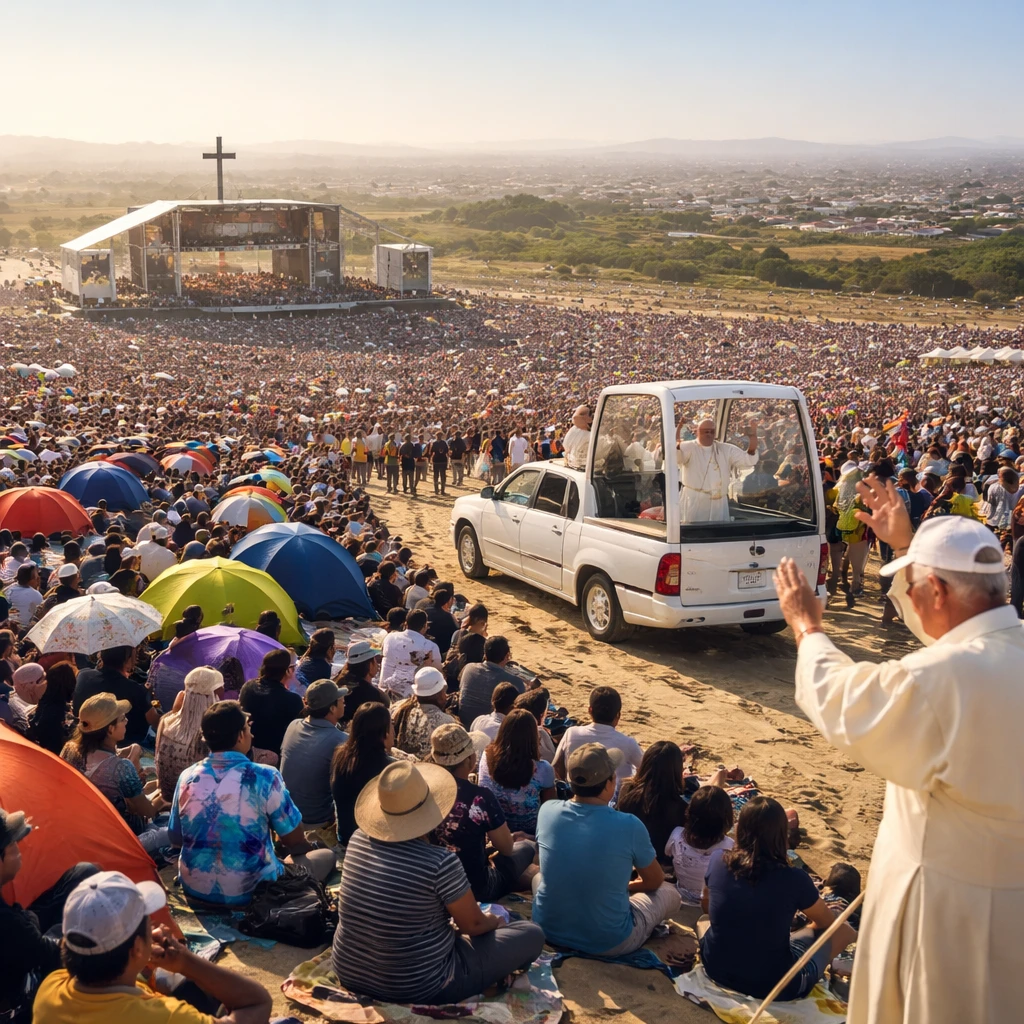
On an early Friday in Chiclayo, in Peru's north, long lines of people converged on the outskirts of the city as they awaited an outdoor Mass to be led by Pope Leo, the former bishop many here remembered from his eight years serving locally.
The gathering took place at Pampas de Pimentel, a wide desert park west of Chiclayo, where people camped overnight in advance of what was described as the centerpiece of the pontiff's 12-day South America tour. Chiclayo lies about 10,700 km (6,648 miles) from Rome, and the pope, who served as bishop in the area from 2015 to 2023, remains known to many locals by familiar names such as "Padre" or "Amigo."
Residents and pilgrims spoke of a desire to see him in person and receive his blessing. Noemí Chuman Pasco, 55, a Chiclayo resident who knew him during his years as bishop, said she wanted to see the pope in person. Magdalena Sequel, 78, recalled attending Masses he celebrated at a local Catholic shrine and described him as "very kind and affectionate with everyone," noting his humility.
The pope, born in Chicago and elected leader of the Catholic Church last year under the name Leo after previously being known as Robert Prevost, arrived in Peru on what officials and supporters described as the emotional final leg of a three-nation tour. He had also visited Uruguay and came to Peru from Argentina earlier in the trip.
During the Peru leg, the pope declared on a Wednesday that the country where he served as a missionary for about 20 years was his homeland. He was scheduled to arrive in Chiclayo from Lima around 9 a.m. (1400 GMT) and to remain in the area through Sunday to lead a total of eight events. Among those planned was a private dinner with priests who formerly reported to him when he served as bishop.
Chiclayo is Peru's fourth-largest city, with a population of roughly 620,000. The city's economy is supported in significant part by agriculture, and the presence of large crowds for the papal visit placed an unusual, temporary focus on the city's hosting capacity and the nearby open spaces used for mass gatherings.
Crowds for the pope's visit to Peru were the largest seen during his 18-month papacy. Authorities and observers reported that about 3 million people gathered in Lima on Wednesday after his arrival from Argentina, marking the largest turnout of his tenure to date.
On the ground in Chiclayo, the atmosphere combined devotion and anticipation. Many people settled in the Pampas de Pimentel ahead of the Mass, preparing to spend extended hours outdoors in the arid parkland. The pope himself, who began this South America tour less than a month after lung cancer surgery, had shown robust public appearances throughout the trip. Observers noted his active engagement with crowds - greeting people aboard an open-air popemobile, making impromptu balcony appearances at the Vatican embassy in Lima where he was staying, and even singing local songs at certain events.
Local parishioners and older residents particularly emphasized the personal connection they felt to the pope because of his years serving in the region. The visit combined religious ceremony and reunion-style encounters between the pontiff and communities he once led, and it unfolded as part of a packed schedule of public and private engagements during his stay in the Chiclayo area.
Summary
Pope Leo returned to the region where he served as bishop from 2015 to 2023 to lead an outdoor Mass at Pampas de Pimentel near Chiclayo, drawing large crowds and several days of planned events as part of a 12-day South America tour.
Key points
- Thousands gathered at a desert park outside Chiclayo ahead of an outdoor Mass led by Pope Leo, who served as bishop in the area for eight years.
- The visit is part of a 12-day South America tour that included stops in Argentina and Uruguay; about 3 million people gathered in Lima earlier in the tour.
- Chiclayo, Peru's fourth-largest city with a population around 620,000, relies in part on agriculture - the influx of visitors temporarily focused attention on local hosting capacity and nearby open spaces used for mass gatherings.
Risks and uncertainties
- Large, concentrated crowds at Pampas de Pimentel create logistical and public-safety challenges for local authorities and services - impacting sectors such as local transport, emergency services, and temporary accommodation providers.
- The pope's health history - including lung cancer surgery less than a month before the tour began - remained an observable element of public attention, introducing uncertainty about the continuation of intensive public engagements.
- The scale of attendance seen in Lima and expected in Chiclayo could strain municipal infrastructure and require significant short-term resource allocation by local governments and service providers.
Note: The article reports the events, participant statements, schedules and attendance figures as provided by local sources and participants.