
Overview
Taiwan's latest annual review of the Chinese military threat describes a Beijing that is growing more unpredictable while tightening its hold on neighbouring airspace and waters. The defence ministry's assessment, released as part of its routine annual reporting, outlines how Chinese military activity around the island has concentrated on measures that restrict Taiwan's external lines of communication and seeks to degrade Taiwan's command-and-control and air-defence capabilities early in a conflict.
Escalation and unpredictability
The report states the regional security situation "continues to escalate" and points to "rising unpredictability" in Chinese decision-making. The ministry connects much of this instability to what it describes as an "unprecedented" purge of senior military officers inside China, a development the report says has added uncertainty to Beijing's military posture.
Patterns of operations around Taiwan
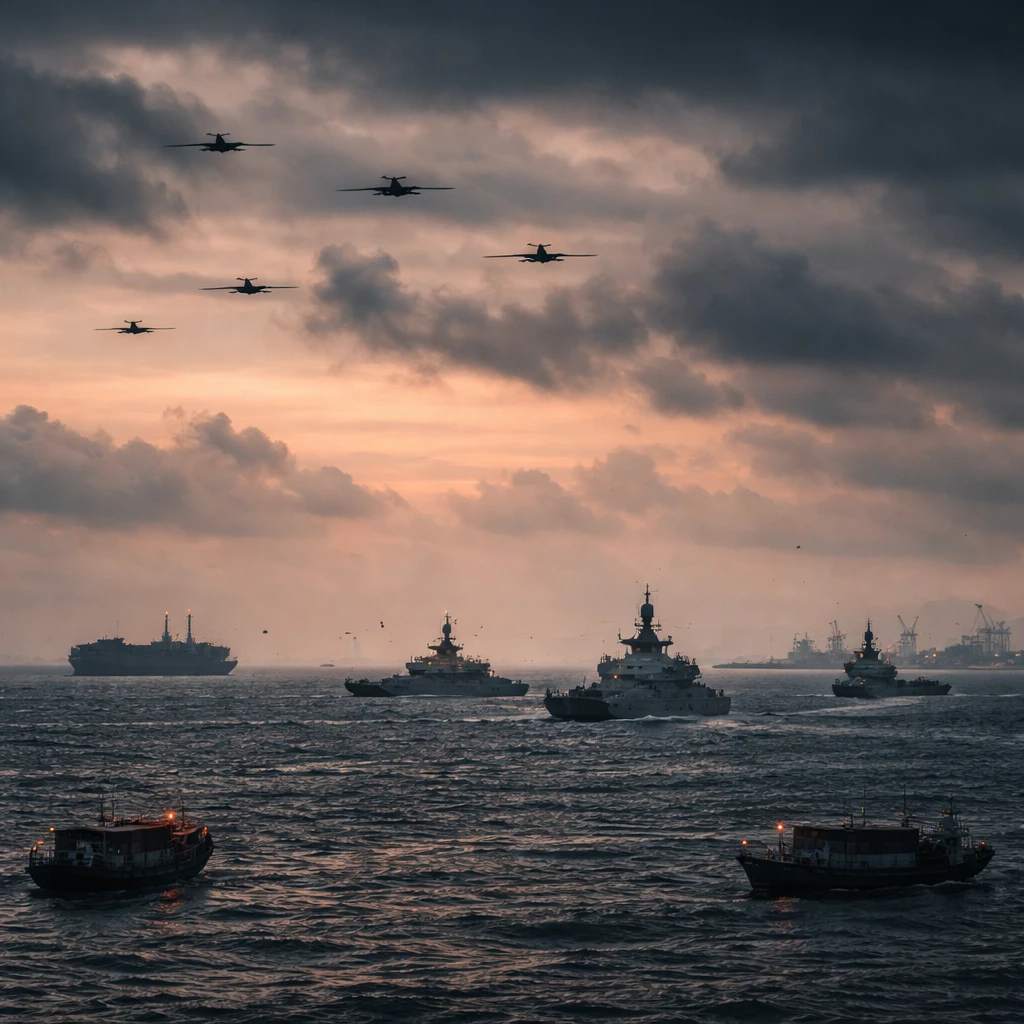
According to the review, exercises China has conducted in recent years have focused on "joint blockade/control" of Taiwan's external sea lanes. The ministry said that, during these drills, Beijing employs not only military aircraft and ships but also coast guard vessels to "shape favourable conditions for an invasion of Taiwan ... in order to cut off our external transportation routes and form an encirclement posture". The report also states that while these operations aim to constrain Taiwan's movements and create encirclement postures, China still lacks the capability to carry out an amphibious assault.
Control of maritime and air domains
Through regular combat readiness patrols, missions far out at sea and various exercises, China is, the ministry said, "strengthening its control" over the sea and airspace around the Taiwan Strait. The report frames this activity as intended "to achieve the destruction of command-and-control and our air defence capacity in the early stage of combat."
Lessons drawn from recent conflicts
The defence review says China is incorporating lessons from the wars in Ukraine and in the Gulf region into its training and exercises. It highlights, in particular, the effectiveness of swarms of inexpensive drones observed in the Ukraine-Russia war. The report also notes apparent problems exposed for the United States by the war against Iran and says China is studying those issues as well.
The document lists difficulties it attributes to the U.S.-Israel-Iran conflict, stating that it "highlighted issues such as rapid ammunition consumption, strain on air-defence interception systems, industrial mobilisation, and the fragility of allied cooperation." The report says Iran has targeted U.S. bases in the Middle East, forcing Washington to expend expensive air-defence munitions, although the Trump administration says stocks remain adequate. The review also includes the statement that U.S. President Donald Trump launched the war against Iran alongside Israel six months ago, initially promising a victory within weeks.
Implications noted by Taipei
Taiwan's government reiterates its rejection of Beijing's sovereignty claims and emphasizes that only the island's people can decide their future. The review also restates the pattern of near-daily Chinese military presence in waters and airspace around Taiwan and notes that the United States supplies Taiwan with weapons while maintaining a policy of ambiguity about whether it would fight to defend the island.
Concluding assessment
The annual report presents a picture of a more assertive and tactically adaptive Chinese military presence in the vicinity of Taiwan, coupled with internal shifts that Taipei says increase unpredictability. It warns that China is shaping conditions through coordinated use of military and coast guard assets to limit Taiwan's access and degrade key defensive capacities, while drawing operational lessons from recent conflicts abroad.