
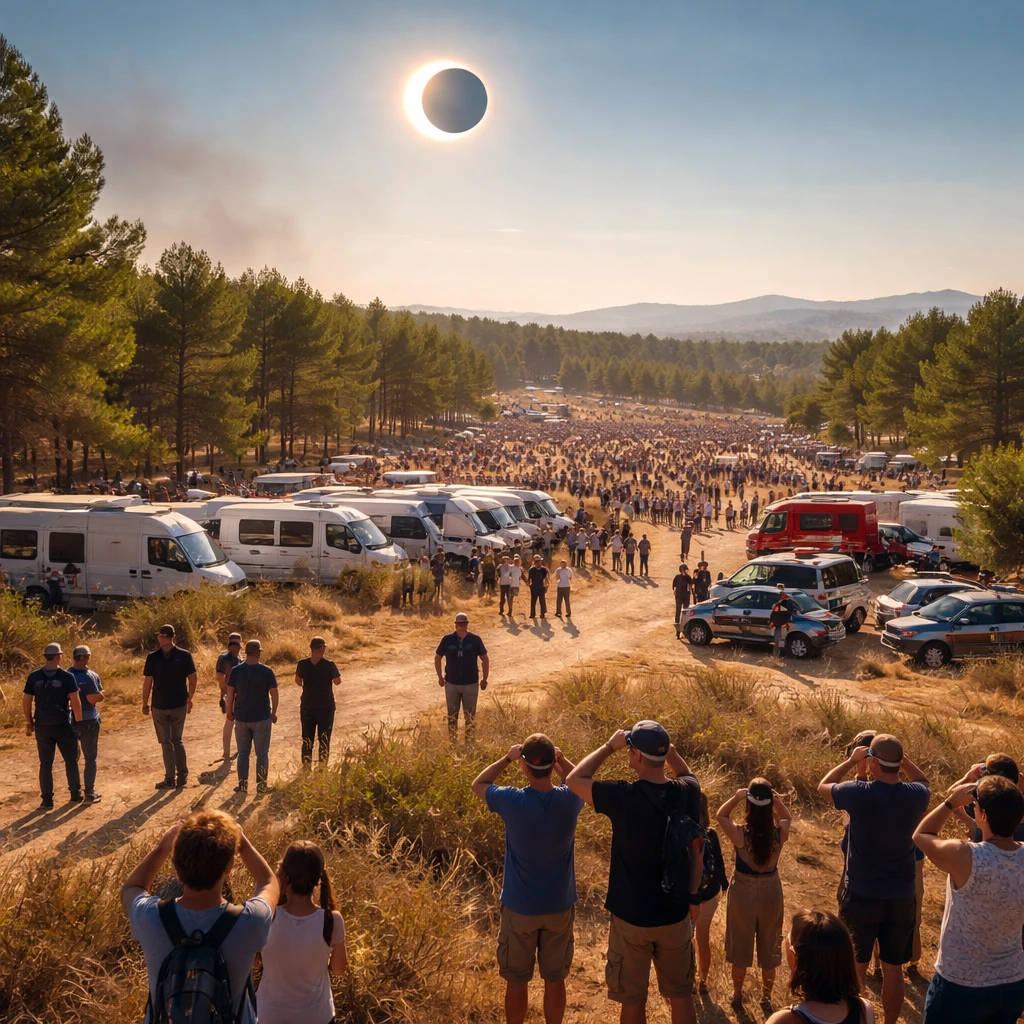
Spanish authorities are launching a nationwide public-safety and policing operation ahead of a rare total solar eclipse on August 12 that will be visible in full only from parts of Spain and Iceland. Regional governments along the track of totality have prepared 660 official observation sites and associated parking and camping facilities to accommodate what they expect will be a significant influx of visitors.
Officials across the country anticipate as many as 6 million people could travel to locations within Spain to view the eclipse, and will place more than 35,000 officers on duty as part of a coordinated security effort aimed at limiting hazards tied to mass gatherings in natural areas, Virginia Barcones, secretary-general for Civil Protection and Emergencies at Spain’s Interior Ministry, told Reuters.
"We’ve had an extremely tough summer in Spain, with yet another series of major forest fires. That’s why we must restrict any kind of activity that could generate a spark," Barcones said, stressing that authorities are focused on preventing ignition sources such as discarded cigarettes and unsanctioned barbecues.
A dedicated control room in Madrid will oversee surveillance and co-ordination with regional governments during the eclipse period. The event is being cited as an example of the way changing climate patterns are already altering how public events are managed, with organisers factoring in heat and heightened fire risk when planning safety operations.
Weather agency Aemet has issued alerts for several Spanish regions on the day of the eclipse, warning of temperatures reaching up to 40 degrees Celsius (104 degrees Fahrenheit) and a wildfire danger level described as "high" or "very high" in areas along the eclipse path. The combination of high temperatures and very dry conditions has left large swathes of the countryside tinder-dry.
As of Monday evening, three major wildfires were active in the provinces of Huelva, Segovia and Huesca. The Environment Ministry reports that, so far this year, fires have burned about 200,000 hectares - a figure it says is six times greater than the area scorched by the same date in 2025. "This is a very bad time of year ... It’s statistically the week when the most wildfires occur in Spain," Raul de la Calle, secretary-general of the Association of Forest Technical Engineers, said.
Local communities and grassroots groups in small towns along the eclipse trajectory have launched their own awareness efforts, urging visitors to avoid particularly sensitive natural areas. In Buitrago de Lozoya, a town of roughly 2,000 residents north of Madrid, a local organisation, Monte en Pie (Keeping Woodlands Alive), staged a protest objecting to planned activities that it says could increase fire risk near forests.
Nearby Tres Cantos cancelled all public events for eclipse day because of concerns about wildfires, although an observation site close to Buitrago is still expected to draw about 3,000 people, including regional officials from Madrid. Monte en Pie’s leader, Ana Hernandez, emphasised the long-term damage a major fire could inflict. "We are in a high wildfire-risk area. Barbecues and the use of machinery are prohibited because the countryside is extremely dry ... The more people there are, the greater the danger," she said.
Authorities estimate around 1.5 million people may be on the roads during the day, travelling toward rural northwestern and central areas of Spain along the eclipse route. To reduce the chances of ignition and other hazards, national and local agencies have launched public information campaigns. Messages posted on local and social media and on visitor forums warn against parking in unauthorised areas, littering, using barbecues or venturing into fire-prone countryside.
Despite repeated cautions from officials and local groups, many visitors appear undeterred. Travel industry data show strong interest in inland viewing locations: Booking.com reported that foreign searches have more than tripled in cities such as Burgos and Soria, while Amadeus data indicate bookings to Asturias rose 292% compared with a year earlier. The industry association ASEICAR says that around 70% of Spain’s rental motorhomes, camper vans and caravans - a fleet it estimates at about 500,000 vehicles - are already booked for the eclipse period.
Authorities faced with the dual challenge of facilitating a major astronomical event and guarding against an elevated wildfire season are attempting to balance public demand for viewing opportunities with strict risk-mitigation measures. Organisers have emphasised official sites with designated parking and camping as preferred options in an effort to concentrate crowds in areas where safety controls and emergency services can be deployed effectively.
With extreme heat alerts and ongoing active wildfires in parts of the country, emergency services will be closely monitoring conditions as the eclipse approaches. The scale of the policing and public-safety effort reflects both the anticipated size of the influx to rural areas and heightened concern about accidental ignitions at a historically vulnerable time of year for Spain’s forests.