
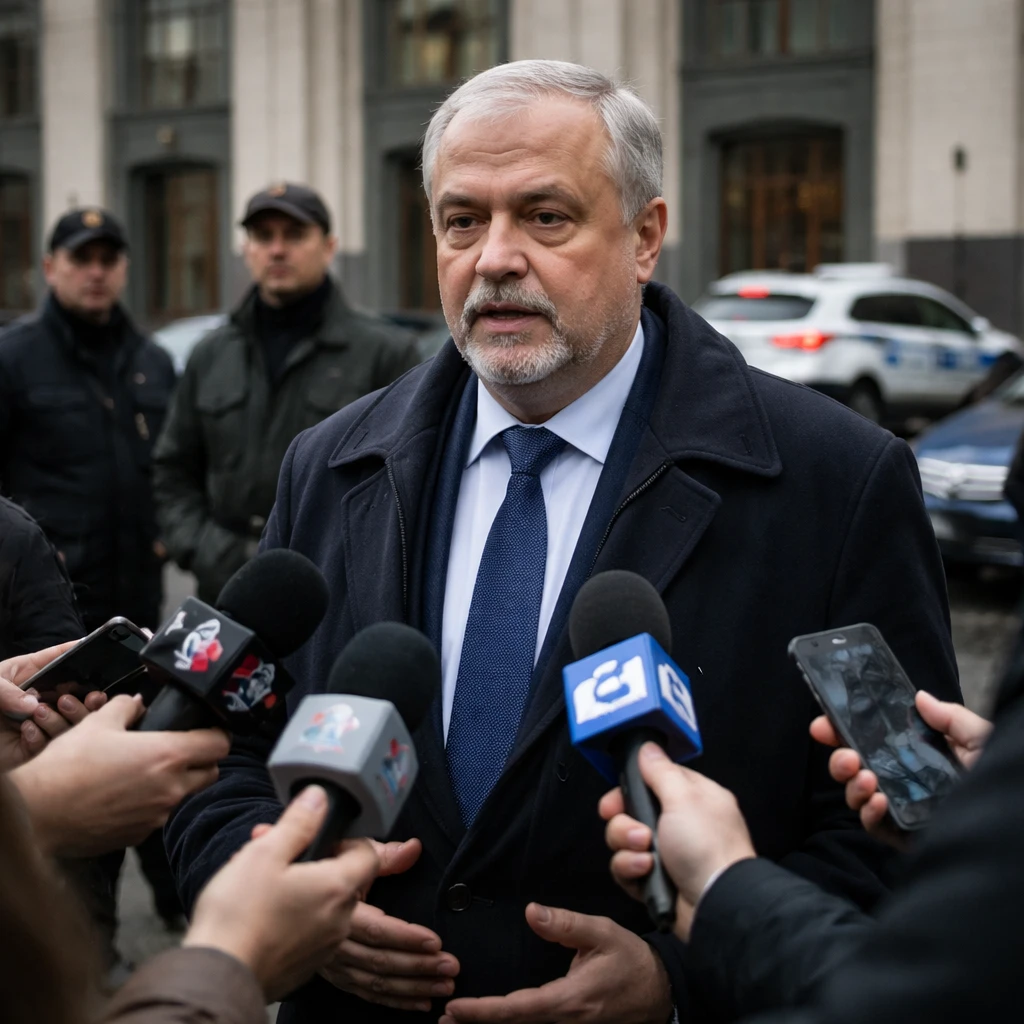
Boris Nadezhdin, a veteran opposition politician who has pushed for an end to the war in Ukraine, says recent moves by the authorities are designed to prevent him from qualifying and campaigning for a seat in the lower house of parliament later this year.
Nadezhdin, who was ruled ineligible to challenge President Vladimir Putin in the 2024 presidential contest, is attempting to collect the signatures required to stand in September's election for the State Duma. Last Friday, officials added his name to Russia's register of "foreign agents" - a designation that carries connotations of spying and is applied in Moscow to people whom the authorities consider to be engaged in anti-Russian activities.
On Monday, police held Nadezhdin for questioning after he posted a social media entry that included a link authorities said led to allegedly "extremist" content. The politician dismissed the allegation and said the action was part of a broader effort to prevent him from speaking publicly about issues he has highlighted during his campaign.
"They wanted to ensure that, God forbid, Nadezhdin didn’t end up in the Duma doing the same thing he’s been doing all along: saying the war must stop, that Russia needs normal development and a return to a normal human life, rather than what’s happening now," he told Reuters on Monday evening.
Nadezhdin said the aim of recent steps against him was straightforward. In his words: "The goal is simple: take me out of the game, prevent me from getting into the State Duma, and stop me from running a campaign - for peace, for freedom, and for things like having the internet and gasoline, at the end of the day."
In a video released this week, Nadezhdin described the conflict as a "completely senseless fratricidal war" and called for a freeze of fighting along the current front lines.
Speaking out on those topics carries risks in Russia, where the Kremlin has intensified measures against dissent during the 4-1/2 years of the war in Ukraine. While the ruling United Russia party is widely expected to retain dominance at the ballot box, the electoral period can offer relatively greater space for marginalised opposition voices to make public statements.
The liberal Yabloko party, which supports a ceasefire, has registered hundreds of candidates for the Duma, though observers consider it unlikely to win seats. The party has also suffered recent losses: last month its deputy chairman, Maxim Kruglov, was sentenced to seven years in prison after being convicted of spreading falsehoods about the Russian military.
Nadezhdin, who is 63, is scheduled to appear in court on Friday for a hearing related to the alleged link to extremist material, a charge he described as "ridiculous." He has also warned that a short custodial sentence could be life-threatening because of an existing heart condition. Despite that, he posted on Telegram on Tuesday: "We’re hanging in there, we’re not losing heart!"
This episode highlights the tensions surrounding the upcoming parliamentary campaign: an opposition figure seeking to enter the Duma while facing legal and administrative barriers that he says are designed to silence criticism of war policy, restrictions on internet access, and domestic shortages of gasoline.