
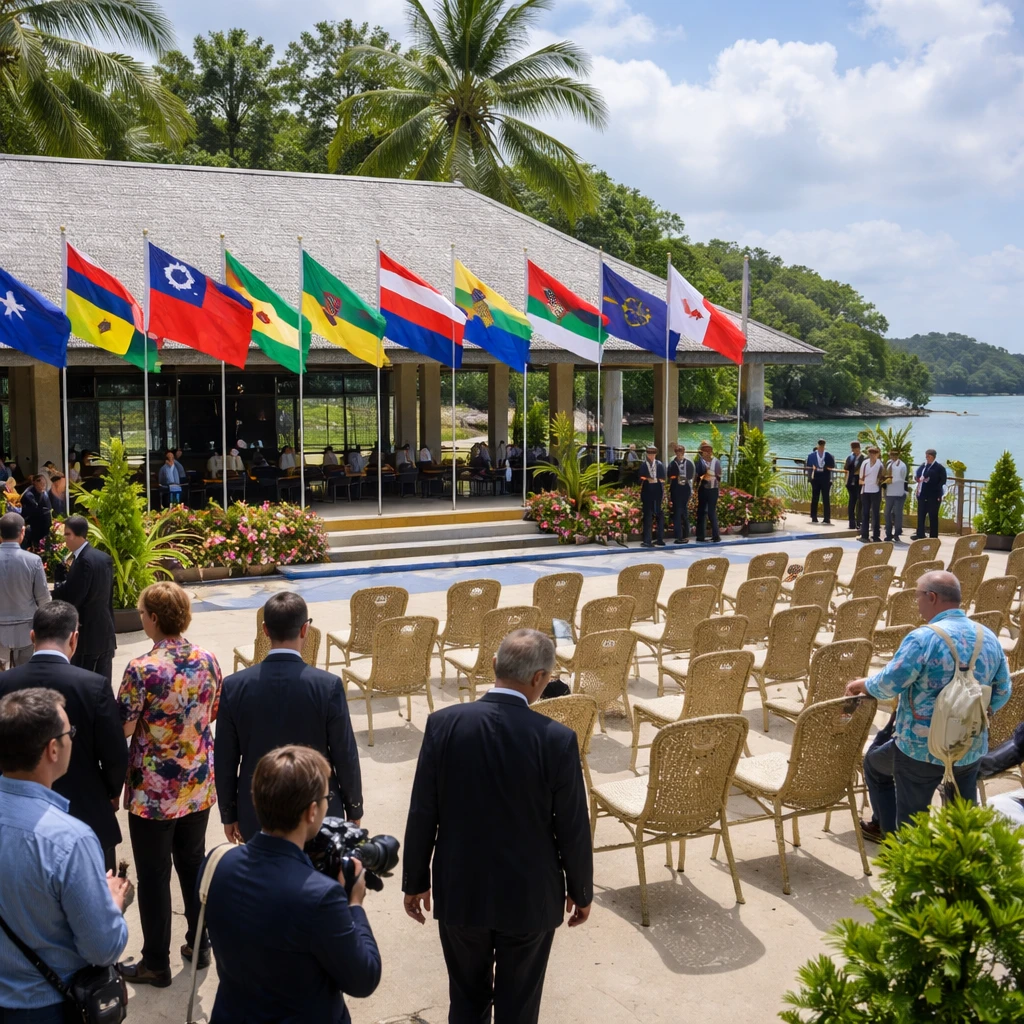
Leaders and senior officials from Pacific Island nations have gathered in Koror for the annual Pacific Island Forum, but at least five heads of government are not present for the summit that began on Monday. The meeting - hosted by Palau President Surangel Whipps Jr. and running through September 4 - was intended as a display of regional solidarity but has been overshadowed by tensions linked to China and Taiwan.
Palau, an archipelago of more than 500 islands that maintains formal diplomatic relations with Taiwan, invited Taiwan Foreign Minister Lin Chia-lung to participate in meetings and side events held alongside the forum. Taiwan is attending as a development partner rather than as a formal dialogue partner like China, which views Taiwan as its own territory.
China challenged Palau's decision to include Taiwan in the forum, saying Taiwan had "no qualifications" to take part in the gathering. In a related move last month, Beijing issued a travel advisory declaring Palau "unsafe" for tourists. The U.S. embassy in Koror responded, saying it "opposes any attempts by China to weaponize tourism to coerce Palau."
Notable absences at the leaders' table include the prime ministers of Fiji, Vanuatu, Samoa and the Solomon Islands, along with the president of Kiribati. Organizers said these countries will be represented by ministers or other senior officials in their stead.
Among the leaders who were expected but did not remain in Palau was Solomon Islands Prime Minister Matthew Wale. He arrived but departed to return home and face a no-confidence motion. Wale had been elected in May, taking over from a previous administration that had strengthened ties with Beijing and signed a security pact with China - a move that drew concern from the United States and other partners.
Kiribati explained that President Taneti Maamau was unable to travel because its parliament was sitting and because flights were limited. The combination of domestic scheduling and transport constraints was given as the reason for the president's absence.
Dialogues with external partners are set to resume at this year's forum after several were excluded from last year's meeting in Honiara. Representatives from the United States, China, Japan and Singapore are returning as dialogue partners. Among those expected in Palau are U.S. Deputy Secretary of State Christopher Landau and China’s Special Envoy for Pacific Island Countries Affairs Qian Bo.
Palau’s president framed the summit around economic development and regional cohesion. Speaking at the Smaller Island States (SIS) meeting, the first leaders' gathering of the week, President Whipps said the theme - "B.E.L.A.U. - Building Economies: Life. Action. Unity." - reflected a central goal: economic growth that elevates livelihoods and fosters sustainable opportunities across the region. "It must elevate the livelihoods of our people, create tangible and sustainable opportunities for our economies, and unite us in our ongoing efforts to deepen regionalism through integration," he said.
New Zealand Foreign Minister Winston Peters told reporters that Pacific nations seek substantive, practical results from the summit. "We want more doing, less hui," Peters said, using the Maori word for meetings. He highlighted oil supply disruptions as one of the region's pressing concerns and indicated an announcement on relief measures could come within days.
Security questions are also expected to be on the agenda. A recent meeting of Pacific Island foreign ministers in Suva did not produce a collective response to a Chinese missile test in the Pacific, leaving uncertainty ahead of leaders' deliberations in Palau. Peters said it remained unclear whether a common position would be reached at the summit, and he noted that the passage of time since the missile test raised questions about the utility of a response now.
With some leaders absent, contested participation by Taiwan and renewed attendance by major dialogue partners, this year's forum opens in a context of diplomatic friction and practical challenges. The host government has emphasized economic cooperation and unity, while regional representatives and external envoys prepare to negotiate outcomes on energy security, tourism and broader questions of regional stability.
Summary: The Pacific Island Forum began in Palau under the banner of economic building and unity, but diplomatic tensions over Taiwan's role, a Chinese travel advisory, and several leaders' absences have complicated the gathering. Dialogue partners including the U.S. and China are present, and discussions are expected to address oil supply disruptions and regional security.