
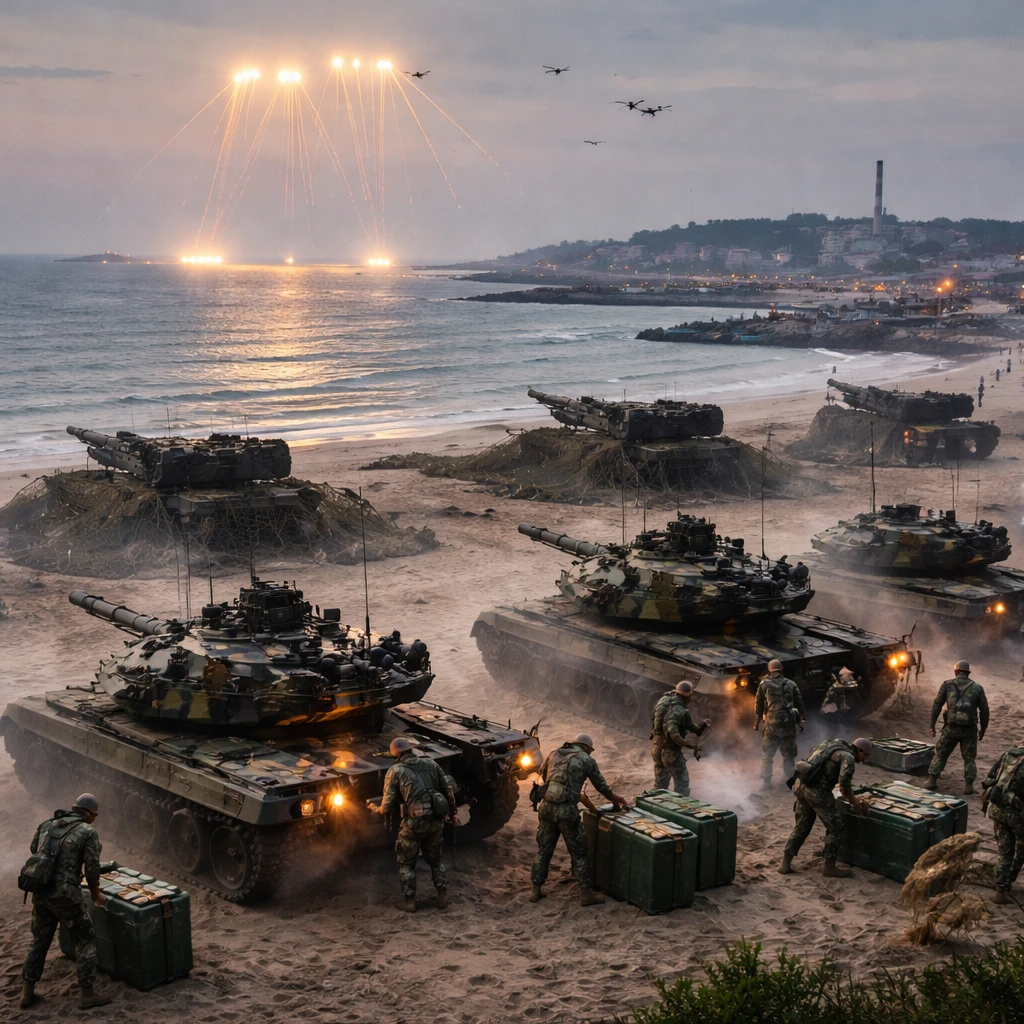
Before sunrise on a main island in the Penghu archipelago, soldiers methodically removed long, silver 105mm shells from green plastic canisters and loaded them into the hatches of four tanks. Once the rounds were checked and secured, the garrison waited in silence for the command to open fire.
The August 10 live-fire rehearsal was one fragment of a larger set of maneuvers carried out during Taiwan’s annual Han Kuang exercises. The troops on these islets are part of a larger force that defends the Penghu Islands - a chain of roughly 90 islands and islets situated about 50 kilometers off Taiwan’s southwest coast - and they are training specifically to confront a Chinese assault.
Strategic role of Penghu
Senior Taiwanese security officials and military analysts say the Penghu group would figure in the opening moves of any attempted Chinese invasion. Holding the islands would allow Taiwanese forces to interdict or strike at a Chinese invasion fleet attempting to reach the main island. According to analysts, the logic is straightforward: for the People’s Liberation Army to operate against Taiwan without risking losses from Penghu’s weapons, Beijing would either have to seize the islands or neutralize their long-range missile capabilities.
Su Tzu-yun of Taiwan’s Institute for National Defense and Security Research framed the operational constraint this way: PLA vessels that attempted to bypass Penghu and approach Taiwan directly "could be struck by missiles from Penghu." He added: "That forces the PLA to attack Penghu before it can attack Taiwan."
Weapons, deployments and deterrence
Taipei has positioned longer-range systems on Penghu as part of its deterrence and anti-landing scheme. A senior Taiwanese official told Reuters that the deployment of weapons such as the Hsiung Feng III missiles on Penghu could complicate PLA preparations along China’s coast by placing staging areas and assembling forces within reach of Taiwanese counterstrikes even before they embark across the Strait.
Those familiar with Taiwan’s planning warn that if Penghu were lost to a PLA operation, control of the Taiwan Strait would effectively shift in Beijing’s favor. Such an outcome, the official said on condition of anonymity due to the sensitivity of the subject, would undermine Taiwan’s ability to contest movements across the waterway.
In a visibly new step, Taiwan’s Navy Coastal Operations Command reportedly deployed to Penghu for the first time during the same week as the Han Kuang drills, placing Hsiung Feng missile launch vehicles in beachfront positions to bolster anti-ship and anti-landing operations, according to Taiwan military officials briefed on the matter.
Drills and frontline tactics
The Han Kuang live-fire sequence opened in pre-dawn shadow and was marked by artillery units firing illumination rounds into the sea. The shells flared and burst offshore, temporarily turning night into day across the ocean approaches. As daylight advanced, tanks and armored personnel carriers moved forward, grinding through dust and fumes as they executed simulated repulsions of hostile landings.
Artillery, mortars and infantry fired into the water to simulate interdiction of approaching craft. Machine-gun tracers arced orange and red against the morning sky as the forces practiced layered defenses from sea to shore. The exercises form part of a rehearsed response to air and sea landings, and the August sequence was explicitly staged to replicate an enemy attempt to put troops ashore.
Unmanned systems and the new drone unit
Taiwan’s defense ministry has emphasized the contribution of unmanned aerial vehicles to the defense of the Penghu Islands. In July, the military established the first drone force on the islands, and those UAVs were employed during elements of the Han Kuang drills. Taiwan’s principal security partner, the United States, has likewise placed emphasis on drones as critical to any defense of Taiwan.
Political context and official stances
Beijing has not renounced the use of force against Taiwan and has been undertaking a major military buildup. China regards Taiwan as its territory. U.S. officials have said that President Xi Jinping has directed the PLA to be prepared to seize Taiwan by 2027. Taipei maintains it is already independent and says its future should be determined only by the Taiwanese people.
China’s defense ministry did not answer questions about Penghu. Earlier this year, ministry spokesperson Jiang Bin described Taiwan’s fortification plans as "increasingly absurd and delusional" and warned Taipei that it faced "total destruction" if it provoked war.
Taiwan’s defense ministry declined to comment on combat plans for Penghu when asked, and the Pentagon did not respond to Reuters’ inquiries.
Exercises highlighted: weapons, timing and outcomes
The Han Kuang array of rehearsals includes combined arms live-fire events like the one on Penghu. During the August operations, troops staged a sequence designed to blunt amphibious landings and defend key approaches. In addition to the ground forces, long-range missile launchers were positioned on beaches, and the newly formed drone units provided reconnaissance and other capabilities in the drills.
Chinese strategists, while often circumscribing public discussion of specific plans, have previously emphasized the strategic value of the islands. Retired Lt. Gen. Wang Hongguang was reported to have urged that the PLA "strategically suppress" Taiwan by occupying Penghu. Exercises that model cross-strait conflict have, in the past, shown Penghu vulnerable: one war game attended by retired U.S., Taiwanese and Japanese officers last year concluded with Penghu falling just one day after a surprise barrage of long-range strikes across Taiwan. That rapid collapse reportedly astonished Taiwanese personnel who observed the simulation. When questioned about that exercise, Taiwan’s defense ministry pointed to Defense Minister Wellington Koo’s remark that the government factors such simulations into adjustments to its defensive plans.
Civil defense, local resilience and logistics
Taipei has also invested in bolstering the resilience of Penghu’s population of about 110,000 people. Programs aim to certify civilians to support wartime needs. On Penghu, roughly 1,200 people have been certified under the government’s "whole-of-society defense resilience" program; nationwide, authorities expect about 200,000 people to complete similar training by the end of the year.
Volunteers are trained to assist in emergencies ranging from earthquakes to an invasion, and their responsibilities can include first aid, distribution of supplies, setting up defensive fortifications and countering hostile propaganda. Yen Min-ching, a retired police officer and now an elected neighborhood chief, is among those certified. He has urged residents to join the program, mindful of Penghu’s exposed position between the Chinese coast and Taiwan.
Huxi township chief Chen Chen-chung, whose district contains critical infrastructure - cargo docks, a civil-military airport and the main power plant for Penghu - said the islands "would definitely be one of the first places attacked." Chen leads a civil defense group of about 100 people whose wartime tasks would include ration distribution and logistical support. He has advised residents to keep more than half a month’s worth of supplies on hand.
Magong, the urban center in Penghu, has run drills to simulate both blockades and full combat and has established municipal agreements with grocery stores, pharmacies and construction companies to ensure the safeguarding of emergency supplies and repair capabilities in the event of crisis, according to government documents.
Local businesses have also entered into arrangements to support military logistics. Ho Chi-hua, an auto workshop owner, signed an agreement to help repair military vehicles and took part in an August drill that simulated damage to logistics facilities. He acknowledged that such cooperation could make his business a wartime target but said he accepted the risk, explaining: "We have a responsibility to protect our own land and our own way of life."
Preparing for non-military coercion
Penghu’s preparations address the possibility of coercive measures that fall short of direct invasion. Beijing could impose a blockade on Taiwan that would strain Taipei’s trade-dependent economy and leave offshore islands isolated from supplies. Local residents worry such a choke could quickly produce shortages; Kao Yu-jou, a 15-year-old student on the islands, suggested people might capitulate in the face of hunger, saying: "People might think: let’s surrender first, get something to eat, and after I’m full, then we’ll see."
Other residents said they would resist. Taxi driver William Chen noted: "If my homeland were invaded, there’s no way I could just stand by."
Historical echoes and assessments
Penghu has long served as a staging point in regional conflicts owing to its deep natural harbor. The islands have seen military action and strategic targeting in past wars. Contemporary analysts argue the geography still complicates both attack and defense.
Some analysts think Penghu’s defenders could inflict significant losses on an attacking force. Ian Easton of the U.S. Naval War College, a researcher on invasion plans, noted that the prospect of heavy casualties historically led U.S. planners to cancel a proposed offensive on Penghu during World War Two. "My guess is that if the terrible crunch ever comes, the PLA will find these islands a tough nut to crack," he said.
Outlook
For Taiwan, maintaining a credible defense on Penghu involves a mix of hardened weapons placements, mobility and integration of new systems such as UAVs, together with civilian preparedness and logistical agreements to mitigate the effects of siege or blockade. For residents of the islands, the work is both practical and existential: local officials and volunteers are actively rehearsing responses to conflict and disruption and making arrangements to sustain essential services and supplies.
How those preparations would withstand a concerted PLA operation remains a matter the Taiwanese government and military continue to test through exercises and planning, while Beijing publicly emphasizes that Taipei’s fortifications are provocative. The balance between deterrence, defense and the risk of escalation shapes both military deployments and civil preparations on these frontline islets.