
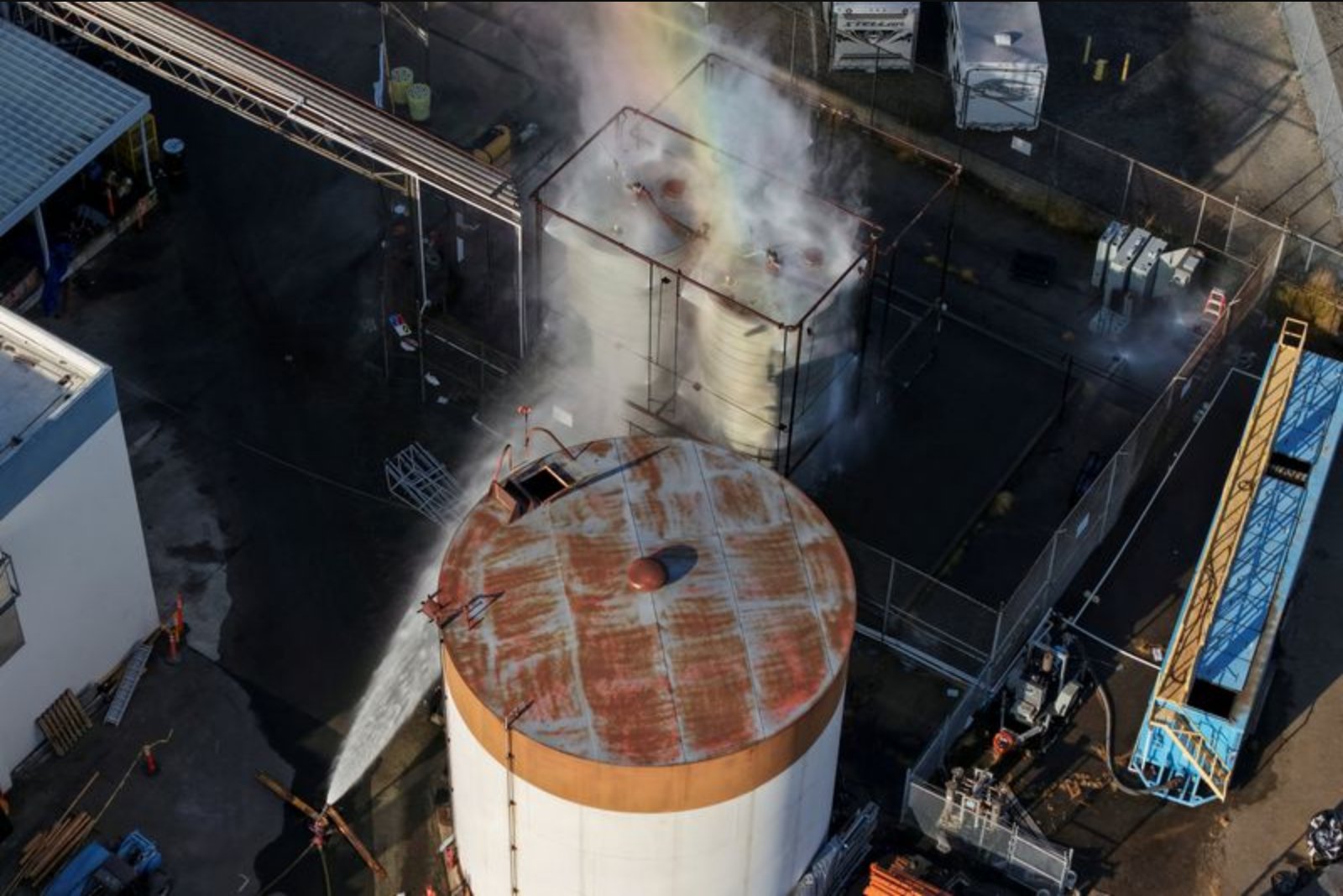
Emergency officials in the Los Angeles suburb of Garden Grove ordered large-scale evacuations after a chemical storage tank began showing signs that it could either rupture and leak or explode, potentially releasing toxic vapor into surrounding neighborhoods.
Firefighters responded using a mechanical device that allowed them to spray water on the tank while keeping personnel at a distance. Craig Covey, division chief of the Orange County Fire Authority, said in a video posted to social media that the cooling effort stabilized the tank's temperature and "bought us time." In an earlier video, Covey described the situation as having two remaining possibilities: the tank could crack and spill or it could blow up, placing neighboring tanks at risk.
"I know I keep talking about we were handed this situation where there’s only two things that can happen, it could crack and leak, or it could blow up. That’s not acceptable to us," Covey said in the later video. He said a broad team of experts was being assembled "locally, regionally, across the state, and across the country, to try to figure out how to fix this." Covey described his objective as bringing together "all these brilliant minds" to develop a plan that would prevent an explosion.
The tank in question contained methyl methacrylate, a flammable and volatile chemical used in plastics and manufacturing at an aerospace plant, according to reports. Officials estimated that if the tank were to fail, it could release up to 7,000 gallons (26,500 liters) of toxic chemicals.
The incident began on Thursday and escalated on Friday when the manufacturing company provided an update that raised the assessed risk of an explosion, said TJ McGovern, interim chief of the Orange County Fire Authority. In response, authorities established three evacuation shelters to accommodate displaced residents - one in Garden Grove and one each in the nearby cities of Anaheim and Cypress.
Garden Grove Police Chief Amir El-Farra reported that about 40,000 people resided within the evacuation zone, and he said roughly 15% of those individuals were refusing to leave. Health officials warned that, if vapor were to escape, prolonged exposure could cause severe respiratory problems. However, Dr. Regina Chinsio-Kwong of the Orange County Health Care Agency noted that air quality monitors had not detected any vapor to date and that people are "safe as long as you are out of the zone that was determined to be an evacuation zone."
Authorities continued to coordinate a technical response aimed at preventing a catastrophic outcome while maintaining public safety measures for residents in and around the affected area. The situation prompted large-scale emergency logistics, including shelter operations and air quality monitoring, as officials balanced mitigation efforts with the need to keep people out of harm's way.
Context and response
- Mechanical cooling was used to reduce tank temperature and delay potential failure.
- Emergency shelters were opened in Garden Grove, Anaheim, and Cypress to support evacuees.
- Air quality monitors have not detected vapor, according to public health officials.
Officials emphasized ongoing multi-jurisdictional coordination to determine the safest path forward for the tank and surrounding facilities, while continuing to enforce the evacuation order for the affected zone.