
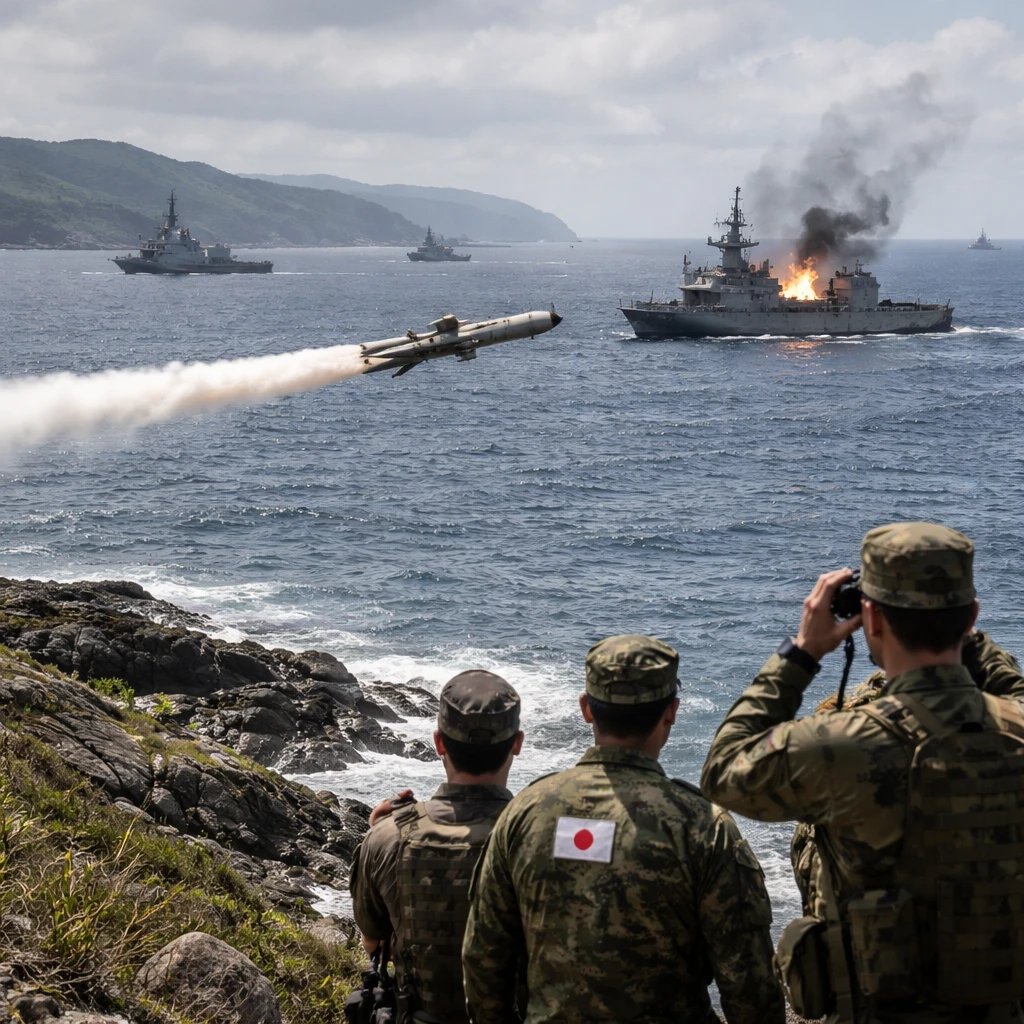
Japan’s Self-Defense Forces conducted a live missile strike on Wednesday as part of a multilateral maritime exercise with the United States, Australia and the Philippines, successfully hitting a decommissioned Philippine Navy vessel in waters that face the disputed South China Sea.
The weapon used was a Type 88 anti-ship missile, fired in two volleys that the Philippine military reported struck the BRP Quezon within six minutes of launch. The engagement occurred roughly 75 km (46.6 miles) off the coast of Paoay in northern Philippines, according to official accounts.
The live fire formed part of the larger annual Balikatan war games, the bilateral exercises between Manila and Washington that are commonly referred to as "shoulder-to-shoulder" drills. This year, Japan joined the exercise as an active participant alongside Canada, Australia, France and New Zealand, marking a broader circle of security partners operating with the Philippines.
The timing of the strike coincided with opening talks between Manila and Tokyo on a potential transfer of defence equipment, a process enabled by Japan's recent decision to remove long-standing restrictions on military exports. Japanese Defense Minister Shinjiro Koizumi said discussions include the possible early transfer of Abukuma class destroyers and TC-90 aircraft to the Philippines.
Philippine Defense Secretary Gilberto Teodoro and Minister Koizumi observed the live missile firing on site, while President Ferdinand Marcos Jr. monitored the exercise via a live video feed from military headquarters in Manila, the president's office said.
"The exercise showcased coordinated maritime strike operations among allied forces and highlighted the AFP’s growing capability to operate alongside international partners in promoting regional security and freedom of navigation," the president's office said in a statement.
The Philippine Department of National Defense described Japan’s Type 88 missile system as "designed to defend coastal areas and deter maritime threats." The defense department and the Philippine military provided the operational details of the firing.
Expressing satisfaction with the outcome, Defense Secretary Teodoro said, "I’m very, very proud and happy that we were able to pull this off for the first time and it will only get larger in scope with more partners."
Earlier in the week, on May 2, Filipino and American forces deployed the NMESIS anti-ship missile in Batanes province, which sits near Taiwan. That operation occurred as tensions continued to simmer around the self-governed island that China claims as its own territory.
Overall participation in this year’s Balikatan exercises exceeds 17,000 troops. That total includes about 1,400 personnel from Japan and roughly 10,000 from the United States, even as U.S. forces remain heavily engaged in operations in the Middle East, officials noted.
China has consistently criticized Manila’s joint drills with allied countries, saying such activities raise regional tensions. The presence of additional partner nations in Balikatan underscores Manila’s widening network of security relationships while also highlighting sensitivities that surround military cooperation in the region.
Context and implications are being tracked by defense and maritime stakeholders as equipment transfer talks continue and multinational exercises expand in scale and participation.