
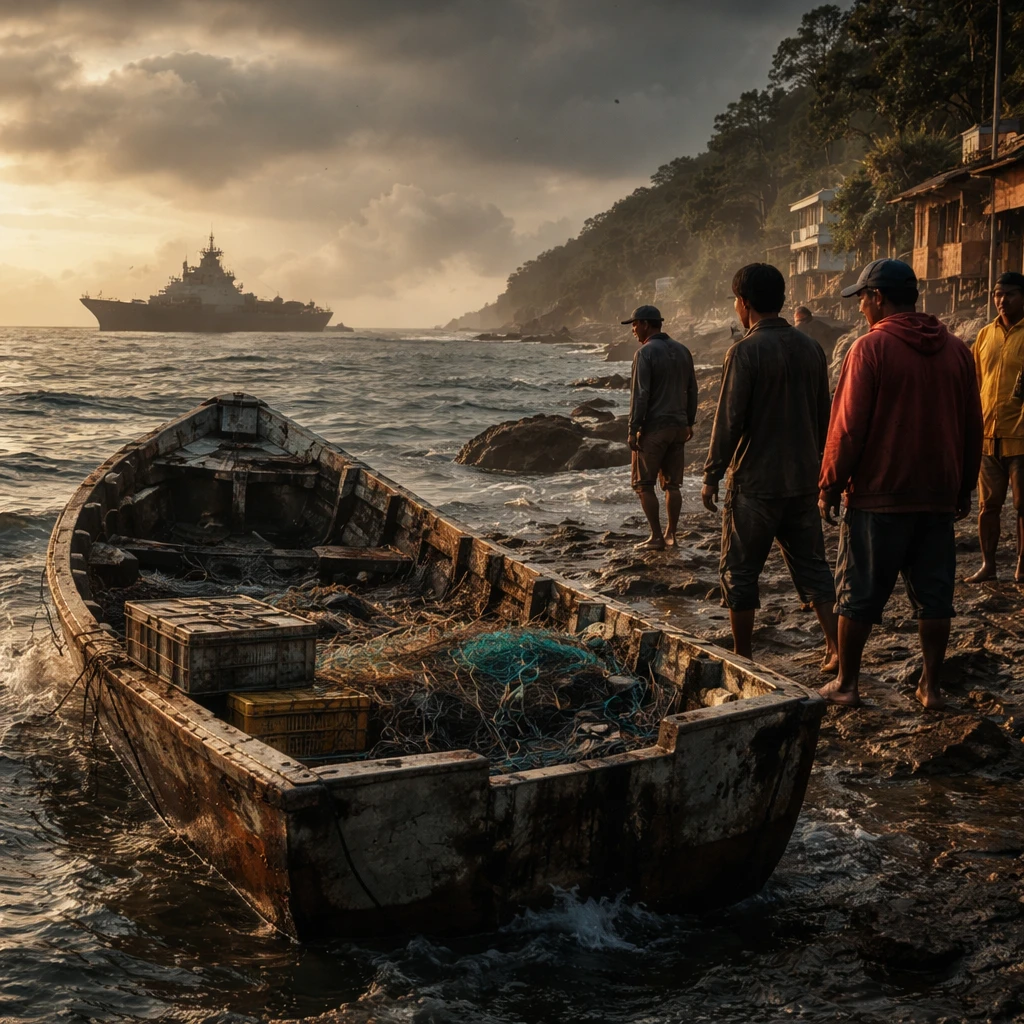
At dawn along Ecuador’s Pacific shoreline, skiffs launch from the tiny ports of San Mateo and Jaramijo with crews hoping for a profitable day harvesting tuna and swordfish. What appears to be a routine fishing morning masks a stark reality: these coastal communities live under pressure from violent trafficking networks on land and lethal counter-narcotics strikes at sea.
Onshore, criminal groups have established a strong presence in Manabi province, turning small ports into nodes for cocaine trafficking and pressing fishermen into service. Offshore, a U.S.-led campaign of maritime strikes has destroyed boats and killed people believed by U.S. authorities to be involved in drug-running. The combination has left some local fishers with few safe options - join smuggling operations and earn sums far beyond legal incomes, pay regular extortion fees to continue fishing, or risk violence from traffickers and the danger of being targeted in military operations.
Accounts of strikes and survivors
The U.S. military has publicly acknowledged destroying 67 vessels and causing more than 220 deaths since last September as part of Operation Southern Spear. Additionally, two attacks that have not been claimed by the U.S. nonetheless mirror the operational pattern of that campaign and involved fishing vessels from Manabi province, according to interviews with survivors and documentation from a local human rights group.
One of the boats hit was the Negra Francisca Duarte II, a 16-person crew that had left from the port city of Manta. On March 17, crew members said they heard a drone overhead shortly before an explosion struck near the galley and set the vessel on fire. Some sailors jumped into the Pacific while others fled in smaller motorized boats. Survivors said they sought refuge at what they thought was a nearby tuna vessel, but instead encountered armed, English-speaking men in military-style uniforms who boarded them, hooded them, bound their hands and took them aboard.
Those men subsequently transferred the crew to a Salvadoran navy vessel, which provided medical attention and later arranged commercial flights to return crew members to Ecuador, according to survivor accounts and a local rights organization. A 52-year-old survivor from the Negra Francisca, who suffered a head injury in the attack, said the experience left him deeply shaken and unsure whether he will ever return to fishing.
Nine days after the Negra Francisca incident, a second drone strike reportedly hit another vessel from the same region, the Don Maca. Survivors describe a similar pattern - a drone strike followed by capture by armed personnel who spoke English and eventual transfer to Salvadoran authorities for repatriation. Separately, at least eight crew members from a third boat, the Fiorella, have been missing since January. Two Fiorella crew on a smaller boat said they saw smoke rising from the main vessel’s last known position.
Local human rights groups and security analysts weigh in
The Permanent Committee on Human Rights, a local advocacy organization, collected a dozen survivor testimonies linking the damaged or destroyed boats to incidents consistent with the strike campaign. Three security experts who spoke to survivors and examined the patterns of attack concluded the United States was almost certainly responsible for the strikes, citing the ongoing campaign by U.S. Southern Command and the specific operational characteristics of the strikes.
Former and current analysts noted Ecuador’s navy lacks the drone and strike capability to carry out such attacks independently, and observers referenced the broader multinational effort to interdict high-seas cocaine shipments in the eastern Pacific as context for the strikes.
The Washington Post reported this week that the boats were struck as part of a covert CIA program. The U.S. Department of Defense redirected questions about specific strikes to the U.S. Southern Command, which declined to comment publicly on operational matters citing security and force protection concerns.
Extortion and recruitment pressures onshore
On land, two powerful criminal organizations - Los Choneros and Los Lobos - have expanded their reach along Ecuador’s coast, forcibly recruiting fishermen for smuggling operations according to Ecuadorian anti-narcotics officials, provincial police and local residents. The United States designated those two groups as terrorist organizations last year. Local authorities and interviewees link Los Choneros to the Sinaloa cartel and Los Lobos to the Jalisco New Generation cartel.
Fishermen who resist recruitment or refuse to cooperate face periodic extortion payments, threats and violence. Those who refuse to participate in trafficking are often required to pay the equivalent of $1,200 per fishing trip - an amount reported by locals to equal three or four times what many fishermen earn in an average month. For crews who agree to transport cocaine, earnings can rise dramatically - fishermen and relatives said payments can reach as much as $40,000 a trip.
Ecuador’s national police acknowledged that some fishermen are coerced into taking part in these illegal activities, exposing them both to legal enforcement and reprisals from criminal organizations. Local authorities estimate roughly 300 residents of Jaramijo have been jailed on drug-trafficking charges in U.S. and Salvadoran prisons over the last five years.
Daily life, coping strategies and economic pressures
Residents describe a sharp uptick in fear and changes to fishing patterns. Some fishermen have cut back on trips entirely because of the twin threats from traffickers and military strikes. Others now fish at night, alter their routes or accept extortion fees and comply with gang instructions that include sailing along approved coordinates and keeping lights on to show they have paid. Smaller inshore boats may be charged less and receive an identification marker indicating compliance with the gang’s demands, according to accounts from locals.
One fisherman reported paying the extortion fee four times and described how the gang supplied a route to follow while warning against deviations that could trigger retaliation or additional payments. Maria Mero, married to a fisherman from the Fiorella, said the fear has reduced the number of trips some men are willing to take: "The fishermen don’t even want to go out now," she said.
Multinational maritime enforcement and its limits
Since last year, the United States, Ecuador and El Salvador have publicly announced stepped-up maritime counter-narcotics cooperation in the eastern Pacific, an area known to be a corridor for northbound cocaine shipments. The coordinated effort emphasizes intelligence-sharing, surveillance and joint interdiction operations.
That cooperation runs alongside Operation Southern Spear, the U.S. campaign of maritime strikes, and Operation Pacific Viper, a U.S. Coast Guard-led initiative targeting high-speed smuggling vessels. The U.S. Southern Command has released night-vision footage of boats engulfed in flames during targeting operations, but has typically provided only casualty counts and limited survivor details.
The U.S. Coast Guard reported that its anti-narcotics activities had led to seizures of 91,000 kg of cocaine and the arrest of 160 suspected traffickers through April. In March, a combined operation by the U.S. Coast Guard and Ecuador’s navy recovered 760 kg of cocaine from an Ecuador-flagged tuna vessel - an amount described as roughly 6% of the total seized offshore of Ecuador in the first half of 2026.
Experts question efficacy of strike-based approach
Some former enforcement officials and analysts warn that destroying boats and targeting crews at sea will not fundamentally disrupt trafficking as long as criminal groups can replace personnel and continue recruiting from communities living in poverty. A former chief of international operations at the U.S. Drug Enforcement Administration said there was "abundant evidence" pointing to U.S. Southern Command responsibility for the strikes, while also noting that sinking vessels alone would not halt trafficking flows.
Analysts focused on organized crime in Guayaquil emphasized that most cocaine shipments continue to move through large commercial ports, and that placing a primary focus on fast-moving fishing boats risks drawing vulnerable, impoverished people into the criminal economy rather than eliminating it. "The current government, together with the United States, is placing too much emphasis on go-fast boats," one organized-crime expert said, arguing that bombing vessels at sea will not stop the broader trade when traffickers can recruit replacements.
"Organized crime understands a central reality: Everyone is replaceable," the same expert added, highlighting how the human cost of maritime strikes and arrests can be absorbed by criminal groups that continue to exploit local labor pools.
Humanitarian and legal questions
The accounts compiled by survivors and rights groups raise questions about how maritime enforcement is being executed and what protections are afforded to people caught in such operations. Some survivors maintain their boats had been boarded and searched by Ecuador’s coast guard hours before a strike and found to be carrying no contraband. One survivor involved in the March 17 attack said his vessel had been inspected and cleared earlier that day.
The Salvadoran navy posted on March 23 that it had rescued 16 shipwrecked Ecuadorians, and the Salvadoran vessel that picked up the Negra Francisca crew reportedly provided care before arranging their return to Ecuador. Ecuador’s president did not respond to requests for comment and the Ecuadorian military said details about drug enforcement operations are classified.
Where this leaves coastal communities
Fishermen in San Mateo and Jaramijo face a narrow set of choices: comply with criminal networks and risk becoming part of trafficking operations, pay extortion fees that outstrip typical monthly earnings, or stop fishing and forgo livelihoods. At the same time, maritime strike campaigns and interdiction operations continue to place fishermen and their communities at the intersection of international security efforts and local criminal coercion.
Survivors of strikes, family members of missing sailors and local rights groups say the current mix of enforcement and criminal predation has made normal fishing life untenable for many. Some crews have stopped going out entirely. Others continue under altered patterns of operation, guided by survival considerations rather than traditional fishing practices.
The unfolding situation underscores the complexity of confronting transnational trafficking networks in regions where poverty, limited state presence and international security operations converge. For coastal Ecuadorian communities, the promise of a good catch now comes with acute risk - on land from extortion and recruitment, and at sea from the lethal outcomes of a campaign aimed at disrupting cocaine shipments.