
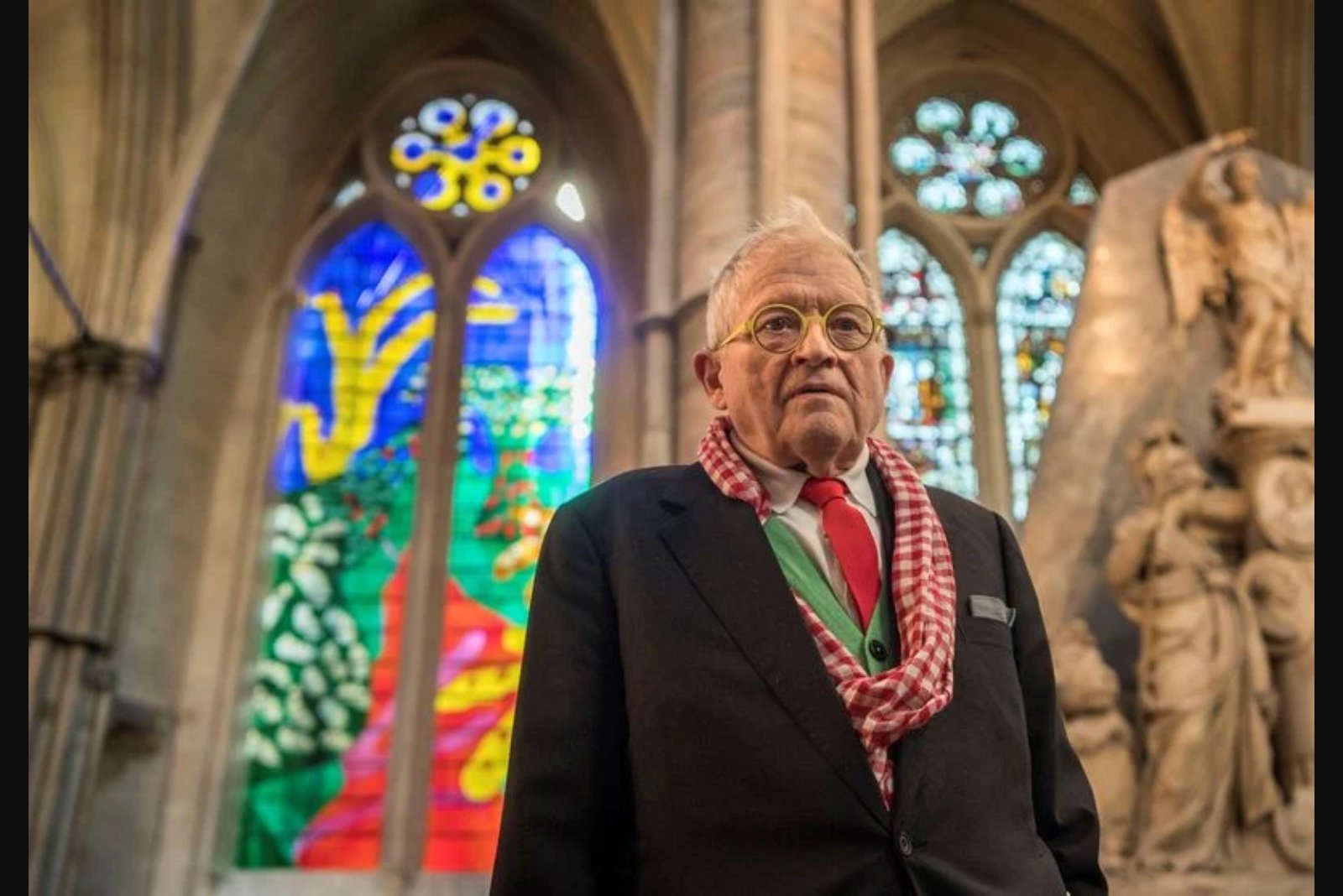
David Hockney, the British artist whose vivid, colour-drenched canvases of Californian life and later pastoral scenes of northern England and Normandy made him one of the most recognisable figures in modern art, has died at the age of 88, Sky News reported. No cause of death was given.
Hockney’s work and public image were often inseparable. Early in his career he cultivated a distinctive look - thick-rimmed spectacles, peroxide hair and a shiny gold jacket - that became emblematic of Britain’s Swinging Sixties. Yet his ambitions went beyond fashion. Raised in the industrial north of England, he recalled as a child watching Laurel and Hardy films and associating the “strong shadows” on screen with sunlight and warmth. In an interview with the BBC in 2009 he said, "Strong shadows meant a lot of sun," and added, "So I thought, well, wherever that is, it’s always sunny." That association would eventually prompt a long migration of subject and place.
Born in Bradford to a father who worked as an accountancy clerk and a devout Methodist mother, Hockney studied art in his home city and quickly moved away from conservative expectations. While still a student in Bradford he chose provocative titles for abstract works - examples included "Going to be a Queen for Tonight" and "Doll Boy" - at a time when homosexuality was punishable by prison. To further his studies he relocated to London in 1959, where he became prominent within the British pop art movement and associated with figures from the worlds of dance and music.
His interest in American art and its use of colour led him across the Atlantic. Using proceeds from his early sales, he visited New York in 1961 and became acquainted with figures including Andy Warhol. Three years later he moved to California to immerse himself in the light and landscape that he believed informed the work he admired. As Peter Adam, an art critic and friend, recounted in a biography, Hockney said, "I thought people who produced such work must live in colour, so I went in search of it," and added, "I had spent the first 20 years of my life in the gothic gloom of the North. Here I felt free."
In California Hockney developed the imagery that would become iconic - luminous acrylic paintings of swimming pools, sunlit interiors, and male nudes in shower scenes that captured a particular sun-drenched lifestyle. These paintings, executed with a clarity of form and intense colour, helped elevate him to international prominence and shaped perceptions of West Coast modernity. Despite the notoriety and commercial success, Hockney maintained a modest disposition toward his practice. "I am actually still a student," he told Adam, "I just happen to have quite a lot of credit cards in my pocket."
Hockney’s profile extended into high-profile social circles. In 1985 he was invited to dine at the White House with President Ronald Reagan, Prince Charles and Princess Diana; his biographer notes that he was delayed by security for half an hour because he arrived on foot while other guests used motor transport.
Critical reception of his subject matter varied. Some commentators dismissed elements of his imagery - depictions of love, sex and material comfort - as trivial. Yet his market recognition grew. One of his best-known works, "Portrait of an Artist (Pool with Two Figures)," depicting a swimmer underwater while another man gazes into the pool, sold for $90.3 million in 2018, which at the time made it the most expensive work by a living artist sold at auction.
Personal loss and shifting priorities affected Hockney’s later output. As friends succumbed to AIDS, the artist’s human subjects receded and were sometimes replaced by his dogs; he said he wept for two days when Stanley, a beloved dachshund who appeared in many works, died in 2001. In the late 1990s he began to travel more often back to Yorkshire to visit his mother. Prompted by a terminally ill friend, he turned his attention to the local landscapes of the Yorkshire Wolds, relocating from California to the seaside town of Bridlington. There he painted the region’s winter bare trees, expansive fields, and meandering tracks, describing the period as the most productive of his career. Hockney observed that the seasonal changes in Yorkshire seemed more dramatic than those in California.
His approach to making and sharing work kept evolving. A former self-styled enfant terrible of British art - frequently pictured with a cigarette - Hockney experimented with communication and technology, using faxes to transmit art and later embracing iPads as a medium. His Yorkshire studies culminated in a stained-glass commission for Westminster Abbey in central London.
In 2018 he purchased a farmhouse in Normandy and turned his attention to the fields and gardens there, producing the 90-metre-long frieze "A Year in Normandie," a project inspired by the Bayeux Tapestry. Throughout his life he retained a rigorous work ethic, shaped in part by early years when he rose at 6 a.m. daily while working in hospitals for two years and later refusing military service in the army. "I tend to think that you should work every day," he said. "And I do." Asked about his sustained energy, he told the BBC in his broad Yorkshire accent, "You don’t retire doing this. You just do it until you fall over."
Hockney’s career spanned decades and geographies - from Bradford to London, New York, Los Angeles, Bridlington and Normandy - and encompassed multiple stylistic phases, technological experiments and public commissions. His death marks the closing chapter of a life in which personal experience, place and an unrelenting commitment to making art were constantly intertwined. Sky News reported his death on Friday. No cause of death has been disclosed.
Summary
David Hockney, the British artist renowned for vibrant acrylic depictions of Californian life and later landscapes of Yorkshire and Normandy, died aged 88, Sky News reported. Born in Bradford, he rose to prominence in London’s art scene, spent decisive years in the United States and returned frequently to northern England, producing notable works and public commissions. One of his paintings sold for $90.3 million at auction, a record for a living artist at the time. No cause of death has been given.