
Two devastating quakes weeks apart have put emergency response systems in Venezuela and Colombia under intense scrutiny, with eyewitnesses, aid workers and private security staff describing dramatically different on-the-ground realities.
The Venezuelan disasters - two tremors of 7.2 and 7.5 magnitude that struck coastal La Guaira - have been blamed for a national death toll currently reported at 6,300. In Colombia, a quake of similar magnitude centered near the city of Cali left at least 285 people dead and roughly 380 still unaccounted for.
Immediate aftermaths: civilians first
In both countries, neighbors and volunteers were crucial in the first hours after buildings collapsed. But what followed diverged sharply.
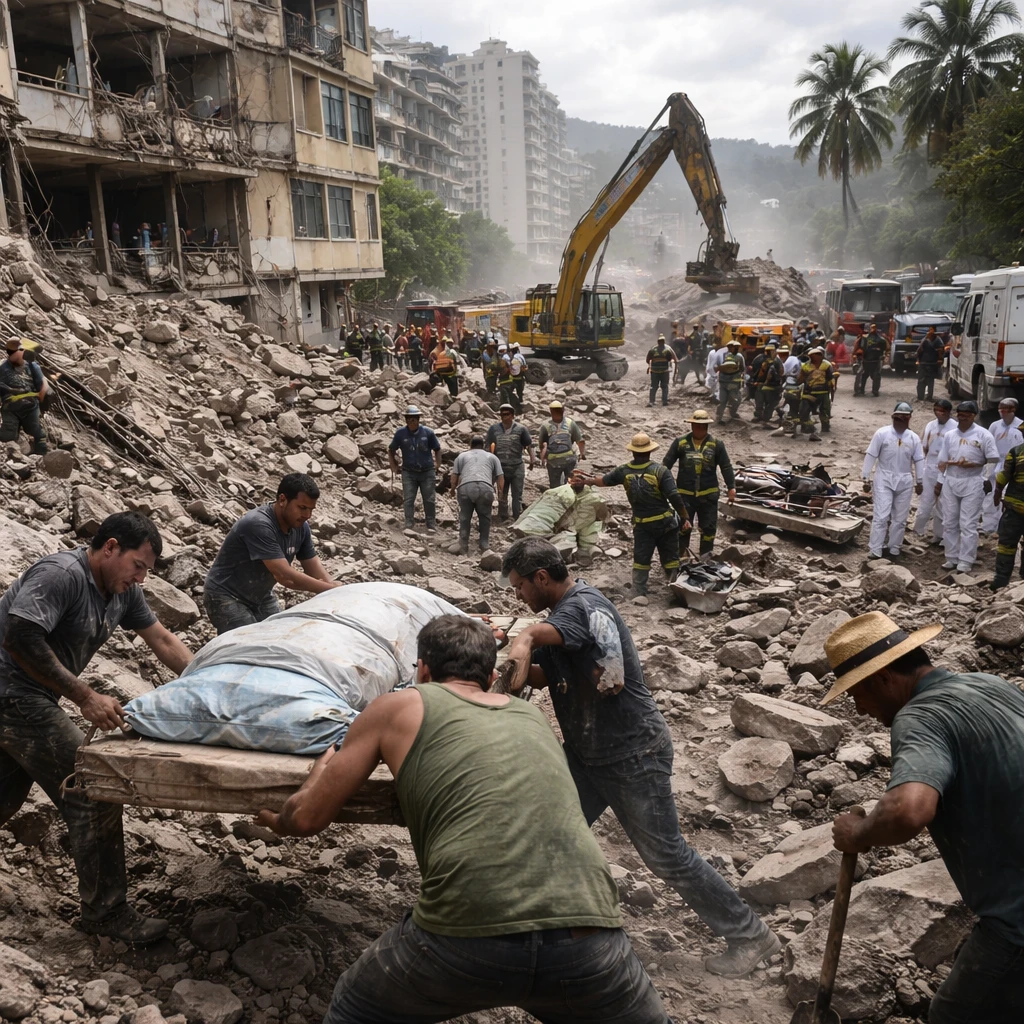
At a landmark 1,100-unit social housing complex in La Guaira, known locally as Los Cocos and named after the late President Hugo Chavez, much of the block gave way in the Venezuelan quakes. Families, neighbors and a handful of local officials spent weeks digging through concrete and debris with bare hands, buckets and sticks. International rescue teams assisted, as did a small contingent of Venezuelan federal officials, but the dominant impression from residents and witnesses was one of civilians carrying the heaviest burden.
Descriptions from the site recount volunteers arriving from other states with generators, food, water and supplies, and locals hauling bodies out on improvised stretchers such as old mattresses until forensic specialists appeared several days later with body bags. Calls for heavy machinery and a greater official presence went largely unanswered at first. A month after the quakes, two cranes and other heavy equipment were finally operating to remove large sections of rubble.
By contrast, when a five-story residential block called Torres del Limonar collapsed in a southern neighborhood of Cali, the initial civilian rescues - about 20 people pulled from rubble by neighbors and volunteers - were followed quickly by an organized, multiagency official response. Local firefighters arrived first and were soon joined by police, navy rescuers and search-and-rescue teams from other cities. Within 48 hours the site was strictly managed: volunteers were limited to specific, controlled tasks to prevent overcrowding and to allow professional rescuers to listen for survivors. A constant rotation of dump trucks cleared debris in the shadow of two cranes, and police forensic teams used metal litters and specialized vehicles to remove bodies.
Capabilities and equipment
Observers and private security staff reported little access to heavy machinery at Venezuelan sites in the immediate aftermath. Civil protection officials in La Guaira who had tunneled six stories into the rubble later required multiple body bags to retrieve decaying remains, working alongside soldiers to remove them. An army sergeant described equipment problems and recounted efforts to identify survivors’ relatives and assess who needed assistance.
In Cali, heavy equipment and forensic protocols were present much sooner. More than a dozen official entities coordinated activity at Torres del Limonar, creating an environment in which hundreds of rescues were possible within the crucial 72-hour window after the quake.
Humanitarian response and uneven needs
Humanitarian workers who have operated in both countries praised Colombia’s efficient local-level organization in getting heavy machinery and official teams to many impacted places. Many of those workers had recently returned from Venezuela and contrasted the two contexts directly. They also warned, however, of isolated and vulnerable areas within Colombia, particularly the coastal Pacific province of Choco. Choco, Colombia’s poorest province, recorded 13 deaths and no registered missing people, but aid workers noted it already faced wide humanitarian needs following decades of neglect and armed violence, which the quake may exacerbate.
Private security observations
Global Guardian, a Virginia-based private security firm whose staff helped relocate or support oil, gas and financial sector employees after the quakes, reported a smoother operational experience in Colombia than in Venezuela. Tomas Michael Carvallo, a senior intelligence analyst at the firm, said there was no access to heavy machinery when his staff arrived in Venezuela and that many immediate search-and-rescue efforts fell to civilians not equipped to move concrete and collapsed buildings.
Political context and official statements
The quakes occurred amid notable political developments in both nations. Venezuelan authorities, led by interim President Delcy Rodriguez, rejected characterizations of a delayed or insufficient response. Rodriguez told reporters in early July that the government acted immediately, saying 4,000 officials had been deployed on the first day, rising to 14,000 the next. She criticized what she called a "media narrative" of chaos.
Observers noted other political shifts in Venezuela. The article records that Washington’s capture of President Nicolas Maduro in January has ushered in a rapprochement with the Trump administration, under Rodriguez’s leadership as Maduro’s former vice-president. The top U.S. diplomat in Caracas did not directly address criticisms of Venezuela’s response, saying only that Venezuela complied with requests to advance humanitarian assistance.
In Colombia, the disaster posed an early test for the country’s newly sworn-in right-wing president, Abelardo De La Espriella, who took office three days before the quake. De La Espriella, known for pledges of tougher security and austerity, has criticized his predecessor for overspending and was immediately reviewing a more than $180 billion budget for 2027 while promising emergency funds for those who lost homes and businesses. Analysts suggested that an effective response could help De La Espriella gain support in regions that opposed him.
Accountability and social tensions
In Venezuela, the response environment has been further complicated by arrests and viral social media footage. Authorities arrested four police officers for alleged looting after the quake, and widely shared videos showed locals confronting an official holding U.S. dollars found in the rubble. Another circulated video showed heavy machinery standing idle, reportedly due to lack of fuel.
Conflict monitoring analysts said the Venezuelan situation reflects deeper institutional erosion. One analyst observed that local-level mismanagement offered evidence of institutional deterioration.
Financing and reconstruction questions
Officials and analysts have linked reconstruction challenges to ongoing tensions over financial assets. The acting Venezuelan government, analysts say, may have an improved chance of making progress in efforts to recover more than $4 billion in gold bullion held by the Bank of England, which Caracas has tied to reconstruction efforts.
Humanitarian groups warned that rebuilding will be long and difficult. Mayerly Sanchez, a coordinator for World Vision, said it will take many years to restore a sense of stability for the two countries, particularly for children, and that the emergency phase has only just begun.
Implications for logistics and sectors
The unequal response capacity in the two countries has implications for sectors tied to infrastructure and movement of goods and people. Venezuela’s long-standing shortages, hyperinflation and workforce departures have been cited as constraining rapid, equipment-based responses. Critics say corruption and underinvestment have eroded the country’s capacity, including in its oil sector. In Colombia, the rapid mobilization of multiple official agencies and heavy machinery demonstrates greater local-level readiness in urban search-and-rescue, though remote and under-resourced provinces could face prolonged disruptions.
As both nations move from immediate response to recovery, coordination between humanitarian organizations, private security providers and governments will shape how quickly infrastructure, housing and essential services are restored.
Note on sources and observations: The reporting is based on interviews with witnesses in both countries, comments from aid workers and observations from a private security firm that assisted personnel after the quakes.