
Colombians are voting in a presidential runoff that will determine whether the country sustains the leftward trajectory set by President Gustavo Petro or shifts toward a right-oriented, security-focused administration led by a political outsider.
The runoff comes after a crowded May election produced no outright winner. Voters will now choose between two finalists: Ivan Cepeda, a left-wing senator who is proposing to continue the current government's social and peace-oriented programs, and Abelardo De La Espriella, a right-wing lawyer and businessman with no prior elected office experience who is campaigning on tougher measures against armed groups and a boost to the oil and gas sector.
Policy contrasts
Cepeda, 63, has framed his candidacy as an extension of President Petro's agenda. That agenda includes state-funded pension support aimed at poorer Colombians, labor reforms supported by unions, renewed peace negotiations with armed groups, and a freeze on authorizing new oil projects. These measures reflect a prioritization of social spending and negotiated demobilization of combatant groups.
De La Espriella, 47, offers a sharply different set of priorities. He has pledged to end ongoing talks with armed groups and to mount a wide-ranging military offensive against them, while opening up and incentivizing Colombia's oil and gas industry. He has also blamed the Petro administration for what he characterizes as the nation's economic and security troubles, and has promised to lower taxes and shrink the size of the state by up to 40%.
At the same time, De La Espriella has said he would leave in place some of Petro's popular measures, including the president's 23% increase in the minimum wage, along with other social programs.
Economic and political constraints
Whichever candidate is elected will inherit a country with high public debt and a Congress that remains politically fragmented. That division in the legislature could constrain the ability of either administration to pass major reforms, particularly those affecting fiscal policy or structural changes to public spending.
Markets and polls have given De La Espriella an edge since he topped the first round with 43% of the vote, but political analysts and observers expect the runoff to be closely contested. Both candidates have worked to mobilize voters who sat out the May election; nearly half of eligible Colombians did not vote in that first round.
Regional context and security concerns
The vote in Colombia takes place amid a regional swing toward right-leaning leaders in several Latin American countries. Recent elections in Chile, Argentina, Costa Rica and Ecuador resulted in right-wing presidents, while Bolivia elected a center-right leader last year. In Peru, counting is ongoing from a June 7 contest in which conservative Keiko Fujimori is positioned to win.
Those shifts, including Colombia's, were largely driven by voter anxiety about escalating crime rates and weak economic conditions. In Colombia, efforts to negotiate peace under President Petro have not halted the growth in strength and numbers of armed groups, and drug trafficking gangs have expanded operations, producing spikes in homicides and extortion in parts of the country such as the Caribbean coast.
De La Espriella has accused Petro and Cepeda - the son of a murdered communist leader - of being allied with criminals, an allegation Cepeda denies and says lacks evidence. Petro's government counters that it has seized more cocaine than any other government.
Cepeda has criticized De La Espriella's legal work, saying the candidate represented clients tied to right-wing paramilitary groups and corruption cases, including work involving Alex Saab, who faces U.S. charges for allegedly laundering money for ousted Venezuelan President Nicolas Maduro. De La Espriella rejects any suggestion that his professional relationships imply complicity in crime.
International dynamics
Internationally, U.S. policy in the region has become more assertive. The article notes that the United States has acted to increase its presence and influence, citing moves such as the arrest of Maduro, targeted strikes against alleged drug traffickers in the Caribbean, and the creation of the Shield of the Americas, a security alliance of right-leaning governments pledging action against drug trafficking.
U.S. President Donald Trump - who has engaged in public disputes with President Petro - publicly endorsed De La Espriella this month. Posting on his social platform, Trump said: "It is my Honor to give Abelardo my Complete and Total Endorsement," and added that the outcome of Sunday’s race is "very important to the future of Colombia and its relationship to the United States."
Logistics and turnout
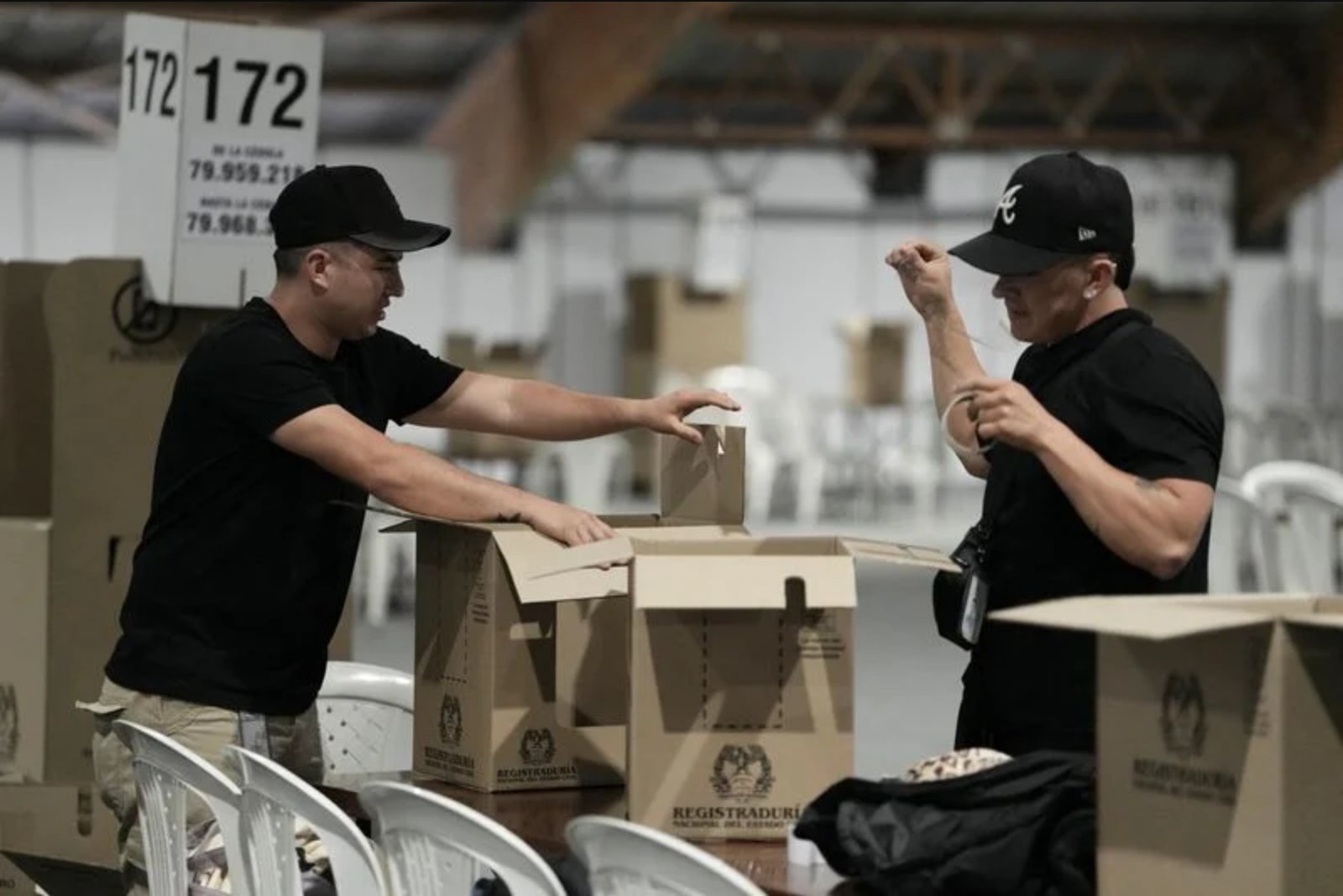
More than 41 million Colombians are eligible to vote in the runoff. Polling stations open for an eight-hour period beginning at 8 a.m. local time (1300 GMT), and initial results are expected a few hours after polls close.
What to watch next
- Voter turnout among those who abstained in May - both campaigns have explicitly sought to mobilize nonvoters.
- How the next administration approaches security operations versus negotiated peace efforts, and the resulting impact on violence hotspots such as the Caribbean coast.
- Immediate market reactions to a victory by either candidate, given their divergent stances on the oil and gas sector and fiscal policy.