
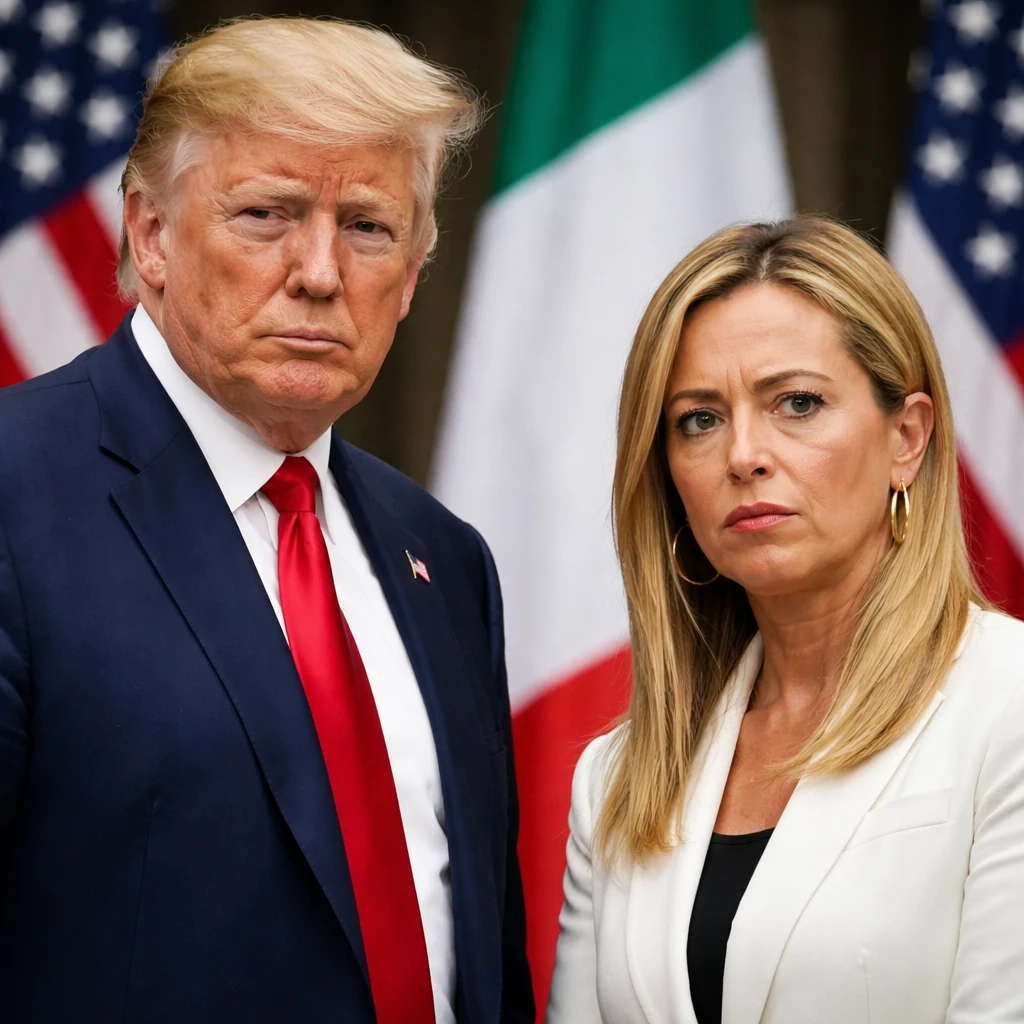
U.S. President Donald Trump and Italian Prime Minister Giorgia Meloni renewed their public dispute over Italy's stance on the Iran conflict, marking a significant shift in diplomatic relations between the two nations. According to reports, the leaders exchanged criticism on Saturday, extending a pattern of discord that has emerged over recent days.
During a social media post, Trump reiterated his assertion that Meloni had attempted to secure a photograph with him at the G7 summit held in France earlier that week. However, he stated that he refused the request, citing Italy's refusal to back the U.S. military campaign against Iran. Trump further implied that Meloni may be seeking stronger alignment with Washington following the conclusion of the military operation.
Meloni quickly countered on Instagram, labeling Trump's repeated statements as "senseless" and emphasizing Italy's sovereignty. "Italy remains a sovereign nation," she declared, adding, "I suggest you focus on yours," a reference to Trump's domestic popularity. Her remarks underscored Rome's commitment to maintaining an independent foreign policy.
The deterioration in relations between the two leaders has been ongoing, primarily driven by Italy's steadfast opposition to the war. As energy prices surged during the conflict, Italy's criticisms intensified. Earlier this year, Rome explicitly denied Washington the use of an airbase in Sicily for combat operations tied to the conflict, pointing to existing restrictions on the facility's use.
Additionally, Meloni publicly criticized Trump's remarks directed at Pope Leo XIV, who had voiced opposition to the war. This added another layer of tension to an already strained relationship.
While there were signs of a temporary easing of tensions during the G7 summit, with Italian officials suggesting that discussions had improved relations, this progress was short-lived. Trump's televised remarks on Friday, in which he claimed Meloni had "begged" for a photograph, reignited the controversy. Meloni firmly rejected this claim, calling it "totally made up," and expressed regret that Trump did not direct similar criticism toward what she described as adversaries of the United States and the West.
This public disagreement represents a rare escalation in tensions between two leaders whose governments have traditionally maintained close ties on economic and security matters. The discord raises questions about the stability of transatlantic cooperation and its potential impact on broader geopolitical and economic alignments.