
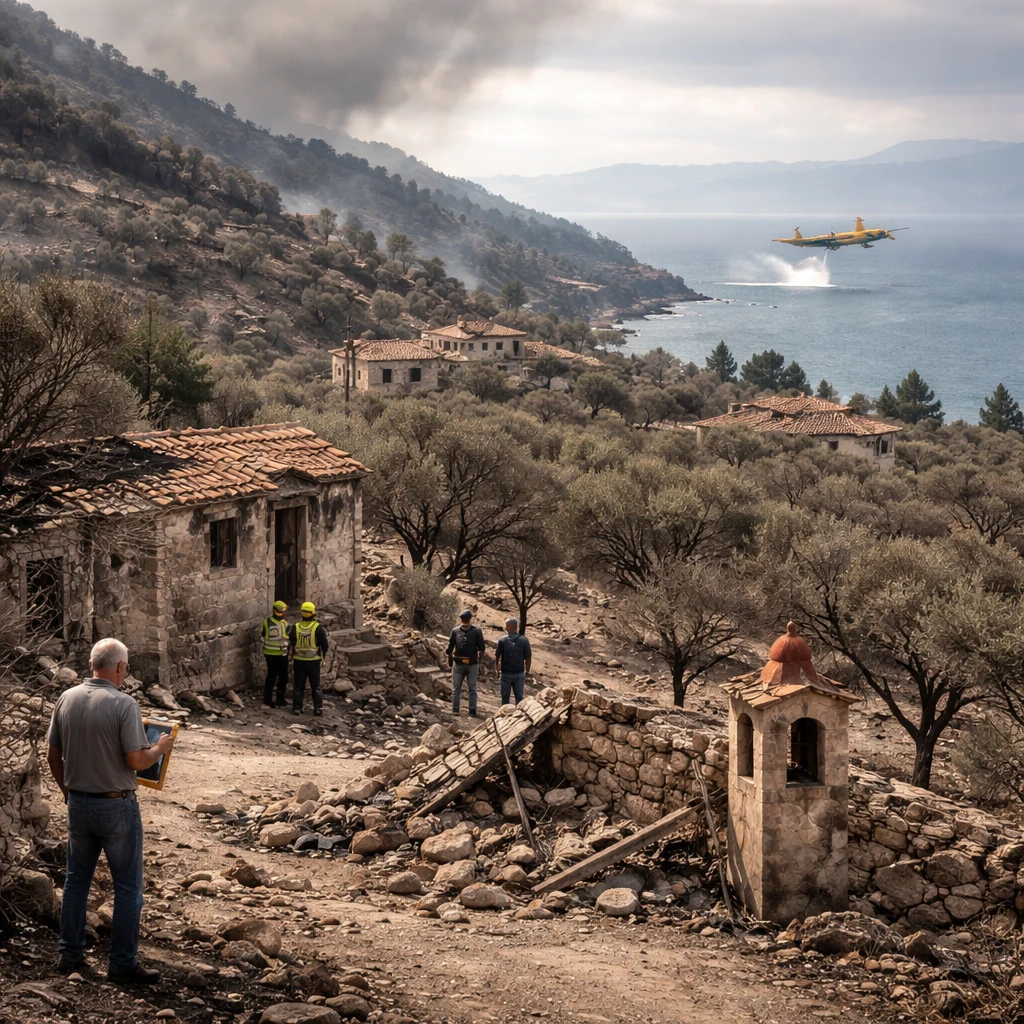
Firefighters reported reduced but still active wildfire conditions in parts of Greece on Tuesday, as residents began returning to properties gutted by flames. Hundreds of personnel remained on alert for fresh flare-ups northwest of Athens, where steep hills and deep gullies complicated containment efforts and allowed blazes to consume homes, forests, farmland and olive groves.
Teams on the ground were aided by water-bombing aircraft and by additional crews sent from Romania and France. Officials said those forces were engaged on three fronts west of Athens, operating in the area along the Gulf of Corinth to extinguish fires that began on Friday.
Authorities said strong, dry winds known locally as the meltemi - blowing in from the Aegean Sea - hindered suppression work and at times grounded water-bombing planes. "We are talking about a fire where we didn’t have an aircraft at our disposal for 30 continuous hours, which caused us a lot of difficulties," Deputy Fire Brigade spokesperson Ioannis Artopoios told public broadcaster ERT.
In the coastal settlement of Porto Germeno, roughly 60 km (40 miles) northwest of Athens, residents picked through the remains of burned houses and the scarred countryside where they once spent summers. Vivi Gialia, 45, stood amid the rubble of her parents' house and the blackened landscape of childhood memories. "It’s as if my heart has been torn out," she said.
Small roadside religious shrines, a common sight near Greek homes, remained intact in some places even where houses had been gutted. In one dwelling a woman swept shards of broken tiles inside a soot-darkened room, and the steel front door of the house was blackened by fire. Gialia criticized what she described as a slow response by firefighting teams.
Europe as a whole has experienced a severe wildfire season following a stretch of record heat and limited rainfall, conditions that many scientists say have been worsened by human-driven climate change. France and Spain faced some of the largest blazes in the region and those fires eased over the weekend, offering a degree of relief. Until this recent outbreak Greece, a country prone to seasonal fires, had seen a comparatively mild summer.
Separate from the ground operations, officials confirmed that two crew members of a firefighting helicopter were killed on Sunday near the seaside community of Psatha, about 40 km (25 miles) from Athens. The incident occurred after a mid-air brush with a second helicopter; the two crew members aboard the other aircraft survived. The helicopters involved were U.S.-registered Bell models, and the U.S. Federal Aviation Administration is investigating the circumstances, Greek authorities said.
Emergency services continued to balance containment tasks with protecting communities and assessing damage to homes and agricultural land, while investigators look into the fatal helicopter collision.