
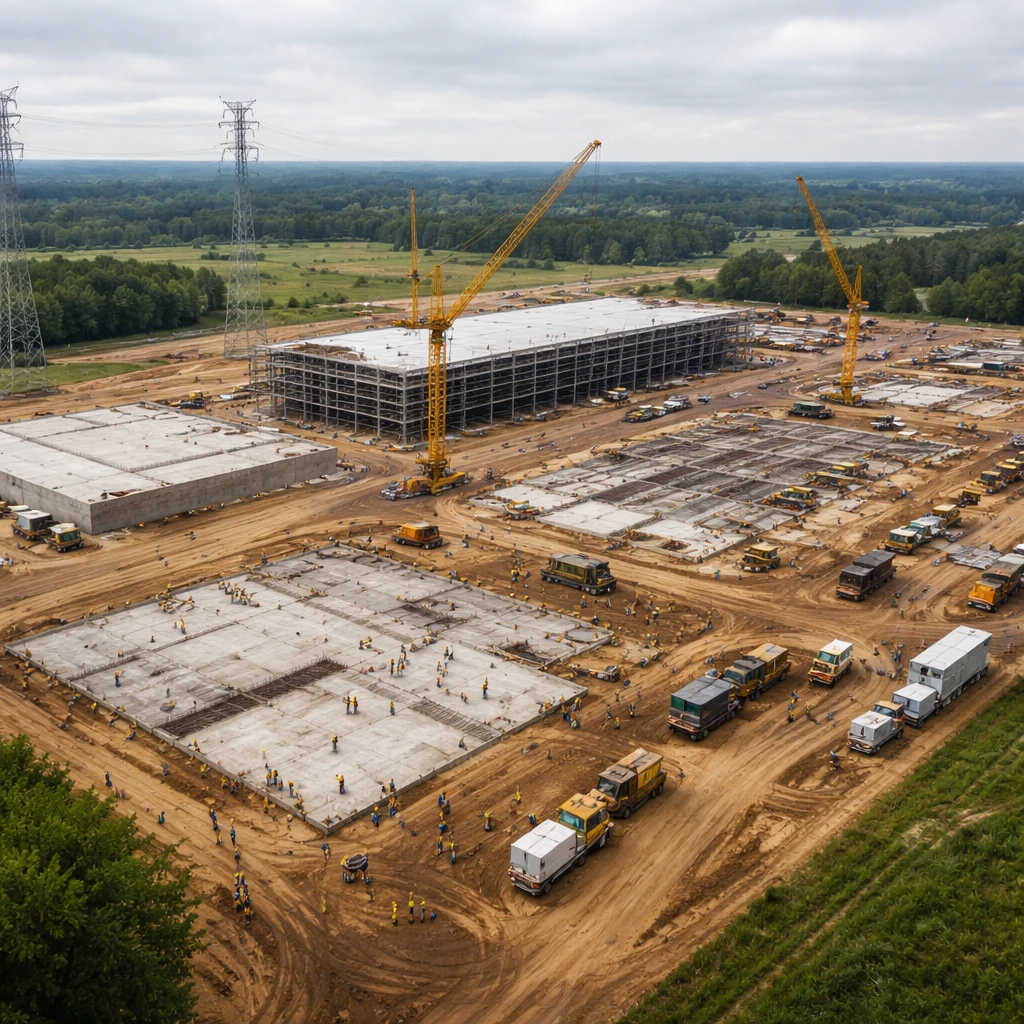
S&P Global Ratings affirmed its 'BB-' issuer credit rating on TeraWulf Inc. (NASDAQ: WULF) on Wednesday and revised the issuer outlook to stable from positive after the company announced a long-term lease with Anthropic for a new AI data center campus in Hawesville, Kentucky. The lease spans 20 years and was reported as valued at $19 billion for a facility designed to support roughly 401 megawatts of compute load.
Alongside the issuer rating on the parent, S&P assigned a 'BB-' issuer credit rating to WULF Compute LLC and set a positive outlook on that subsidiary. The ratings agency framed the outlook change for the parent around uncertainties tied to how the Hawesville campus will be financed, the inherent construction risks, and the fact that Anthropic does not carry a public credit rating.
S&P noted management's indication that the lease will be underpinned by an investment-grade credit, which could serve as lease enhancement if Anthropic remains unrated or is later rated in the speculative-grade category. The agency also described the sale of TeraWulf's stake in its Abernathy, Texas joint venture as a modest credit positive for the company.
The Hawesville development is slated to bring initial capacity online in late 2027, with full buildout expected by early 2028. At full scale, S&P estimates the campus will account for approximately 48% of TeraWulf's total contracted revenue in 2029.
Construction risk is not viewed as unmitigated. S&P pointed to TeraWulf's agreement with Fluor to support design and construction, the project's phased delivery plan, and existing power and transmission infrastructure at the site as factors that reduce execution risk.
WULF Compute LLC benefits from structural protections intended to limit the parent company's ability to extract resources. Under the arrangement, lease payments are directed into a lockbox controlled by the collateral agent and distributed through a waterfall that prioritizes operating expenses, mandatory debt amortization, interest costs and then excess cash flow offers. S&P wrote that WULF Compute's ratings could improve once construction is fully complete and would gain from a backstop provided by Google LLC.
The ratings agency outlined conditions that could prompt a downgrade of TeraWulf's rating. A materially aggressive financing structure that leads to funds from operations to debt falling below 7% or EBITDA-to-interest coverage dropping below 1.5x could lead to lower ratings. Conversely, S&P said it could consider raising the rating if TeraWulf commits to maintaining debt-to-EBITDA below 6x, funds from operations to debt above 9%, and EBITDA-to-interest coverage above 1.75x.
Contextual notes
- The Hawesville project is a major portion of TeraWulf's contracted revenue profile for 2029, representing about 48% when at full capacity.
- Key mitigants for construction exposure include an agreement with Fluor, phased delivery, and existing transmission and power infrastructure at the site.
- WULF Compute's structural controls - lockbox and waterfall distributions - restrict upstream cash flow and prioritize debt and operating obligations.