
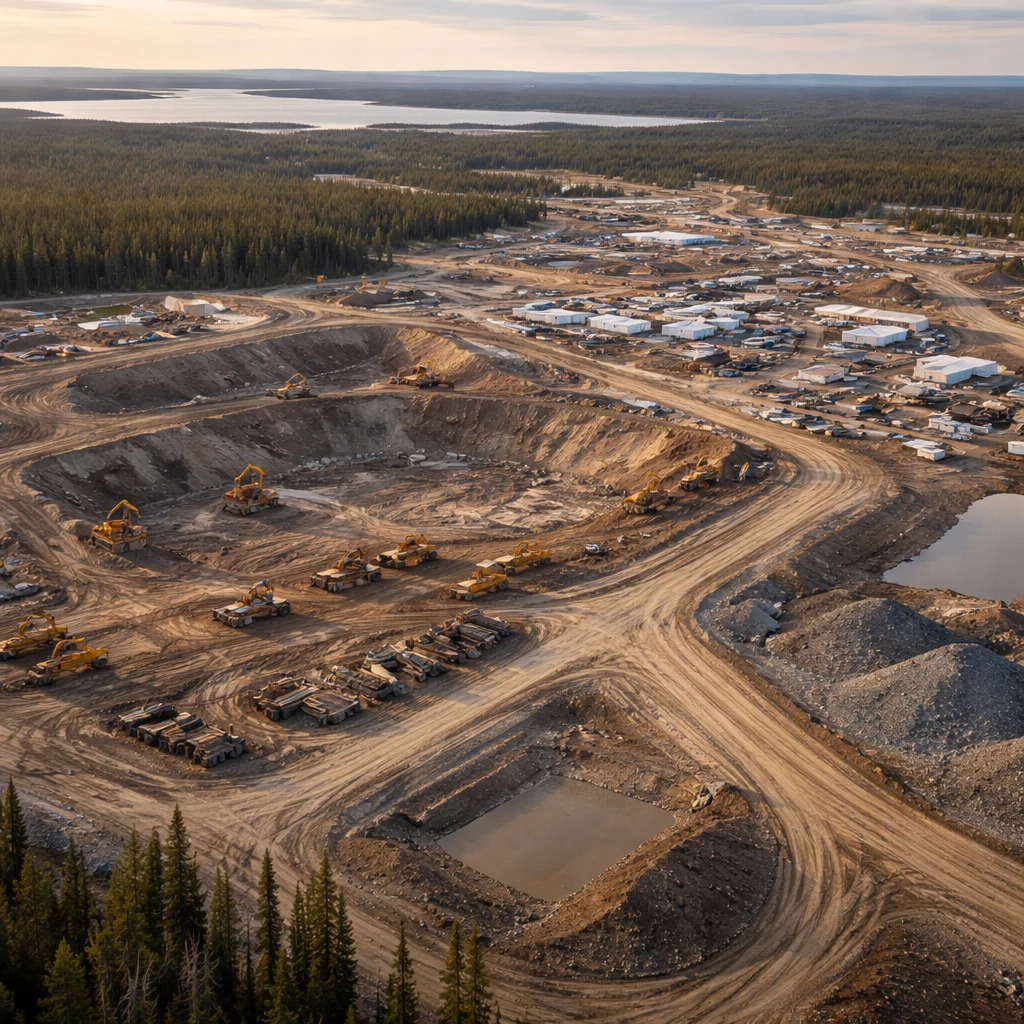
NexGen Energy is holding routine technical conversations with BHP about the Rook I uranium project in Saskatchewan, the Canadian miner's chief executive Leigh Curyer said. The comments come as NexGen has just started construction at Rook I and is lining up about C$1 billion in funding to get the planned mine built.
NexGen's market value has roughly doubled over the last year to C$9.68 billion. The company began construction at Rook I last Thursday and has a target to commence production by 2030.
Management told investors it intends to raise about $1 billion over the coming nine months and is evaluating a suite of financing options. Those include upfront prepayment agreements with utilities, traditional debt instruments and direct project equity, the company said.
When asked about a possible equity partnership with BHP, Curyer characterized the relationship as an open, technical dialogue. He noted that BHP has purchased a sizable parcel of land near Rook I within Saskatchewan's Athabasca Basin and that regular technical exchanges take place between the two firms. Curyer added that BHP is seeking to increase its exposure to assets in politically stable jurisdictions, but said it is unclear how that preference might translate into a formal relationship.
People familiar with the matter said BHP's business development team conducted an evaluation of NexGen last year under the company's former CEO, Mike Henry. Separately, an investor who requested anonymity told reporters that BHP's incoming chief executive, Brandon Craig, who took the helm on July 1, also intends to assess uranium prospects. BHP declined to comment on the discussions.
Although BHP already contributes roughly 5% of global uranium supply as a byproduct of its Olympic Dam copper operations in South Australia, the miner has previously said it would not expand uranium production at that site. The prospect of greater BHP interest in uranium coincides with expectations of rising nuclear power demand, driven in part by the electricity needs of AI-powered data centers and by government efforts to diversify energy mixes.
BHP is also broadening its footprint in Saskatchewan where it is developing what is expected to be the world's largest potash mine. The broader region - the Athabasca Basin - contains the world's largest known uranium deposit and some of the highest-grade resources, according to Canada's natural resources ministry. The basin is already home to major producers and developers such as Cameco, Orano Mining, Denison Mines and Paladin Energy.
NexGen's Rook I project is projected to become one of the world's largest uranium mines once it is operating. Some market participants have suggested that NexGen's recent, sharp increase in market capitalization could raise the price for any potential acquisition by a larger miner like BHP.
Analysts at Canaccord expect global uranium demand to triple by 2035 compared with 2025 levels, a projection that underscores the longer-term opportunity for new supply. Despite that backdrop and ongoing conversations, there is currently no announced agreement or equity investment by BHP in NexGen. Curyer's remarks confirm active dialogue but the interactions reported remain exploratory rather than transactional.
Key points
- NexGen is in routine technical discussions with BHP while starting construction at its Rook I uranium project and targeting production by 2030.
- NexGen aims to raise about $1 billion in the next nine months and is looking at prepayment agreements with utilities, debt, and project equity as possible funding mechanisms - developments that bear on mining and energy finance markets.
- The Athabasca Basin remains a focal point for uranium supply, and BHP's land acquisition nearby signals strategic interest in the region even though no deal with NexGen has been announced.
Risks and uncertainties
- There is no formal agreement with BHP; talks are exploratory, so any potential partnership remains uncertain - this affects mining M&A and project finance expectations.
- NexGen needs to secure roughly $1 billion within nine months; the chosen financing mix (prepayments, debt, equity) could materially affect the company's capital structure and investor returns.
- Rook I's path to production depends on successful construction through to the targeted 2030 start date; delays or cost overruns would influence supply timelines for the uranium market.