
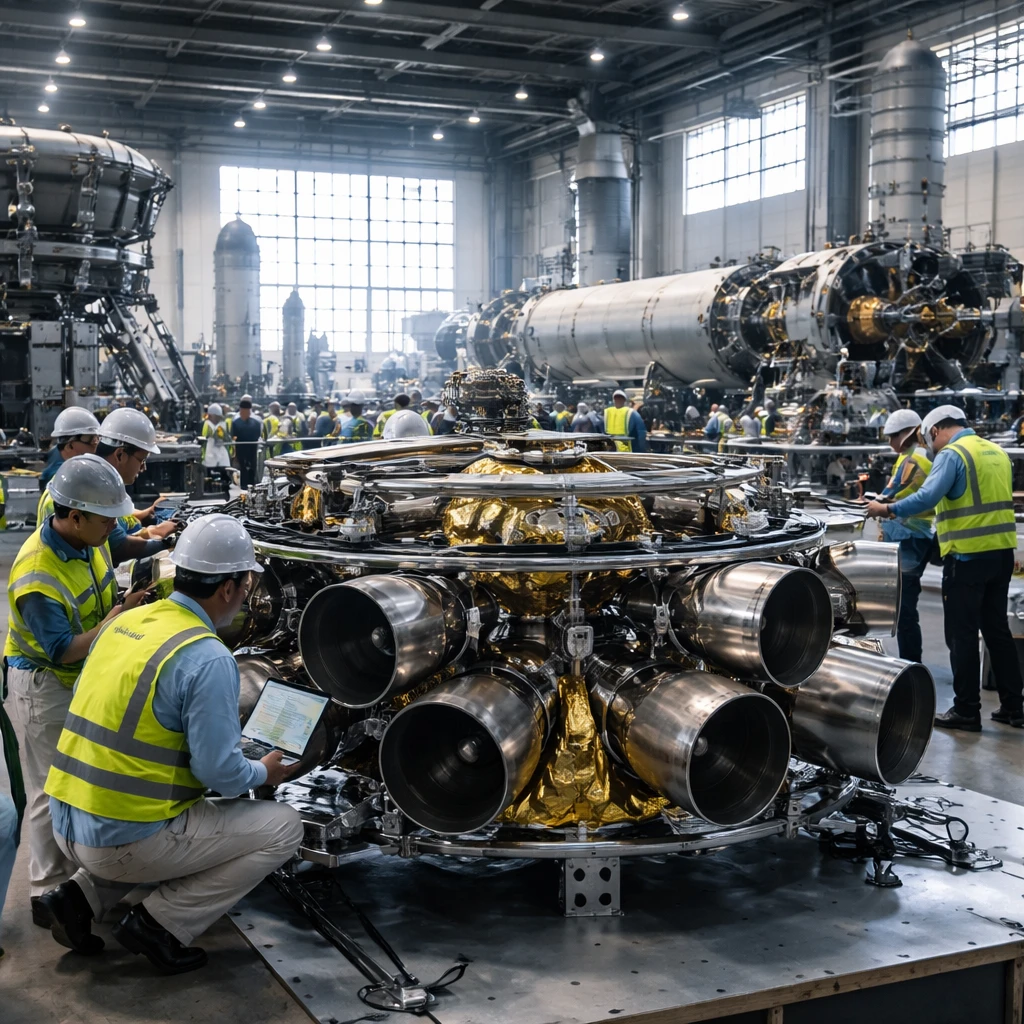
Impulse Space said Tuesday it raised $500 million in a Series D financing round co-led by 137 Ventures and BANNER VC, bringing the company’s lifetime funding to more than $1 billion. Management said the new capital will be directed toward ramping hiring and enlarging manufacturing operations as it scales production of spacecraft and propulsion systems intended to move payloads once they reach orbit.
Based in Redondo Beach, California, the company has completed three missions and reported securing customer contracts worth hundreds of millions of dollars across commercial, civil and government accounts. Its operational fleet includes Mira, a precision maneuvering spacecraft that has performed orbit changes and autonomous rendezvous operations, and Helios, a high-energy kick stage that the company plans to fly for the first time in 2027.
Impulse is developing three named propulsion systems: Saiph, designed for orbital repositioning; Deneb, aimed at long-distance transport; and Rigel, intended for landers and responsive maneuvering. In addition, the company operates Caravan, a rideshare program structured to lower access costs for higher-energy orbits, including geostationary orbit.
The firm has more than doubled its headcount over the last year and currently lists over 200 open positions spanning propulsion, avionics, autonomy, spacecraft systems, manufacturing and mission operations. Facility expansion has accompanied hiring, with footprints now in Redondo Beach, Boulder, Washington D.C., and Mojave, California.
Alongside the lead investors, other participants in the Series D include Founder’s Fund, Lux Capital and Linse Capital. Tom Mueller, the company’s founder and CEO, previously worked at SpaceX.
This funding round is positioned to support Impulse Space as it moves from early operational demonstrations toward higher-rate production and broader commercial and government service delivery. The company’s stated focus on post-launch mobility - through spacecraft like Mira and propulsion systems such as Saiph, Deneb and Rigel - underpins the stated uses for the new capital.
Summary takeaways
- Impulse Space raised $500 million in Series D financing, lifting total capital raised to over $1 billion.
- Proceeds will fund hiring and manufacturing expansion to scale spacecraft and propulsion system production for in-space mobility.
- The company operates Mira and plans Helios for a 2027 first flight while developing Saiph, Deneb and Rigel propulsion systems and the Caravan rideshare program.