
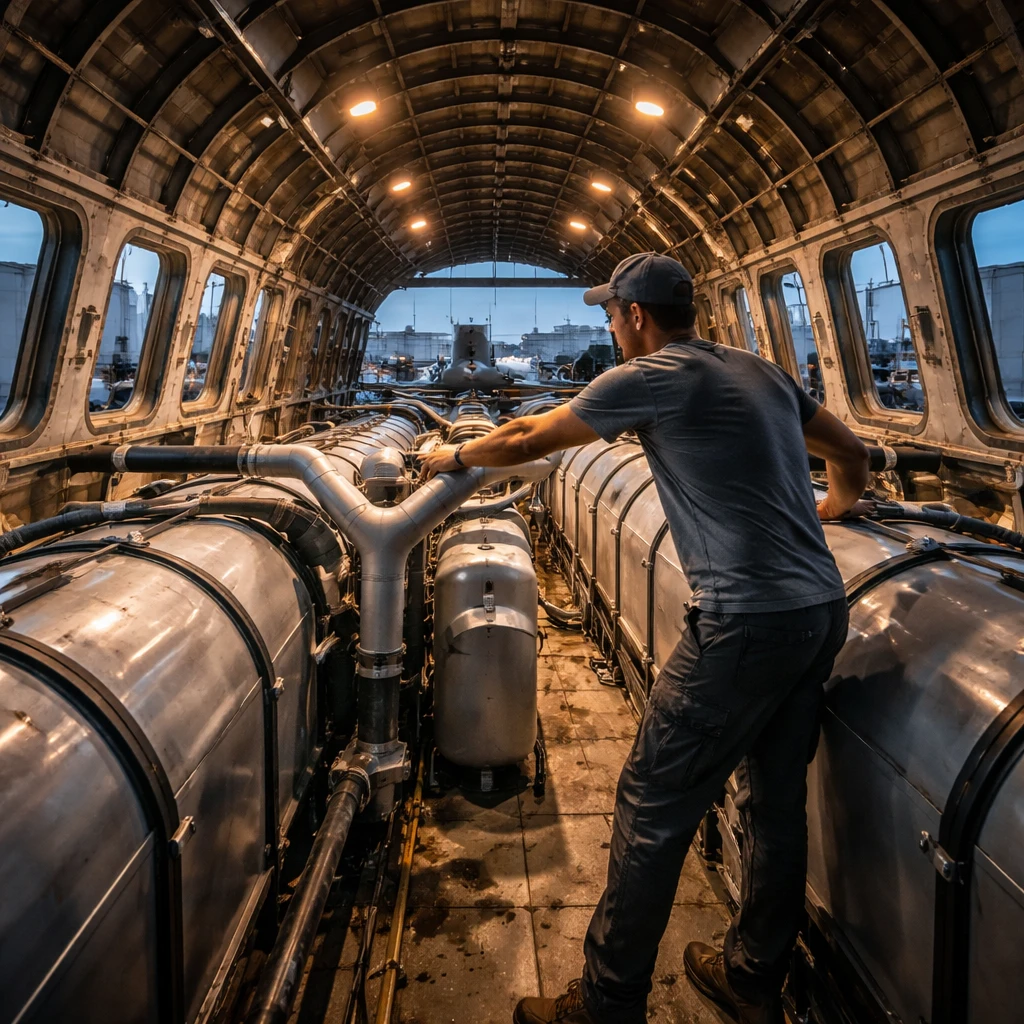
Deep inside the stripped fuselage of a retired turboprop, an engineer demonstrates how a small French team intends to revive a fading category of firefighting aircraft. Jonathan Beck, who leads design at Positive Aviation and is a former Airbus engineer, squeezed between rows of tanks to point out Y-shaped suction pipes and floats intended to allow the aircraft to skim lakes or coastal waters and take on large volumes of water.
The scene is emblematic of a broader movement in Europe: entrepreneurs, engineers and small manufacturers are proposing conversions and new-build amphibious planes to challenge the long-standing dominance of Canadair water-bombers. Momentum has accelerated after almost 500,000 hectares burned across Europe this year, and a parliamentary panel warned last year that France’s existing fleet of aerial firefighters faced a "major crisis" and called for alternatives to the rugged water-scooping Canadairs.
Positive Aviation is using a dismembered ATR-72 fuselage as a testbed and demonstrator, reviving activity at Hangar 16 in Toulouse - a facility noted for its historical link to Concorde. The company is aiming to install tanks and scooping gear in the converted airframe and says it intends to be ready by 2028, according to company president Laurent Schmitt. Positive Aviation also has a provisional order for 10 conversions from Bridger Aerospace, a U.S.-based operator.
A short distance away, Kepplair is preparing to receive an ATR-72 to trial an alternate approach: a ground-loaded tanker that can carry firefighting retardant or water and conduct pre-emptive patrols to intercept blazes at an early stage. David Joubert, founder of Kepplair, described such early intervention as the difference between an uncontrollable fire and one that is halted quickly.
For Europe, the technical art of seaplane and scooper design is not as robust as it once was. The last concerted European effort to rival Canadair came in the 1980s with a program involving Germany’s Dornier and Italy’s Aeritalia - Advanced Amphibious Aircraft (AAA) - but it never progressed beyond plans because of cost. Elmar Welczek, the former AAA project chief and a German professor who is widely recognized in the field of water flying, said western nations have lost skills in professional seaplane design since the 1950s or even World War Two.
Entrepreneurs and startups pursuing conversions or new aircraft must first secure substantial capital to cover research and development, certification testing and manufacturing facilities. John Boag, CEO of Avincis - described as a top private Canadair operator - warned that the time required to move from design to delivery is often under-estimated. Estimates offered by industry participants for development costs range from tens of millions for a relatively simple conversion to $1 billion for a clean-sheet design, and analysts warn those figures could rise further.
Some firms are focused on conversions while others are moving toward entirely new planes. Positive Aviation and Kepplair both plan conversions and staged entry to service: Positive Aviation hopes for 2028 readiness and Kepplair has said it aims to start deliveries next year while raising a new funding round.
Meanwhile, a handful of companies are pursuing fresh amphibious or scooper aircraft built from the ground up. French startup HYNAERO recently announced Latecoere as a provisional partner; HYNAERO says its Fregate-F100 scooper would carry 10 tons of water, cost roughly the same as a Canadair - about $80 million with support - and would be twice as efficient in fighting fires. In Italy, 19-01 Holding has promoted since 2011 an integrated firefighting and emergency-response concept centered on an amphibious plane called WF-X. CEO Renato Sacchetti has said assembly would start in Italy from 2031 and that the project would be entirely privately funded with €1.2 billion committed, although he declined to provide further details.
Belgium's Seagle concept, developed by architect Gaetan du Four, likewise envisions an amphibious aircraft to be built with partners in industry. Du Four said financing and industrial ties must be secured and estimated a realistic timeframe in the middle of the next decade for first flights, noting candidly that he did not expect other new designs to fly before then.
These startups must also contend with a revival of the Canadair line: production of a new Canadair model resumed this year, subject to safety approval, after an 11-year hiatus. The new DHC-515’s deliveries have been delayed three years to 2028, but De Havilland Canada cautions that alternatives may carry more risk. Neil Sweeney, De Havilland's corporate affairs vice-president, stressed that development takes many years and significant engineering effort.
Despite the scale of the challenge - technical, financial and regulatory - European startups and their backers see a narrow window of policy attention. As debates continue among politicians over firefighting capacity, proponents hope political focus and procurement interest will translate into investment. Yet some warn that media and political attention can be fleeting. "What worries me is that in four weeks' time, nobody will talk about it, either media or politicians," Schmitt said, underscoring the risk that short-term attention will not convert into the sustained resources needed to field new aerial firefighting capability.
Context
The drive to expand or replace Europe’s aerial firefighting assets follows reports of extensive wildfire destruction this year. Nearly 500,000 hectares burned across Europe, prompting scrutiny of existing assets and renewed interest in both conversions of retired turboprops and purpose-built amphibious scooper aircraft. Parliaments and aviation suppliers are now weighing the trade-offs between upgrading legacy designs and investing in new-build solutions that require long development cycles and substantial funding.