
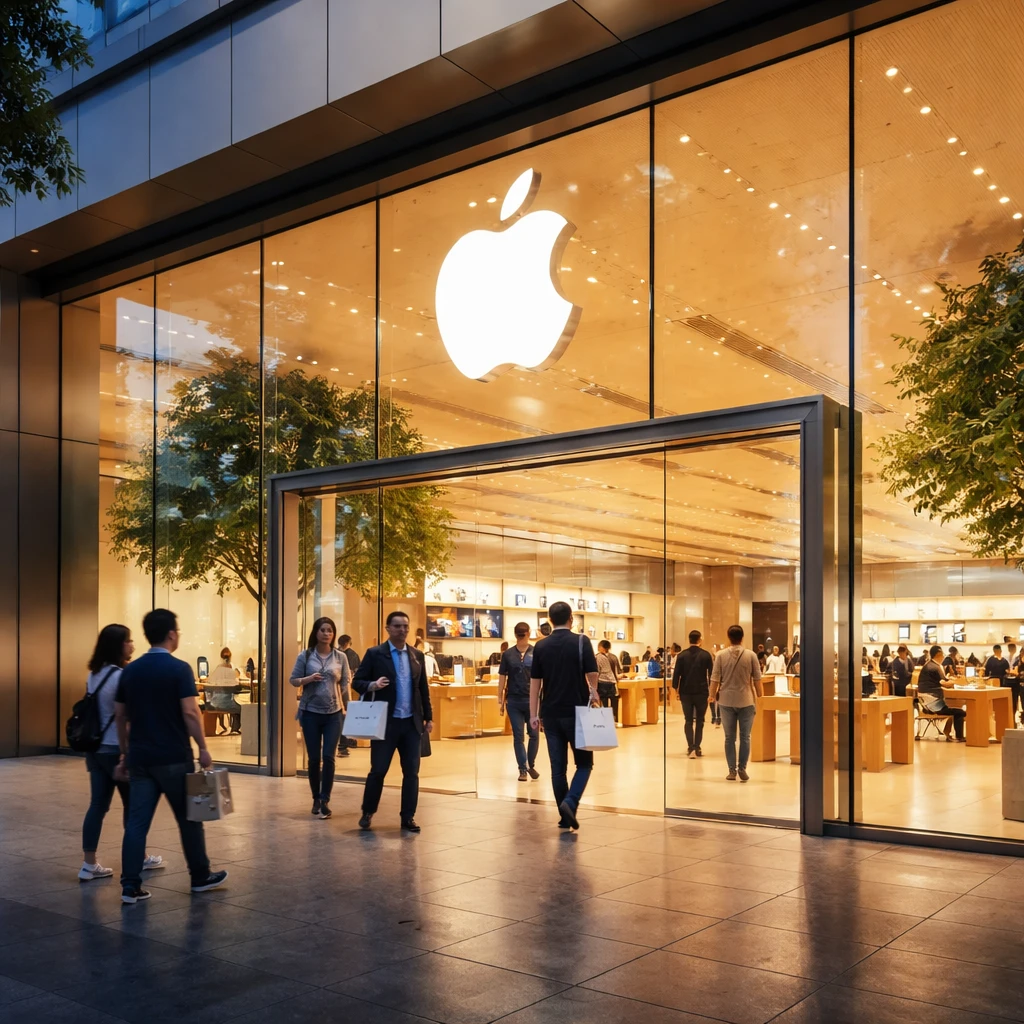
Apple Inc. sits at the center of Berkshire Hathaway’s equity allocations - the single largest stake in a portfolio otherwise filled with blue-chip names. At a share price of $313.87 and a market capitalization of $4.56 trillion, the company produces near $99 billion in free cash flow on an annual basis and posts margins and returns that stand out at the largest-cap level.
Buffett’s investment discipline emphasizes durable competitive advantages born of consumer habits rather than raw technology exposure. Apple, in that framework, is framed not as a mere handset maker but as a comprehensive consumer ecosystem - hardware bundled with services and software that together raise switching costs. The company’s product and service set - iPhone, Mac, iPad, Watch, AirPods, iCloud and the App Store - creates an integrated experience that supports roughly 1.5 billion active devices globally. That installed base is the backdrop for recurring revenue from services and high-margin offerings.
Performance and valuation snapshot
Key financial metrics referenced in recent analysis remain notable: gross margin of 48.7% and net margin of 27.6%, with a return on equity of 148.8%. Free cash flow is reported at approximately $99 billion for the latest fiscal year. Apple’s trailing fiscal revenue stands at $416.16 billion, with an 8.7% compound annual growth rate over five years. Reported earnings per share for the latest fiscal year were $7.46, up from $5.61 five years earlier. Consensus forecasts project EPS of $8.92 for the next fiscal year - an implied increase of 19.6% - and $9.36 the following year, indicating a steady compounding trajectory.
On valuation, the company’s forward price-to-earnings multiple is about 34.9x, and a fair value model cited places intrinsic value at $266.89 per share. By that model, the current price reflects roughly a 15% premium to fair value.
Bull and bear considerations, side by side
- Bull case - A dominant services business (App Store, iCloud, Apple Pay, Apple TV+) provides recurring, high-margin revenue, reducing reliance on hardware cycles. Large free cash flow enables buybacks and dividends. Projections from some analysts include a multi-year EPS ramp, with at least one projection suggesting EPS could reach $13.79 by 2030 on a roughly 14% compound annual growth rate, which could accompany P/E compression toward 28x as growth materializes.
- Bear case - The stock trades at a premium to the cited fair value, and several sell-side analysts have recently trimmed earnings estimates; 13 analysts are noted as revising earnings downward. One major bank maintains an Underweight rating with a $230 price target, highlighting valuation and downside risk. Elevated P/E multiples, reported as roughly 35.5x in some commentary, limit the scope for multiple expansion absent outsized operational upside.
Other market viewpoints include forecasts of an iPhone cycle uplift - one cited estimate projects more than 250 million iPhone shipments in fiscal 2027 - while at the same time references to pressure in China appear among the risks that could affect unit volumes. Buffett’s own position has been durable: he has held Apple since 2016, trimming the holding slightly for tax purposes in 2024-25 but maintaining the position as his largest.
Why Berkshire’s weighting matters
When the portfolio’s largest actor assigns roughly 40% of equity capital to a single company, the market is offered a view into what the investor values most. For Berkshire Hathaway, Apple represents a combination of brand-driven pricing power and broad consumer reach. The company’s margin profile, recurring-revenue mix, and massive free cash flow generation are central to the thesis that pays a premium for business quality and predictability.
Conclusion
Apple’s financial profile - especially the 148.8% return on equity and near $99 billion in free cash flow - underpins the rationale for a concentrated holding despite a price that sits above a modelled fair value. The tension between paying a premium for corporate quality and the possibility of valuation contraction is reflected in differing analyst views. For long-term investors weighing Berkshire Hathaway’s largest bet, the core question is whether the combination of recurring services revenue, sustained pricing power, and significant cash generation justifies current multiples.
Summary
Apple, trading at $313.87 with a $4.56 trillion market cap, remains Berkshire Hathaway’s largest equity holding. The company delivers roughly $99 billion in annual free cash flow, produces high margins and an exceptional return on equity, and operates an ecosystem supporting about 1.5 billion active devices. Those attributes explain Buffett’s conviction even though the stock trades at an estimated 15% premium to a cited fair value of $266.89.
Key points
- Apple’s Services segment is a high-margin, recurring revenue engine that helps reduce dependence on hardware cycles - impact: consumer technology and services markets.
- Reported metrics include gross margin 48.7%, net margin 27.6%, ROE 148.8%, and free cash flow of about $99B - impact: equity markets and large-cap valuation assessments.
- Valuation shows a premium to modelled fair value; differing analyst views include both upside scenarios and downside targets - impact: investor positioning and market sentiment.
Risks and uncertainties
- Valuation risk - the share price is roughly 15% above a modelled fair value of $266.89, and one major house maintains an Underweight rating with a $230 target - relevant to equity valuations and portfolio allocations.
- Earnings revisions - 13 analysts have cut earnings estimates recently, introducing uncertainty to short- and medium-term profit expectations - relevant to sell-side forecasts and market expectations.
- Market dynamics - China market share pressure and the possibility that hardware cycles do not produce expected upside could weigh on shipments and revenue - relevant to global consumer electronics demand.