
Iran's Islamic Revolutionary Guard Corps said Sunday that six drones targeted an air-defense radar at Bahrain's Riffa Air Base, according to a claim that U.S. Central Command had not confirmed. Bahrain issued repeated security alerts as the assertion circulated, but there was no immediate acknowledgment from American military officials.
The claim followed an earlier Iranian assertion of damage at the same facility, which the U.S. military denied. According to the U.S. account, two drones were intercepted and there were no casualties or damage.
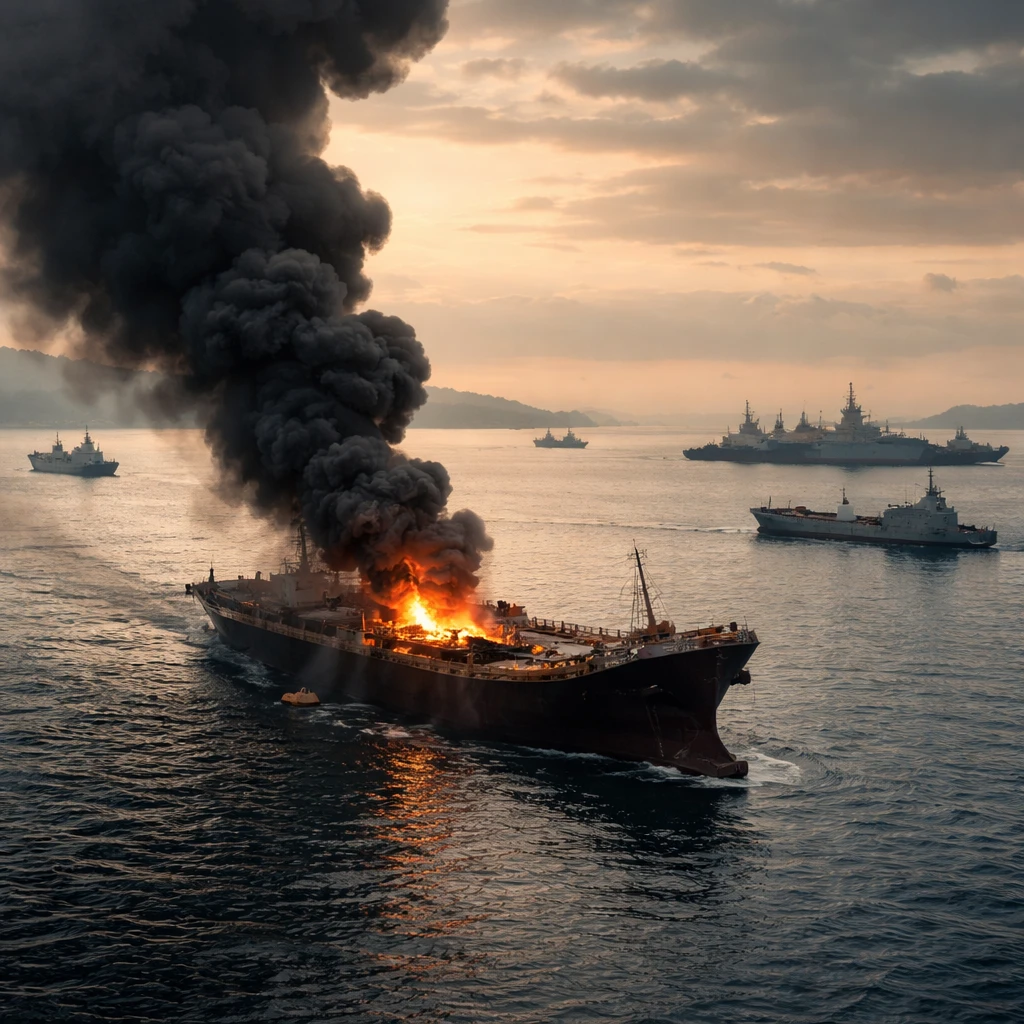
The exchange came as Iran's navy reported that two more tankers struck mines and caught fire in the eastern Strait of Hormuz. That brought the reported total to seven incidents within 24 hours, a figure that, if accurate, would represent a sharp concentration of disruptions in one of the world's most important maritime chokepoints.
Tehran says ships using routes without Iranian authorization are violating its restrictions. Iranian officials have linked reopening the waterway to an end to the U.S. naval blockade and acceptance of seven conditions for an agreement. The conditions themselves were not detailed in the reports.
Iranian Parliament Speaker Mohammad Bagher Ghalibaf said Tehran remained prepared for negotiations or renewed conflict. He warned that its armed forces would determine the scope of any response to further U.S. action.
The disruption extends beyond energy shipments. A senior United Nations official urged Washington and Tehran to permit fertilizer cargoes through Hormuz, warning that missed planting seasons could leave 45 million people facing severe food insecurity. Fertilizer prices have risen 30% since the blockades, the official said.
In Saudi Arabia, a Saudi-led coalition reported intercepting two ballistic missiles heading toward Riyadh and three Houthi drones over the kingdom's eastern region. The Houthis separately claimed to have downed a Saudi reconnaissance aircraft over Yemen's al-Jawf province.
Iran's Revolutionary Guards also claimed to have destroyed a U.S. MQ-1 drone over Qeshm Island, an assertion not independently verified.
Diplomatic attention now turns to the November 18-19 APEC summit in Shenzhen, where U.S. President Donald Trump is expected to discuss the Iran war with Chinese President Xi Jinping and Russian President Vladimir Putin. Trump recently reassigned Vice President JD Vance from Iran negotiations and said reaching a deal was no longer a priority.
For markets, the reported shipping incidents and the fertilizer warning point to potential pressure on energy and agricultural supply chains, though the full extent of the disruption remains unclear. The U.S. military's denial of the earlier Bahrain claim and the absence of confirmation for the latest one leave the security picture uncertain.