
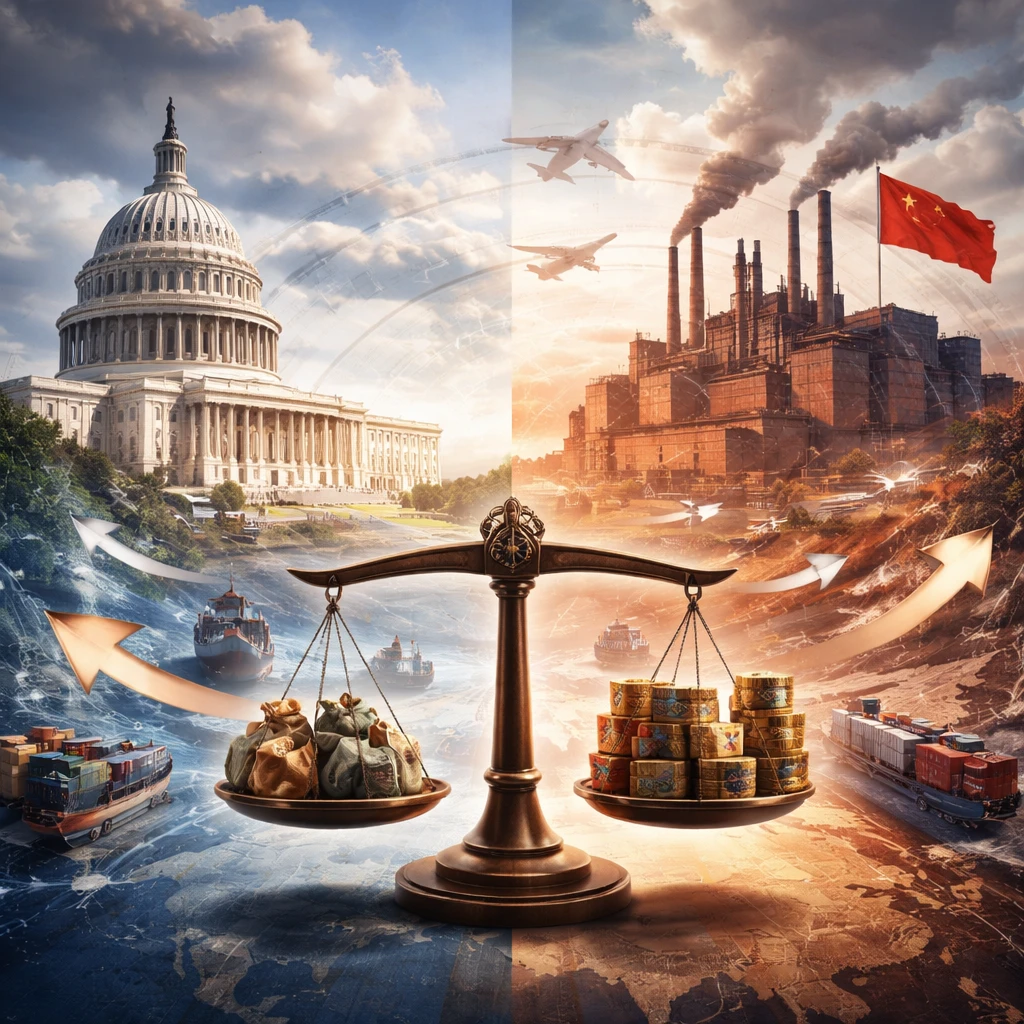
The United States has rolled out a new set of tariff increases on Chinese goods, a move that threatens to reignite trade tensions with Beijing while serving as the centerpiece of Washington's broader effort to reshape global commerce. The strategy seeks to penalize the world's largest manufacturing hub by pressuring other countries to reduce their economic dependence on China.
The new tariffs remain within the limits agreed upon in a trade truce with China, but the US has deliberately left the door open for further measures. This raises the stakes ahead of the fourth summit between the two countries' leaders, scheduled for Miami next month, and the January 10 expiration of their existing trade agreement.
According to Mark Williams, chief Asia economist at Capital Economics, the latest measures provide the US with additional leverage. He noted that the focus on China in third-country reports echoes earlier efforts in the second Trump administration to use economic pressure to push other nations to strengthen their trade defenses and decouple from China.
The Trump administration announced plans to raise tariffs on China by 20%, on top of the 25% levies that date back to the president's first term. That 25% level was the cap agreed upon in the truce, and any breach could push second-term tariffs as high as 40%.
China's foreign ministry responded by rejecting accusations of unfair industrial practices but did not threaten retaliation. The new tariffs follow an eight-month investigation into unfair trade practices that examined excess industrial capacity around the world.
The US is applying similar pressure to other economies with which it has trade deals or is negotiating, including the European Union, Japan, and some Southeast Asian nations. China, however, stands out as the primary target. Washington has criticized its partners for doing too little to curb imports and investment from a global power rival that is on track to greatly exceed a $1 trillion trade surplus for a second consecutive year.
For instance, the US Trade Representative's report on Vietnam mentions China more than 250 times, while its findings on the EU mention China more than 300 times.
Will US-China Ties Blow Up Again?
The latest tariff push follows the Supreme Court's declaration that the 'Liberation Day' tariffs of April 2025 were illegal. That earlier burst raised tariffs on virtually all trading partners, but China was the only nation to fight back with full force. Reciprocal tariffs briefly escalated to three digits, and China used its dominant position in rare earths refining to demonstrate its ability to halt global industries, from autos to defense, through export controls.
Subsequent US-China summits stabilized ties somewhat. China's warm welcome for Trump this month, when Xi broke from precedent to greet him with a hug at the airport in an event of the kind the US president enjoys, complete with dancers and rifle-toting soldiers, suggests another 2025-like climax is not imminent.
This week, Beijing extended a suspension of its controls on rare earth exports to the US, while China Southern Airlines said its subsidiary Xiamen Airlines agreed to buy 50 Boeing 737 MAX 8 planes, suggesting the truce is holding.
And while the option to further raise tariffs promises more leverage for the United States, Washington will be wary of the levies' inflationary impact. The cost of living topped voters' grievances when they dealt a major defeat this month to Trump's Republican Party at midterm elections for Congress.
Chen Bo of the National University of Singapore commented, 'China definitely does not want to fight another trade war with the US, and the US probably doesn't want to either. Both sides want to reach a deal,' added Bo, a senior research fellow at the university's East Asian Institute.
More Tension Between China and Other Trade Partners?
As seen after 'Liberation Day,' when Washington raises tariffs on China - in the latest move by roughly 7.5 percentage points - its trade deficit with Beijing shrinks, while other economies' deficits with China expand. That pressures governments to protect their own domestic industries and jobs against a Chinese economy that contributes less to global demand than it does to supply.
Beijing's critics say China's weak household consumption and growing export dependence means its economy grows at the expense of other countries. Viktor Shvets, a global strategist at Macquarie Capital, said, 'China's inability to restructure its economy will be an even greater driver of trade tensions than the whiplash of inconsistent US trade policies.' While the EU bears the brunt of China's imbalances today, he said, the same fate is inevitable for everyone else. 'We thus expect both tariffs and non-tariff measures to multiply.'
Brussels, which convinced Beijing this year to accept quotas on some EU imports of Chinese cars, plans more trade measures. That EU deal shows China cannot maintain an aggressive posture on trade on all fronts at all times and more such compromises are on the cards, said Bo Zhengyuan, a partner at research consultancy Plenum.
'China hasn't always gotten its own way on trade,' said Bo, who is based in the commercial hub of Shanghai, adding that concessions by Beijing will 'still need to be made' in order to meet its partners in the middle.