
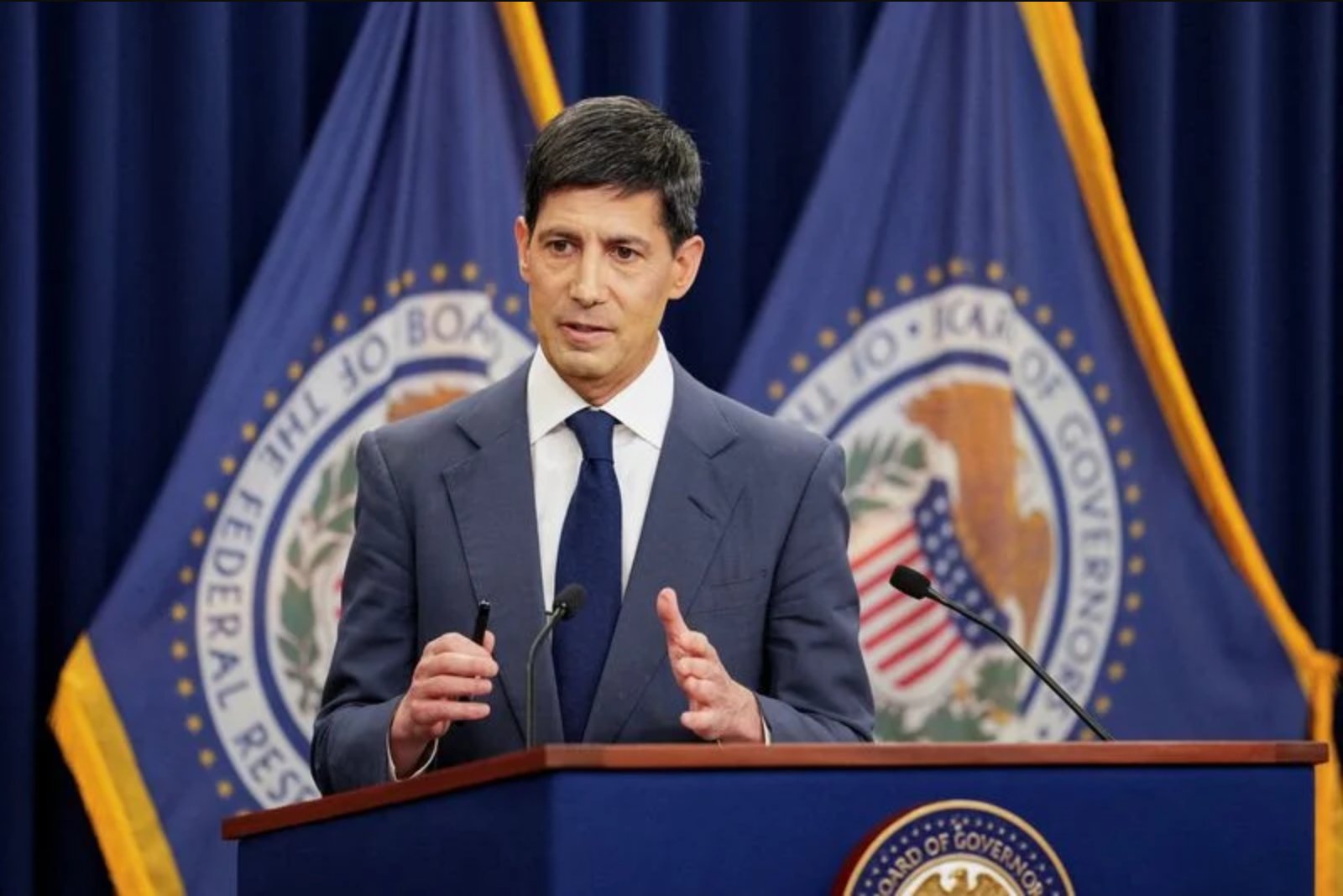
Federal Reserve Chair Kevin Warsh enters a consequential week in his new role as head of the U.S. central bank, confronting two developments that could sharply influence how he and his colleagues operate. On one front, the U.S. Supreme Court may soon hand down a decision in a case testing whether President Donald Trump lawfully sought to remove Fed Governor Lisa Cook. On the other, Warsh will speak at the European Central Bank’s annual forum in Sintra, Portugal, where his preference to minimize public forward guidance will be observed by fellow central bankers and global market participants.
The Supreme Court, now in the final week of its current term, could rule as early as Monday on the dispute surrounding Cook. The case stems from Trump’s August announcement that he was firing Governor Cook. Lower courts have already concluded that Cook is likely to win her legal challenge to the attempted dismissal and have allowed her to continue serving on the Federal Reserve’s Board of Governors while the matter moved through the appeals process.
At issue is a statutory and constitutional question that has not previously been fully defined by the courts: Fed governors may be dismissed "for cause," but what precisely that standard entails has not been litigated. Trump is the first president to try to remove a sitting Fed governor, and he has argued that alleged misstatements on a home mortgage application by Cook justified her ouster. The attempted removal has been widely interpreted as an unusual intrusion into the Federal Reserve’s independence, taking place amid the president’s desire to install governors who might be more amenable to his preference for steeper interest rate cuts.
Earlier this year, Supreme Court justices displayed skepticism toward the arguments advanced by the Trump administration when the case was heard. Although the court has, in the past, permitted the removal of officials from other independent agencies, justices indicated that the central bank occupies a distinct status. Legal observers took that line of questioning as a signal the court could craft a rationale to shield Fed policymakers from being removed at will - a posture that, if affirmed, would significantly narrow the president’s ability to reshape the board through dismissals.
A ruling in Cook’s favor would do more than vindicate her legal position. It would reduce a key political risk facing Warsh - the possibility that his leadership could be undermined by a rapid sequence of firings ordered by the president, possibly including the chair himself. Such a decision would also underscore the limits on presidential influence over Fed decisions, potentially insulating Warsh and his colleagues from removal threats and allowing them to act with greater latitude on monetary policy.
These legal and political dynamics intersect with market expectations and economic data. Investors have become more inclined to anticipate rate increases in coming months after a key inflation gauge for May ran at more than double the Fed’s 2% target. That strengthens the case among market participants for further tightening rather than the rate cuts that the president has publicly sought. The divergence between investor expectations and the president’s preferences sets a delicate stage for Warsh, who must balance the Fed’s price-stability mandate with visible political pressure.
Despite his predecessor’s high-profile clashes with the White House, recent comments from President Trump and Treasury Secretary Scott Bessent toward current Fed leadership have been comparatively milder. Former chair Jerome Powell faced harsher treatment during his tenure for resisting calls to cut rates, earning a derisive nickname and drawing a since-dropped criminal probe and calls for his removal. Powell remains a member of the Fed’s board.
In public, President Trump has offered warmer words about Warsh. On NBC News’ "Meet the Press" earlier this month, he said, "Kevin is fantastic, and I want him to do whatever he wants. I don’t want to have a big influence on him." Those remarks provide a degree of political cover, but they do not eliminate structural tensions between the presidency and the central bank.
Warsh’s own public posture may blunt some of that tension. He has signaled a deliberate retreat from providing forward guidance that would steer markets about the Fed’s likely course on interest rates. The new chair has repeatedly expressed a preference to avoid steering markets in normal times, arguing that investors should respond to incoming economic data rather than central bank promises about future policy actions. That preference was reflected in a revised policy statement that removed guidance language and in his remarks at the press conference that followed the Fed’s June 16-17 meeting.
Responding to a question about conditions that might prompt a rate change, Warsh said, "Your question sounded like an encouragement for me to give forward guidance. We’ve dropped forward guidance. I can’t give any forward guidance about what we’re going to do next. The good news is, we’ll be meeting in six weeks" and issuing an updated policy statement. The comment captured his intent to limit explicit forecasts about the timing of rate moves.
Warsh will face his first major international test of that strategy on Wednesday in Sintra, where he will appear on a question-and-answer panel alongside other prominent central bankers, including ECB President Christine Lagarde, Bank of England Governor Andrew Bailey and Bank of Canada Governor Tiff Macklem. Market observers and global peers will watch to see how far his low-information approach extends in a forum where coordination, clarity and credibility all carry weight.
Although the ECB under Lagarde has also moved away from rigid forward guidance, the Bank of England continues to provide relatively detailed commentary about how the economy might evolve under various scenarios. The U.S. dollar’s unique role as the principal reserve and trading currency means that unexpected shifts in U.S. rates can ripple across other markets and currencies. The Fed’s open swap lines also serve as a backstop for dollar liquidity around the world, underscoring why U.S. policy communication matters internationally.
A global audience will be attentive to how Warsh’s restrained communications style influences both peer central bankers and market expectations. Pierre-Olivier Gourinchas, who is stepping down next week as the International Monetary Fund’s chief economist to return to academia, told Reuters that strong forward guidance had received criticism because it locked central banks into future actions regardless of changing economic conditions. He argued that those commitments hampered central banks’ ability to react promptly to the post-pandemic inflation surge. "So I think moving away from these strong forms of forward guidance is entirely appropriate. Saying there is no forward guidance, I don’t think that is actually the case ever. You do it explicitly, or implicitly, the market is going to form a view," Gourinchas said.
Warsh’s approach, then, is being tested on two linked fronts: the domestic legal barrier to political interference highlighted by the Cook case and the international communication challenge of running a major central bank whose actions have outsized effects on global markets. How the Supreme Court rules and how Warsh presents his policy framework in Sintra will together help define the contours of his early tenure.
Summary
Kevin Warsh’s initial period as Federal Reserve chair is being shaped by a pending Supreme Court decision over President Trump’s attempt to fire Fed Governor Lisa Cook and by Warsh’s upcoming appearance at the ECB’s Sintra forum. A ruling protecting Cook from removal would limit presidential authority to dismiss Fed policymakers and reduce political risks to the Fed, while Warsh’s decision to curb formal forward guidance will be examined by global peers and markets as inflation data pushes investors to price in higher rates.
Key points
- The Supreme Court could decide imminently on whether President Trump lawfully attempted to remove Fed Governor Lisa Cook - a decision that may clarify the "for cause" removal standard and protect Fed independence.
- Warsh has moved away from explicit forward guidance, reflected in a revised policy statement and comments at the Fed’s June 16-17 press conference, a stance that will be tested in public at the ECB forum in Sintra.
- Recent data showing a May inflation gauge at more than double the Fed’s 2% target has increased investor expectations of rate increases rather than the cuts the president favors, weighing on market and political dynamics around the Fed.
Risks and uncertainties
- A Supreme Court ruling that allows for broader presidential dismissal authority could heighten political interference risks and unsettle monetary policy decision-making - an outcome that would affect financial markets and the Fed’s institutional independence.
- If Warsh’s limited public guidance is interpreted as insufficiently informative, markets could form divergent expectations about U.S. interest rates, potentially producing volatility in currencies and global asset prices given the dollar’s central role.
- Persistent inflation readings above the Fed’s target increase the chance of additional tightening, which could affect borrowing costs, financial conditions and sectors sensitive to interest rates.
Disclosure
No conflicts to disclose.